
You open three tabs to compare lending rates, two more to check whether a new pool is real or just subsidized for the week, and another dashboard to see whether your USDC is still sitting in the place you picked on Sunday. By the time you've decided what to do, the numbers have already moved.
That cycle is familiar to anyone holding stablecoins in DeFi. The hard part usually isn't finding yield. It's tracking fragmented opportunities, judging whether the extra return is worth the added risk, and staying disciplined when rates keep shifting.
An AI crypto trading app promises relief from that grind. But the label gets abused. Some apps automate real execution. Others only surface ideas, send alerts, or run paper strategies behind a polished interface. If you're going to trust software with capital, that distinction matters more than any homepage claim.
The End of Manual Yield Hunting
Manual yield hunting feels productive right up until you calculate the hidden cost. You spend time checking lending markets, comparing pools, watching incentive programs, and trying to spot whether a strong headline rate is sustainable or just temporary. Meanwhile, your capital often sits idle because you don't want to move too early or move into the wrong place.
That pain isn't limited to beginners. Experienced users hit it too. The more protocols you know, the more monitoring work you create for yourself. A simple stablecoin strategy can turn into a part-time operations job.
Why the old workflow breaks
The manual approach usually fails in three places:
Research overload: You have to evaluate rates, protocol quality, chain costs, and withdrawal conditions at the same time.
Slow execution: By the time you act, the opportunity may have changed.
Decision fatigue: Too many options push people into one of two bad habits. Chasing every new rate, or doing nothing.
A lot of users start looking for DeFi without manual research because they aren't trying to become full-time analysts. They just want their stablecoins working without constant babysitting.
Practical rule: If your strategy only works when you stare at dashboards every day, it isn't passive. It's disguised labor.
The market shift toward automation isn't niche anymore. The AI trading platform market was valued at USD 13.52 billion in 2025 and is projected to reach USD 69.95 billion by 2034, which tells you where asset management is moving. In crypto, that trend shows up most clearly in tools that monitor opportunities continuously and act faster than a human can.
What users actually want
Most stablecoin holders aren't asking for an exotic strategy. They want software that can:
Monitor continuously: Keep watching when they log off
Reallocate intelligently: Move capital when the risk-adjusted setup improves elsewhere
Stay understandable: Show what it did and why
Respect liquidity needs: Avoid trapping funds when users may want them back soon
That's the appeal of an AI crypto trading app. Not magic. Not guaranteed profits. Just a better operating system for a market that never stops moving.
What Exactly Is an AI Crypto Trading App
A real AI crypto trading app is best understood as a 24/7 portfolio operator. It watches market inputs, evaluates strategy rules, and takes action without waiting for you to approve every small move. That makes it very different from a signal bot or a dashboard with AI branding.
Consider the distinction between a weather app and a thermostat. A weather app tells you what's happening outside. A thermostat reads conditions and changes the environment automatically. Many products in crypto behave like the first type while marketing themselves like the second.
Advisor tool versus execution tool
A lot of confusion starts here. One app may scan markets, summarize sentiment, and recommend trades. Another may route funds, rebalance positions, and manage exits based on live conditions. Both can be useful. Only one is doing autonomous execution.
If you need a cleaner baseline for that distinction, this guide on what AI trading is is a useful reference point.
Here's a practical comparison:
Type | What it does | What it doesn't do |
|---|---|---|
Signal app | Surfaces opportunities, alerts, and trade ideas | Doesn't move capital on your behalf |
Rule-based bot | Executes preset if-then logic | Doesn't adapt well when conditions change |
AI crypto trading app | Interprets inputs, adjusts decisions, and executes within defined parameters | Doesn't remove market risk |
What makes it "AI"
The term matters less than the behavior. In practice, a stronger AI trading app does three things a basic bot often can't:
Learns from changing conditions: It doesn't rely only on fixed thresholds.
Processes messy information: News flow, on-chain behavior, and market structure don't arrive in neat rows.
Adapts execution: It can alter positioning logic when the environment shifts.
That's why the best use case isn't always aggressive speculation. For many users, the more practical application is yield management. Stablecoin strategies benefit from constant monitoring, disciplined movement between venues, and less emotional interference.
The useful question isn't "Does this app use AI?" It's "What decisions can it make, and what actions can it execute without me?"
The objective isn't constant trading
Hype often derails the conversation. A mature app isn't trying to trade for the sake of activity. It's trying to manage assets according to a goal. For stablecoin holders, that usually means preserving liquidity, seeking competitive yield, and avoiding unnecessary risk.
A noisy app can look complex while doing very little. A good one often looks quieter. It waits, reallocates selectively, and treats capital like something to protect first and optimize second.
Inside the Engine How AI Trading Apps Work
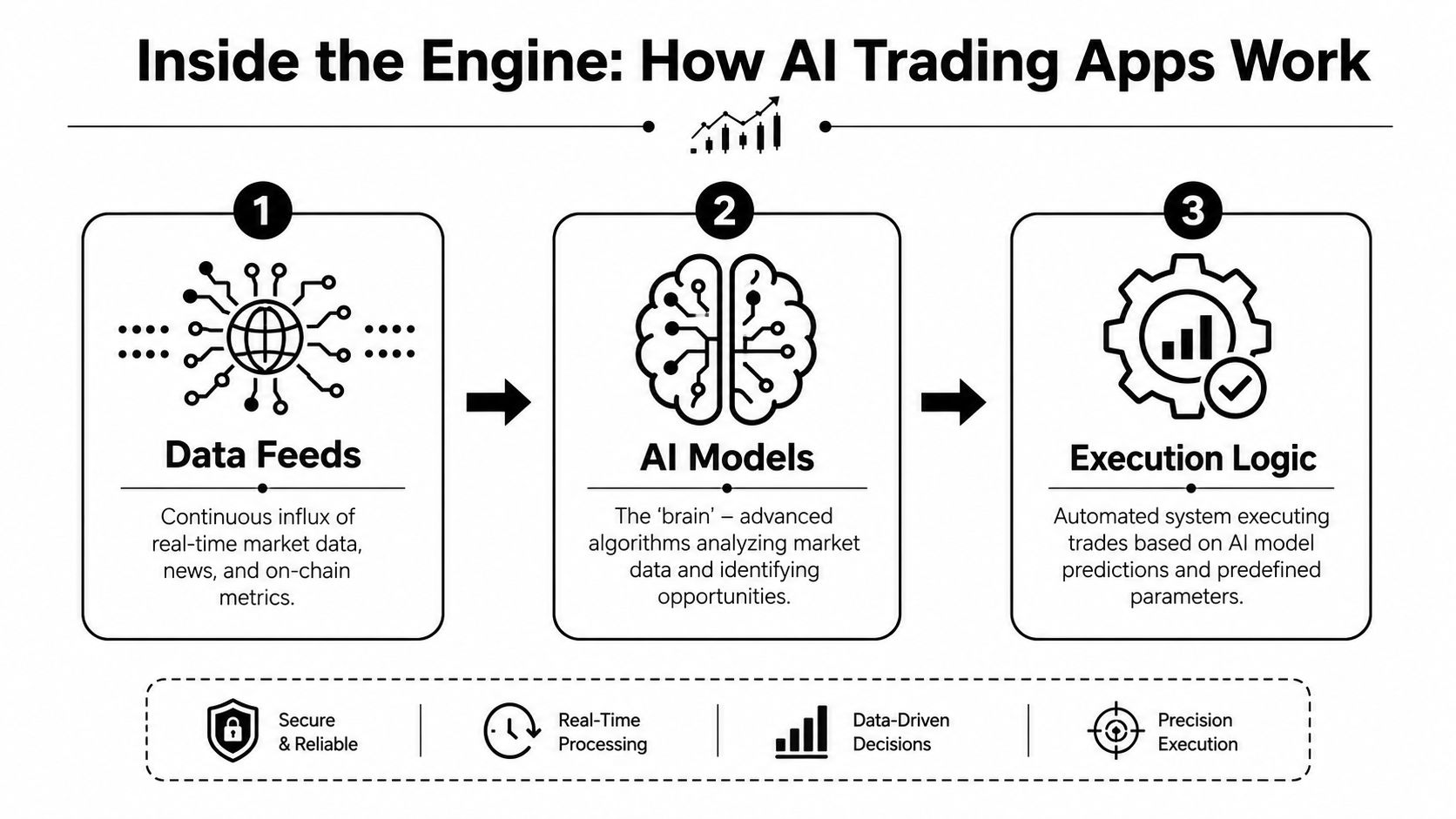
Under the hood, most serious systems have three layers. The easiest way to understand them is as eyes and ears, brain, and hands. If one layer is weak, the whole product becomes unreliable.
Data feeds
The app first needs inputs. In crypto, those usually include on-chain activity, protocol-level changes, order flow, liquidity conditions, and off-chain information like headlines or social sentiment. If the inputs are delayed, noisy, or incomplete, the strategy starts from a bad map.
One important capability here is sentiment analysis. Kraken notes that advanced AI crypto trading apps use Natural Language Processing to analyze global news and social media in real time, allowing algorithms to adapt before price patterns even form. That's useful because markets often react to narrative changes before they settle into chart structure.
For teams building these systems, collecting reliable public data is a bigger engineering problem than many users realize. Sites rate-limit aggressively, APIs differ in quality, and anti-bot defenses can block collection pipelines. If you want a realistic look at that side of the stack, Scrapfly's web scraping anti-bot guide is a good technical primer.
AI models
This is the decision layer. The model takes raw inputs and turns them into choices. Depending on the product, that may mean classifying market conditions, ranking opportunities, adjusting risk posture, or deciding whether not to trade is the better trade.
A basic bot might follow a rule like: if rate A falls below threshold X, move funds to protocol B.
A more adaptive system asks harder questions:
Is the new venue liquid enough for the move to be worth it?
Has sentiment deteriorated even if the current yield still looks attractive?
Is the opportunity durable, or just boosted by temporary incentives?
Execution logic
This layer touches capital. It's where the app signs, routes, deposits, withdraws, swaps, or rebalances according to its decision process and whatever permissions the user has granted.
Execution quality matters because good strategy can still fail through sloppy implementation. An app may identify a strong opportunity, then lose the edge through poor timing, failed transactions, or bad routing logic.
A model that predicts well but executes badly is like a sharp driver with a broken steering system.
The best products make this layer visible. Users should be able to see what happened, where funds moved, and what conditions triggered the move. If the execution layer is opaque, you're trusting a black box at the exact point where trust matters most.
Automating Stablecoin Yield Strategies
Stablecoins are where an AI crypto trading app becomes concrete. You're not asking the system to predict the next narrative coin. You're asking it to manage cash-like crypto capital across changing opportunities without forcing you to monitor every venue yourself.
The setup matters because stablecoins sit at the center of on-chain liquidity. Business Research Insights notes that stablecoins power $46 trillion in annual transactions and that total stablecoin supply has reached over $300 billion. That's why they're such a natural base asset for automated yield strategies. The markets are deep, the use cases are broad, and the capital doesn't need a directional bet on ETH or BTC just to be productive.
A simple weekly example
Take a small deposit, say $100 USDC.
On day one, the app may allocate it to a lending venue because the return is acceptable and the liquidity profile is clean. Midweek, another venue may offer a better setup, not just a higher headline rate but a better combination of yield, liquidity, and operational simplicity. A real execution engine can move the capital without requiring you to wake up, compare screenshots, and click through three interfaces.
By the end of the week, the visible benefit isn't just whatever yield was earned. It's that the money stayed active while you did something else.
This is the appeal behind automated stablecoin investing. The software handles the scanning and reallocation work that people usually do manually.
What the app is actually evaluating
It isn't enough to chase the highest displayed number. A useful agent weighs several conditions at once:
Base yield quality: Is the return coming from lending demand, liquidity incentives, or something less durable?
Move friction: Will gas, slippage, or bridge complexity eat the benefit?
Exit conditions: Can funds come back out cleanly if needed?
Protocol context: Is this a mature venue with visible usage, or a fresh pool with little operational history?
Here's where users often get tripped up. The best strategy in DeFi usually isn't "highest yield wins." It's "best available yield after risk and friction."
A short demo helps make that more tangible:
What works and what doesn't
What works is selective movement. The app waits for meaningful differences and then reallocates. What doesn't work is hyperactivity. Constant hopping can turn a good system into an expensive one, especially when every adjustment adds execution overhead.
That trade-off is easy to miss because interfaces love to make motion look smart. In practice, stablecoin automation is closer to treasury management than casino trading. The stronger apps know when to stay put.
Navigating Security Custody and Critical Risks
The biggest mistake users make isn't picking the wrong strategy. It's ignoring where control sits and how failure happens. If an app looks smooth but hides custody, contract exposure, or risk logic, the convenience can become the danger.

Custody comes first
Start with the simplest question. Who controls the funds?
If the platform is custodial, you're trusting the operator with asset control and internal processes. If it's non-custodial, you're usually authorizing actions through wallet permissions or smart contract logic while retaining more direct control. Neither model is automatically perfect, but they create very different trust assumptions.
Before you care about AI quality, know the custody model. A sleek app with vague custody is a bad trade.
Smart contract risk is strategy risk
For DeFi yield systems, app risk and protocol risk are intertwined. Even if the app itself works exactly as designed, the underlying protocol can fail through bugs, exploit paths, or governance decisions that alter expected behavior.
A practical review should include:
Permission scope: What can the app or contract do with your funds?
Protocol selection: Does the platform explain where capital may go?
Operational clarity: Can you understand how deposits, exits, and reallocations happen?
Withdrawal behavior: Can you get out without hidden friction?
This isn't paranoia. It's basic systems thinking. In crypto, your strategy is only as safe as the weakest contract in the chain of actions.
Market risk doesn't disappear because the app is smart
Marketing often gets too clean. AI can improve monitoring and response, but it doesn't make black swan risk vanish. Coinbase's guidance highlights that many guides skip how AI agents handle black swan events and that users need ways to validate an agent's risk controls before trusting it in sudden market shifts.
If a platform can't explain what happens during stress, assume the answer is "you find out live."
Ask operational questions, not branding questions. What happens if liquidity dries up? What happens if a connected protocol is exploited? To what extent, if any, can the agent amplify its trading positions? Is there a limit on how aggressively capital can be repositioned?
A serious platform should have clear answers. Even if those answers are imperfect, transparency is safer than polished vagueness.
A Practical Checklist for Choosing Your App
Choosing an AI crypto trading app gets easier when you ignore homepage language and inspect behavior. Most weak products fail the same way. They look automated, talk like agents, and then rely on you for every meaningful action.
A good screening process starts with one question: Does it actually trade or just advise? That isn't a theoretical concern. A 2026 study reported by TheStreet found that only three of ten evaluated AI crypto projects genuinely executed trades autonomously, while most offered advice or simulations instead.
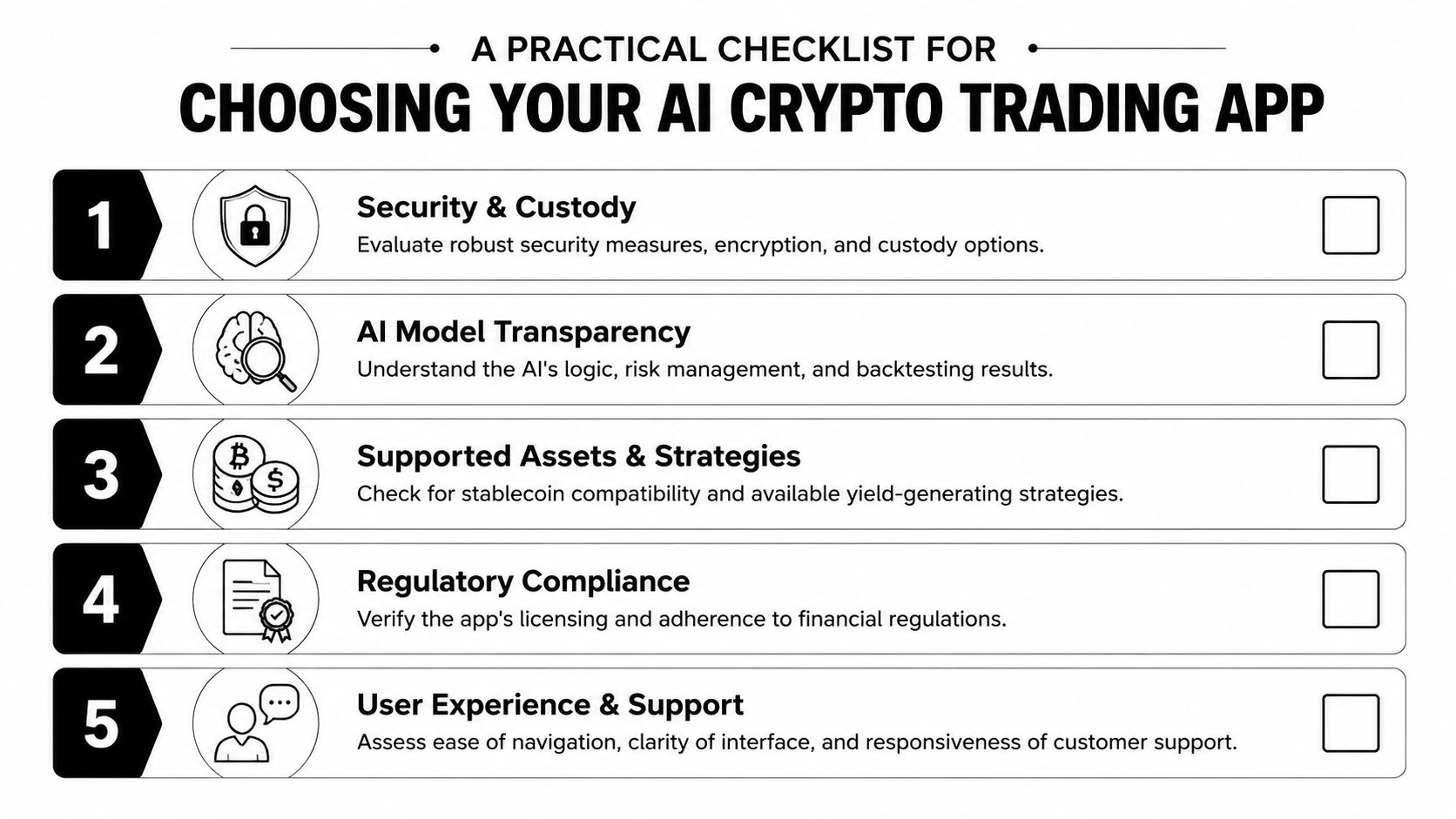
The five checks that matter
Autonomy
Ask the app to show the exact point where analysis becomes execution. If every move still needs manual confirmation, you're looking at an assistant, not an autonomous trading system.
Transparency
You don't need the company's full model architecture. You do need a clear explanation of what the system is allowed to do, where it can allocate capital, and how decisions are surfaced to users.
Custody and access
Read the withdrawal terms carefully. Can you exit when you want? Are there lockups, waiting periods, or penalties? If the app is built for stablecoin cash management, liquidity shouldn't feel like an afterthought.
Strategy fit
Some apps are designed for directional trading. Others are better suited for stablecoin yield, treasury allocation, or low-touch portfolio management. Pick the one that matches your actual need, not the most exciting interface.
Support and interface quality
If the app is hard to understand when everything is calm, it will be worse when markets get messy. Clear logs, understandable balances, and responsive support aren't cosmetic features. They're part of risk management.
Quick red flags
Use this as a fast filter when comparing products:
Marketing-first language: Heavy use of "AI-powered" with little explanation of execution
No action history: You can't inspect what the system did
Opaque capital routing: The app won't say where funds may go
Withdrawal ambiguity: Terms are buried or unclear
Simulation theater: Impressive dashboards, but no evidence of live autonomous execution
Field test: Ask, "Can this product move funds on my behalf right now under rules I've approved?" If the answer is fuzzy, keep looking.
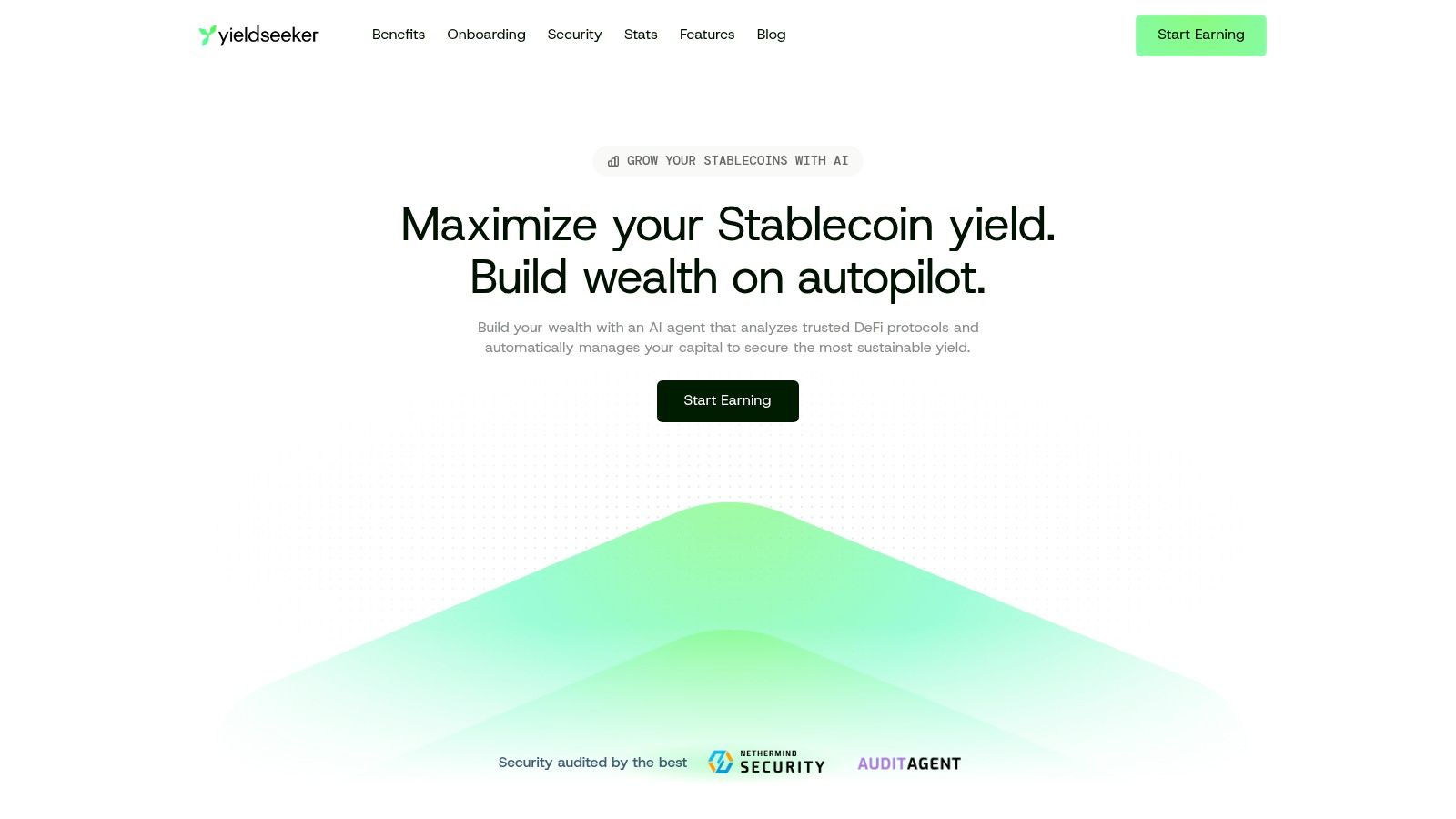
Some platforms do align better with these standards. A product like Yield Seeker, for example, is easier to evaluate because the user can inspect the stablecoin-focused use case, accessible withdrawals, and the practical execution path rather than just reading broad AI claims. That's the benchmark to use with any app, not blind trust in a brand name.
Your Path to Smarter Automated Yield
The best reason to use an AI crypto trading app isn't novelty. It's relief. Relief from checking too many dashboards, from reacting too slowly, and from letting idle stablecoins sit untouched because the research burden keeps growing.
The useful mental shift is simple. Stop asking whether an app sounds intelligent. Ask whether it performs the work you'd otherwise have to do yourself. A real system monitors inputs continuously, turns analysis into action, and gives you enough transparency to understand how your capital is being managed.
Start small. Test the custody model. Review how withdrawals work. Watch whether the app's behavior matches its marketing. If it only suggests moves, treat it like research software. If it executes autonomously, evaluate it like infrastructure.
That distinction changes everything. It helps you avoid fake automation, choose tools that fit stablecoin yield management, and keep control over risk while reducing the day-to-day workload.
If you want a practical place to start, explore Yield Seeker. It's built for stablecoin holders who want automated, risk-aware yield without the usual manual research loop, and it lets you begin with a small USDC deposit while keeping funds accessible.