
Three screens are open, one brokerage app is logged in, a crypto wallet sits on another tab, and the third tab is a market scanner you still don't trust. That's where many investors hit the wall with ai investment tools. The useful ones don't all do the same job, so the key question is whether you need natural-language research, rules-based automation, stock scoring, crypto analytics, or on-chain yield execution.
The tools below are grouped by that job, then ordered from brokerage-linked products to self-custodial DeFi agents. That makes it easier to start where your money already sits, then decide how much automation you're comfortable with. If you're comparing the broader category, TradingList's AI token guide is a useful companion read.
1. Magnifi
Magnifi fits investors who want a research assistant before they want a trading robot. It pulls together SEC filings, earnings, and news into one conversational workflow, then analyzes connected brokerage portfolios for account-level context. The platform is US-focused, and that matters, because regulated oversight and custodial setup are part of the product's appeal.

What works and what doesn't
The strongest part is speed. Instead of hopping between filings, earnings pages, and portfolio views, you can keep the research and the account view in one place. That makes Magnifi feel practical for newer investors who want a guided workflow, not a blank prompt box.
Practical rule: Use it for research compression, not blind execution. If you can't explain why the recommendation fits your risk limits, don't trade yet.
The limitation is straightforward. Pricing details aren't consistently published, so you should expect channel-dependent terms. Some features are limited to US persons, which makes it less useful if you want a globally available research layer. Visit the Magnifi website and check the current disclosures before linking any account.
2. Composer by SoFi
Composer is for people who already think in rules. It lets you discover, build, backtest, and automate strategies with AI-assisted idea generation, then run them inside supported US brokerage accounts. The platform's appeal is less about flashy predictions and more about turning a portfolio idea into a repeatable system.
Read more about automated investment platforms
Where it helps most
Composer works when your thesis is expressible as rules. Rebalancing, multi-asset rotation, and guardrails are where it makes sense. If your strategy can be written clearly, the platform reduces manual follow-through and keeps you from improvising mid-trade.
The trade-off is control. Some advanced traders report UX and execution friction, which is common in tools that try to simplify automation without exposing every lower-level setting. That's not a deal-breaker, but it does mean you should test the strategy logic carefully before funding it.
Custody and pricing notes
Composer sits in the brokerage and fintech lane, so standard account protections matter more than wallet custody. Pricing and routing details can change, so read the current account documents rather than assuming the plan you saw last month still applies. The product is now under SoFi, which gives it a stronger support backdrop than a standalone startup, but it's still worth verifying the current fee schedule at the Composer website.
3. Capitalise.ai
Capitalise.ai is the no-code option for traders who want to turn plain English into conditional execution. You write an if-then idea, connect a supported broker or exchange, and let the platform monitor and execute the rule set. That makes it especially relevant for traders who want automation without learning a scripting language first.

Why it appeals to systematic traders
The main value is accessibility. If you can describe an entry rule, exit rule, or alert condition in plain English, you can usually get to a working strategy faster than with traditional coding. For many retail traders, that lowers the barrier to testing a disciplined process.
Use it for rules, not intuition. Once the system is live, the edge comes from consistency. If you keep editing the rule set every few hours, you're just recreating manual trading with extra steps.
The main caveat is coverage. Regional availability varies, and the Interactive Brokers integration terminated on March 31, 2026, which affects US reach. Futures and options are also not supported, so traders who need derivatives exposure should look elsewhere. Check the current supported venues on the Capitalise.ai website before you build anything you plan to rely on.
4. Danelfin
Danelfin is a stock-scoring tool, not an execution layer. It gives you an AI Score, forecast horizons, model portfolios, and trade ideas for US and EU equities, then leaves the order entry to your broker. That separation is useful if you want analysis first and trading second.

How to use it without overtrusting it
Danelfin works best as a screening layer. The score can narrow a list fast, and the forecast views help you decide whether a name deserves deeper work. That's a practical use case for stock pickers who want a cleaner first pass through a crowded watchlist.
The problem is the same one most scoring systems face. A score isn't a trade, and a forecast isn't a guarantee. You still need to understand the business, the valuation, and the risk profile before acting on the output. The Danelfin website is the right place to verify coverage and current plan access, especially if you want API access on higher tiers.
Best fit
Use Danelfin if you want explainable equity ideas and don't need crypto or DeFi in the same interface. It's better for listed stocks than for multi-asset speculation. That focus is a strength, not a weakness.
5. Kavout
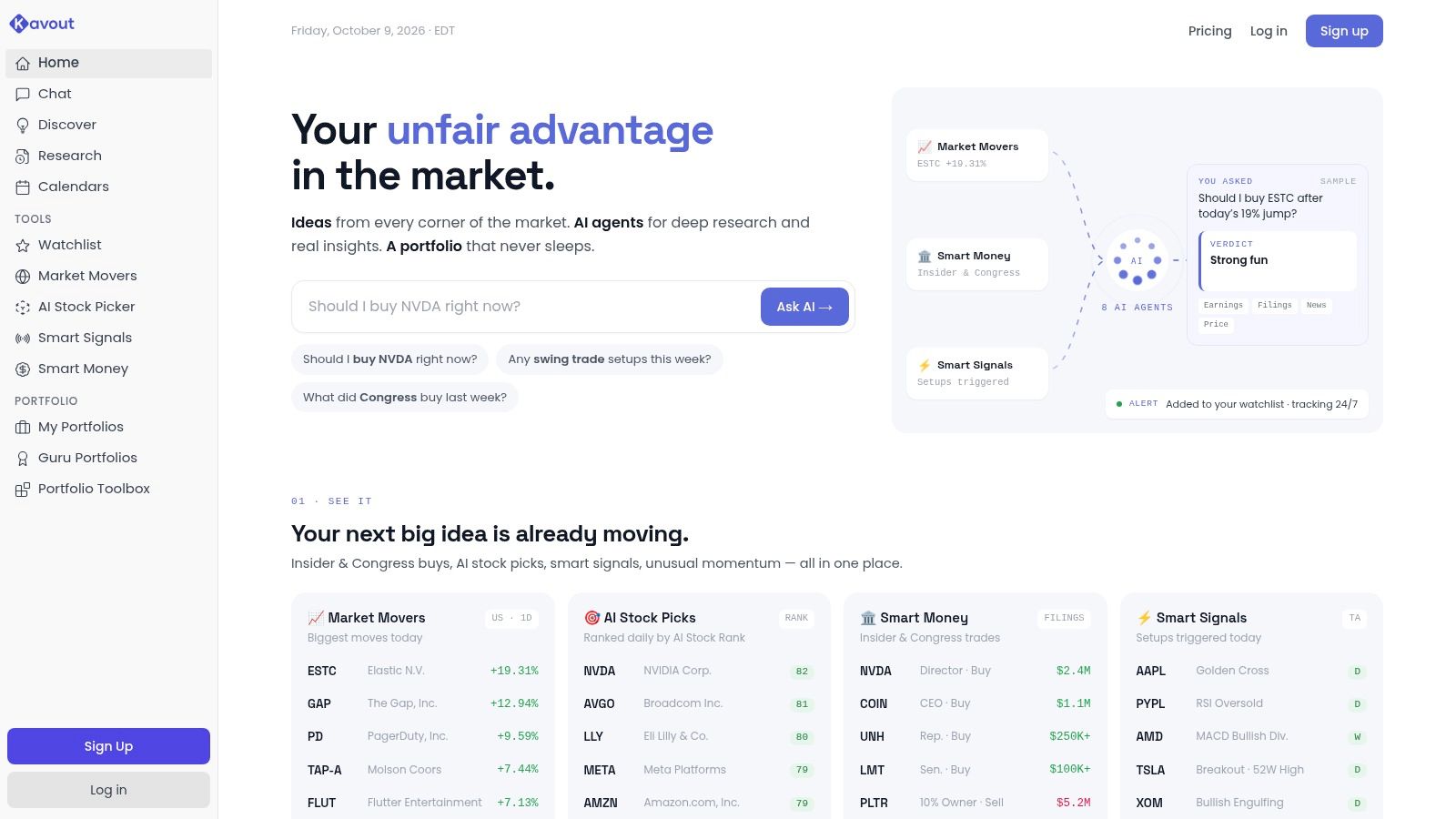
Kavout is built for people who want a machine-learning ranking system with more depth than a consumer app. Its K Score ranks thousands of global stocks using fundamentals, technicals, and alternative data. That puts it closer to a quant research tool than a casual investing app.
Where it fits in a workflow
This is the kind of platform you use when the goal is to rank, filter, and compare, not to get hand-holding. It suits DIY investors who already have a process and want another signal layer, plus researchers who need data or API access for custom work. The daily ranking rhythm is useful if your process depends on fresh signals.
The trade-off is friendliness. Kavout is less beginner-oriented than app-first tools, so the learning curve is higher. Pricing and commercial terms can vary by package and usage, which is normal for tools that serve both individuals and institutions. Visit the Kavout website and check whether the plan structure fits your workflow before you wire it into a broader research stack.
Custody and region
Kavout doesn't hold your assets in the way a brokerage does. That makes custody simpler, but it also means the burden of execution stays with you. It's a good fit when you want scoring and factor analytics, not an all-in-one trading environment.
6. TrendSpider
TrendSpider is for active traders who care about charting, scanners, alerts, and backtesting in one place. It layers AI and machine-learning features on top of technical analysis, so you can move from pattern recognition to strategy testing without stitching together multiple tools. That consolidation is the main reason traders keep it on their list.
Why traders keep returning to it
TrendSpider is strongest when you want an integrated technical workflow. Scanners find setups, alerts track levels, and backtests help you avoid trading a pattern that only looks good on a static chart. That combination helps active traders cut down on tool sprawl.
If your process depends on entries, exits, and alerts, use the platform to test the rules before you trust the chart.
The downside is obvious. Long-term investors often won't need this much chart infrastructure, and pricing can be messy during promotional periods. Read the current plan page at the TrendSpider website before you assume yesterday's promo still applies.
Practical limit
TrendSpider helps you systematize trading, but it won't remove discipline problems. If you keep overriding signals because of headlines, the platform can't fix that. It's a tool for process, not for conviction.
Why AI trading setups fail when users skip rules
7. Token Metrics
Token Metrics is the crypto-side equivalent of a scoring and prediction engine. It offers AI-driven token ratings, short-term price predictions, screeners, mobile monitoring, and developer access through an API and SDK. That makes it useful for crypto traders who want signals they can plug into a larger workflow.
What makes it useful
The modular design matters. Some users only want ratings and watchlists. Others want an API that can feed a bot or internal dashboard. Token Metrics supports both, which is why it shows up in more technical crypto stacks.
The caution is the same one I'd give any fast-moving market tool. Crypto predictions can get noisy quickly, especially when liquidity changes or sentiment flips. Use the ratings as a filter, not an automatic buy signal. Check the current product structure and terms at the Token Metrics website, because subscription packaging has changed in the past.
Best use case
This is a research and monitoring layer, not a custody layer. You still need exchange controls, sizing rules, and a separate risk plan. That separation is healthy, because it keeps the tool from becoming a single point of failure.
See how AI is used in crypto investing workflows
8. Yield Seeker
Yield Seeker fits the on-chain yield execution job. It is built for stablecoin yield on Base, starts from as little as $10 USDC, and uses a personalized AI agent to monitor curated vaults and reallocate capital in real time. The setup is non-custodial, uses Coinbase Trusted Execution Environment isolation, and says it includes audits from Nethermind and AuditAgent plus an auditable activity log.

Why it stands out
The practical appeal is automation with visibility. The dashboard, built-in terminal, and agent chat let you see what the system is doing while it handles monitoring, allocation, and reallocation. That matters if you want yield exposure without living inside DeFi dashboards.
Yield Seeker also reduces some common friction. It says there are no lockups and no withdrawal fees, and its tiering is simple, with a free Basic plan and a Pro plan for heavier use. It also cites realized APY ranges of roughly 3 to 14% depending on settings. Treat that as a live market outcome, not a promise, because yield can change with vault behavior and market conditions.
Custody, pricing, and fit
Custody stays with you, which is the main reason to consider it. The trade-off is familiar to anyone using DeFi. Stablecoin risk, protocol risk, and smart-contract risk still apply, even with audits and transparency features in place. Plan details can change, so verify the current terms at Yield Seeker before moving funds.
9. Deploy Finance
Deploy Finance targets users who want autonomous on-chain strategies while keeping self-custody. The wallet remains user-controlled, and the agent executes within the permissions you give it. That makes it feel closer to a DeFi operating layer than a traditional investment app.
What it does well
The platform's strength is operational clarity. Because trade-only permissions stay tied to your wallet, the custody model is easier to reason about than a setup where someone else holds the keys. Users can also choose from different agent profiles, which helps if you want to separate a conservative yield approach from a more aggressive one.
The weak point is the normal DeFi one. On-chain execution still exposes you to gas costs, exchange mechanics, and protocol risk. The product also has a shorter public track record than more established tools, so you should test it in small size and inspect every transaction path. Review the current documentation on the Deploy Finance website before you connect capital.
Best fit
Use Deploy Finance if you want agentic execution but refuse to give up custody. That combination will matter more to experienced crypto users than to casual investors.
10. Peridot Finance
Peridot Finance leans into AI-native DeFi brokerage. Its agents find yield opportunities, explain the rationale, then execute after user approval. That approval step is important, because it gives the user a real checkpoint before capital moves across chains.
Why the approval step matters
Peridot's model is more conversational than fully autonomous. The agent proposes, explains, and waits. For many users, that's the right balance between speed and oversight, especially when chain fragmentation makes multi-step yield discovery tedious.
The developer angle also stands out. The open-source agent kit and broader stack make it easier to customize automations, which is helpful if you're building tooling on top of it rather than just using the app. The current site at the Peridot Finance website is the place to verify which chains and venues are live for your region.
Watch the custody flow carefully. Early-stage DeFi agents can look polished while still hiding brittle execution paths. Read the approval and routing logic before you commit size.
Practical limit
Peridot is promising, but it's still early enough that security and availability deserve extra scrutiny. If you want a broad, production-heavy setup, verify every supported venue first. If you want a programmable multi-chain assistant, it's one of the more interesting options in this group.
Top 10 AI Investment Tools Comparison
Product | Core features | UX / Quality (★) | Price / Value (💰) | Target audience (👥) | Unique selling points (✨) |
|---|---|---|---|---|---|
Magnifi | Conversational AI research; portfolio analysis; RIA oversight | ★★★★, NLP research workflow | 💰Varies; advisor model | 👥 US retail investors & beginners | ✨ Aggregates SEC filings & earnings into unified research |
Composer by SoFi | AI-assisted strategy discovery, backtesting, automation & rebalancing | ★★★★, end-to-end automation | 💰Varies; brokerage-linked | 👥 DIY investors wanting rules-based automation | ✨ Strategy library + automated rebalancing; SoFi backing |
Capitalise.ai | No-code NLP "if/then" strategy builder; broker integrations | ★★★, easy rule creation | 💰Free tier; paid plans for advanced features | 👥 Retail traders wanting systematic rules without code | ✨ Plain-English conditional strategy engine |
Danelfin | AI Score, multi-horizon forecasts, model portfolios, API (higher tiers) | ★★★★, transparent scoring & workflows | 💰Subscription; API on higher tiers | 👥 Stock pickers & analysts | ✨ Clear AI-score methodology + published model performance |
Kavout | Daily ML-driven K Score, factor analytics, API/data delivery | ★★★★, quant/data-focused platform | 💰Tiered (self-serve → enterprise) | 👥 Quants, researchers, institutions | ✨ Proven ML scoring used by funds; robust API access |
TrendSpider | AI/ML pattern recognition, scanners, backtesting, alerts & automations | ★★★★, deep technical toolkit | 💰Subscription (promos common) | 👥 Active traders & technical analysts | ✨ Agentic market scanners + automation hooks |
Token Metrics | AI token ratings, 7-day predictions, screeners, SDK/API | ★★★★, crypto research & signals | 💰Subscription; API/SDK tiers | 👥 Crypto investors & developers | ✨ Token ratings + developer SDK for agent integration |
Yield Seeker 🏆 | AI agents auto-allocate stablecoin yield on Base; non-custodial, audited vaults, live reallocations | ★★★★★, effortless dashboard, agent chat & terminal | 💰Free Basic; Pro $29/mo (early $19) | 👥 Beginners, crypto natives, busy professionals & treasuries | ✨ 🏆 Personalized AI agents, Coinbase TEE isolation, third-party audits, no lockups |
Deploy Finance | Autonomous on-chain agents executing DeFi strategies from user wallet | ★★★, agentic execution with self-custody | 💰No subscription; users pay network/exchange fees | 👥 DeFi users prioritizing self-custody | ✨ Trade-only wallet permissions; fee-only model (no mgmt fee) |
Peridot Finance | AI agents + MCP server; one account multi-chain; open-source agent kit | ★★★, developer & agent-first UX | 💰Varies; developer / enterprise focus | 👥 Developers & multi-chain DeFi users | ✨ Multi-chain account model + open-source agent stack |
Match the Tool to the Job Before You Commit Money
The cleanest way to choose among ai investment tools is to start with the job, not the branding. If you need research support, shortlist Magnifi. If you want rules-based automation, look at Composer by SoFi or Capitalise.ai. If your focus is stock scoring, Danelfin and Kavout make more sense. If you need crypto analytics, Token Metrics belongs in the comparison. If your goal is on-chain yield execution, the conversation shifts to Yield Seeker, Deploy Finance, and Peridot Finance.
Before you fund anything, check the custody model, who holds the keys, the current fee terms, and whether the platform still supports your region and account type. Pricing changes, integrations change, and plan names change. That's especially important for products that sit inside brokerage workflows or across DeFi venues.
Test with a small amount first. Read the activity log, inspect the backtest, or replay the execution path before you trust the system with meaningful capital. A polished score or agent doesn't remove market risk, protocol risk, or smart-contract risk, and it doesn't make projected returns certain. It just reduces the amount of manual work you have to do before you decide.
If you want an AI-first way to automate stablecoin yield without giving up control, Yield Seeker is built for that workflow. It focuses on audited, non-custodial DeFi yield management on Base, with a low entry point and a clear activity log. Visit it, verify the current terms, and decide whether that style of automation fits your risk tolerance.