
You see a stablecoin dashboard advertising a double-digit APY. The deposit looks simple, so you approve the transaction before checking where the return comes from. Later, you discover that the yield depended on a thin lending market, a liquidity pool with weak exit depth, or a token incentive scheduled to end.
That's why the best crypto yield farming strategy can't be chosen from an APY column alone. The useful comparison combines risk, expected return, liquidity, and operational complexity. A lower rate may be the better result if the strategy relies on durable borrower demand, keeps withdrawals practical, and avoids unnecessary borrowing.
The ranking below moves from easier stablecoin deployments to more advanced structures. Each option includes a practical setup note, a real use case, and the main failure mode to monitor. Treat every quoted yield as variable, and remember that stablecoins still carry smart-contract, oracle, liquidity, depeg, and counterparty risks.
1. Lending Protocol Yield Aggregation
Lending aggregation is the most practical starting point for many stablecoin holders. You supply assets such as USDC or DAI to lending markets, then spread capital across established venues instead of depending on a single protocol. Borrowers pay interest, and suppliers receive a variable share after the protocol's costs and reserve mechanics.
A basic deployment might divide capital between Aave and Compound, while a peer-to-peer matching layer such as Morpho can seek more efficient matches between lenders and borrowers. The important distinction is between organic lending revenue and rewards paid in a volatile governance token. A displayed APY can fall rapidly when borrowing demand weakens or emissions change.
Stablecoin lending requires more than comparing rates. A useful allocator checks utilization, available liquidity, collateral quality, oracle design, reserve levels, and the concentration of borrow demand before moving funds.
Practical setup
Start with a small allocation across independent lending markets. Use an automated monitor to compare net rates, but set a minimum spread before rebalancing. A move that earns a slightly higher gross rate may lose money after gas, transaction fees, and slippage.
Practical rule: A lower rate in a deep pool can be more useful than a higher rate created by near-full utilization.
Research on Aave finds that utilization transmits changes in borrowing demand into supplier rates. Higher utilization can increase the quoted return, but it can also make withdrawals more sensitive to stress. The Bank of Canada identifies borrower default and insufficient collateral as core lending-platform risks, so rate monitoring should sit alongside collateral and liquidation analysis. The lending-rate research and risk discussion supports treating utilization as a risk signal, not just a yield signal.
2. Risk-Adjusted Yield Optimization via AI Allocation
AI allocation works best when it reduces research and execution friction without hiding the decision from you. An agent can compare lending markets, liquidity pools, and automated vaults, then allocate according to risk limits instead of selecting the highest displayed APY.
For example, a system may compare Aave, Curve, and Compound while tracking liquidity depth, utilization, protocol exposure, reward-token volatility, and recent rate persistence. Yearn vaults and Convex strategies illustrate the broader automation model, where contracts handle allocation, compounding, or incentive optimization across several venues.
The key question isn't whether the platform uses AI. It's whether you can understand what the system is allowed to do.
What to verify before depositing
Ask how the allocator defines risk, how often it rebalances, and whether it can move funds into a new protocol without your approval. You should also be able to see the current allocation, the underlying protocols, the reward sources, and the conditions that trigger an exit.
Risk limits: Confirm whether you can cap exposure by protocol, chain, stablecoin, and strategy type.
Allocation visibility: Check whether the platform explains why it selected a pool instead of presenting an opaque score.
Execution costs: Make sure rebalancing accounts for gas, bridge fees, slippage, and failed transactions.
Withdrawal process: Verify whether you can exit the original stablecoin or receive a derivative that needs another market.
AI yield allocation can reduce manual dashboard switching, but automation doesn't remove protocol risk. It can execute a poor decision faster if the inputs are incomplete or the risk parameters are too loose.
A sensible rollout starts with a small amount and a conservative setting. Compare realized returns with a simple lending benchmark, then review whether the agent's actions matched your expectations. Transparency matters more than a complex label.
3. Stablecoin Liquidity Pools
Stablecoin liquidity pools earn from trading activity rather than borrower interest. You deposit a pair such as USDC and USDT or USDC and DAI into an automated market maker, then receive a proportional share of swap fees and any additional incentives.
Stablecoin pairs usually have correlated target prices, which can reduce impermanent loss compared with volatile-asset pairs. That doesn't make the position risk-free. A depeg can push the pool toward one asset, while weak trading volume can leave you with a return that doesn't justify the contract, liquidity, and issuer exposure.
Curve's stablecoin pools, Uniswap v3 positions, and Balancer stablecoin pools all require different operating decisions. A concentrated Uniswap v3 position can capture more activity inside its chosen range, but it can stop earning fees when the market moves outside that range.
Setup note
Choose a pool with consistent volume and enough exit liquidity for your position. Estimate expected fees after gas and compare them with a single-asset lending position. If you use concentrated liquidity, define the price range, monitoring schedule, and rebalance trigger before depositing.
Impermanent loss still matters in stablecoin pools, even when the assets are designed to track similar prices. The loss can emerge through depeg movements, rebalancing, or the opportunity cost of holding the pool's changing asset mix.
A practical example is a USDC and USDT pool that earns fees while traders move between the two assets. The pool may look conservative during normal conditions, but a problem with one issuer or a sudden liquidity shortage can make the position behave very differently. Diversifying across pairs can reduce concentration, though it also adds more contracts and monitoring requirements.
4. Stable Asset Yield via Market Making and Protocol Incentives
This strategy combines trading-fee income with rewards from a protocol's incentive program. You provide liquidity, then receive a share of market-making fees and possibly governance-token distributions tied to gauges, voting, lock duration, or pool priorities.
Curve gauge voting is a familiar example. A liquidity provider may earn fees from swaps and CRV-related rewards, while systems such as Velodrome and Thena use governance and incentive mechanics to direct liquidity toward selected markets. The second income stream can make the headline APY attractive, but it often introduces token-price and governance risk.
Separate the two sources of return
Calculate the position in two layers:
Trading fees: Revenue generated by actual swaps in the pool.
Token incentives: Emissions that may change, decline, vest, or lose market value.
Locking benefit: Any multiplier received for committing liquidity or governance tokens.
Exit cost: Gas, slippage, withdrawal restrictions, and the value of lost flexibility.
A pool with strong trading activity and modest incentives may be more durable than one where nearly all of the return comes from emissions. Review governance proposals because a vote can redirect rewards away from your pool without changing the interface you use.
The reward token isn't yield until you can sell it at a price that justifies the risk.
Locking liquidity only makes sense when the additional reward compensates for the loss of flexibility. If the protocol's governance token is weak or the pool's volume is falling, selling rewards and reducing exposure may be more rational than automatically compounding them.
5. Yield Farming with Native Protocol Incentives
Native-incentive farming targets temporary programs. A protocol distributes its own token, seasonal boost, or governance reward to attract stablecoin liquidity, and you enter while the incentive remains worthwhile.
The opportunity is real, but the timing is central. Yield farming expanded rapidly during DeFi Summer in 2020, when DeFi TVL grew from approximately $800 million in April 2020 to $10 billion in September 2020, a more than tenfold increase in roughly five months, according to Ethereum's DeFi history. By the end of that year, TVL had surpassed $15 billion. That period showed how quickly capital can follow rewards and dilute them.
A program offering ARB, FXS, or time-based Pendle incentives may look generous at launch. The quoted APY can decline as more liquidity arrives, the reward token can fall in value, or governance can discontinue the program.
Use an exit plan before entry
Write down the conditions that will make you leave:
Reward reduction: Exit if emissions fall below the return you need after costs.
Token weakness: Decide whether you'll sell rewards immediately or accept token exposure.
Program expiry: Check vesting, claim schedules, and the announced end date.
Protocol change: Monitor governance proposals, contract upgrades, and liquidity migration.
Capital limit: Keep incentive-heavy positions as a defined portion of the portfolio.
Sustainable revenue should be evaluated separately from emissions. Lending interest, trading fees, and protocol cash flow can continue without the same token subsidy, while temporary incentives can disappear quickly. Don't treat a new reward program as proof that the underlying market has durable demand.
6. Cross-Chain Arbitrage Yield Strategy
Cross-chain arbitrage moves stablecoins between networks when the same asset or comparable strategy offers different net returns. You might supply USDC on one chain, bridge to another where borrowing demand is stronger, and return when the spread narrows.
This approach is more operationally demanding than it looks. The apparent yield difference must cover bridge fees, swaps, slippage, transaction costs, delayed settlement, and the risk that rates change before the funds arrive. A bridge also adds another security and liquidity dependency.
The 2021 DeFi expansion demonstrates why chain diversification matters. DeFi TVL reportedly rose from $18.71 billion to $245.22 billion during that year, while Ethereum's market share fell from about 99% to 62%, as networks including Binance Smart Chain, Terra, and Avalanche attracted capital. The market-share account also records that, on December 30, 2021, Ethereum represented approximately $153 billion across 376 protocols, Terra held about $18 billion across 14 projects, and Binance Smart Chain held about $16.4 billion across 254 protocols. These figures are historical context, not a safety rating.
Setup note
Use established routing infrastructure, test with a small amount, and calculate the complete round-trip cost before moving size. Set an alert for narrowing spreads, but don't let an automated system bridge funds into a chain or protocol that violates your exposure limits.
The main risk is not only a failed bridge. It's correlation. A chain, bridge, stablecoin, or liquidity venue can become difficult to use precisely when users are trying to exit. Keep a portion of capital on the destination chain if you need to manage an emergency, and avoid assuming that a higher chain-level APY compensates for every additional dependency.
7. Collateralized Debt Position Yield Strategy
A collateralized debt position creates stablecoin liquidity by locking collateral and minting debt. You can then deploy the borrowed stablecoins into a lending market or pool, attempting to earn more than the stability fee or borrowing cost.
Maker, Aave, and Liquity represent different versions of the structure. The return comes from the spread between the cost of minting and the income generated by the deployed stablecoins. That spread can vanish when borrowing costs rise, lending rates fall, or the collateral loses value.
This strategy is not passive just because the borrowed asset is a stablecoin. The collateral remains exposed to price movements, oracle behavior, liquidation parameters, and protocol governance.
Manage the debt before chasing the yield
Set a conservative collateral buffer and a liquidation alert well before the protocol's formal threshold. Review the stability fee, liquidation penalty, oracle source, repayment process, and the liquidity available for the minted stablecoin.
If your collateral is volatile and the borrowed stablecoin is deployed elsewhere, you're managing two linked positions. A collateral price decline can force repayment or liquidation while the farming position is losing liquidity. Algorithmic stablecoin exposure deserves additional scrutiny because unusually high returns can mask structural fragility.
A CDP can make sense for an experienced operator who understands the debt engine and has a written unwind plan. It's a poor first strategy for someone who hasn't yet tracked utilization, liquidation prices, and exit costs on a simple lending position.
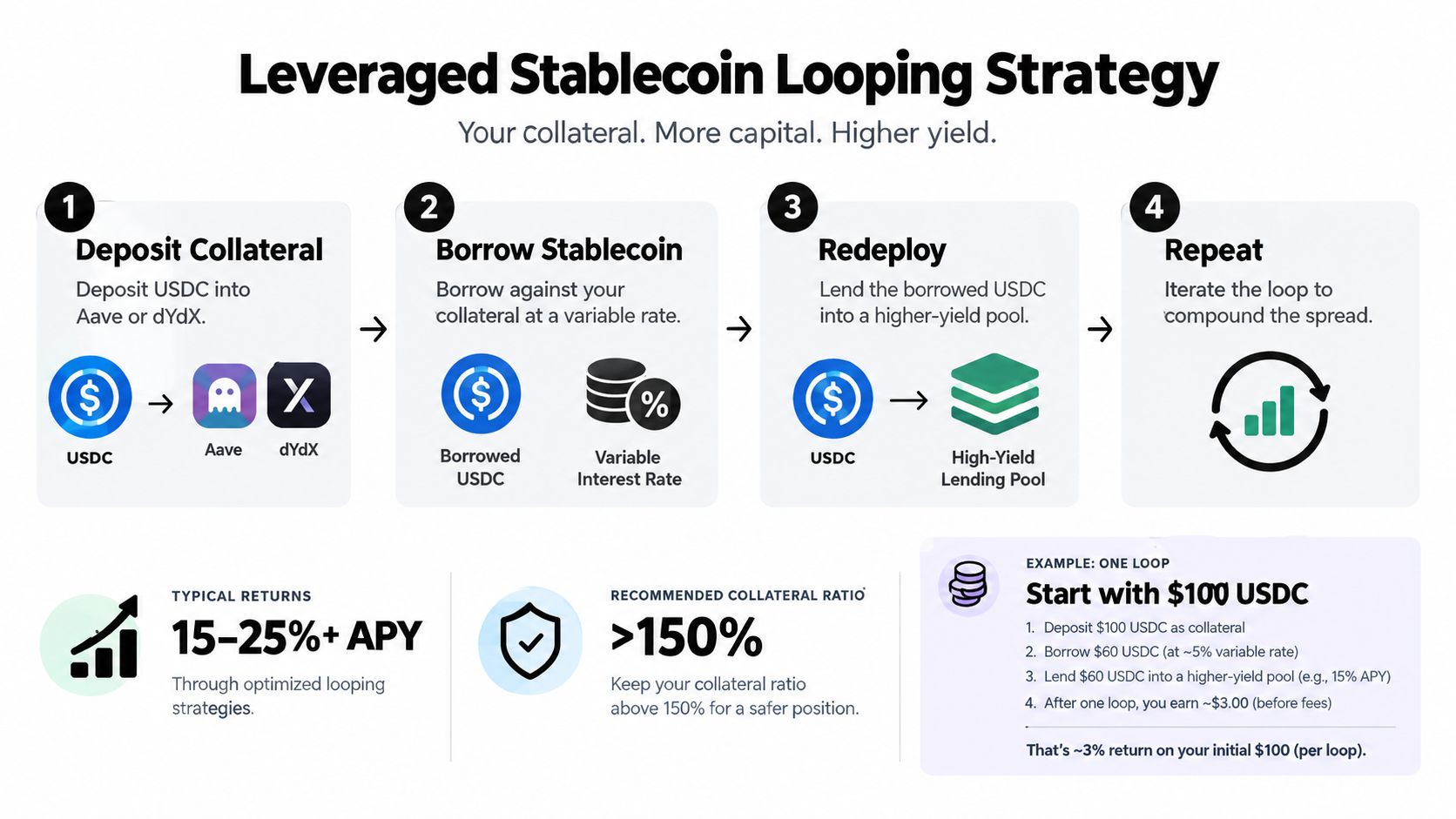
8. Leveraged Stablecoin Looping Strategy
Looping borrows stablecoins against stablecoin collateral, then redeploys the borrowed funds into a higher-yield market. The position earns on a larger gross deposit, but it also pays interest on the debt. The strategy works only while the lending rate remains above the borrowing rate after gas, reserve charges, and execution costs.
A simple loop might deposit USDC, borrow another stablecoin, and supply that debt asset back into a lending pool. Repeating the process increases exposure to the spread, but it also makes the position more sensitive to utilization spikes, rate inversions, oracle issues, and depegs.
Define the failure point first
Don't start with the maximum borrow capacity. Start with the amount you can unwind without relying on perfect liquidity. Keep unlooped reserves available, set an emergency repayment rule, and use alerts for collateral health, utilization, borrowing rates, and stablecoin deviations.
A loop can face stress even when both assets are intended to remain stable. One asset may trade below its target, the oracle may update unfavorably, or withdrawals may become difficult because utilization is high. Contagion is another concern. Research on stablecoin pools warns that high utilization and crypto-collateralized borrowing can connect shocks across lending markets.
Leverage turns a small rate mistake into a position-management problem.
The strategy belongs at the advanced end because the operator must manage debt, collateral, rates, liquidity, and exit execution together. A single loop is easier to audit than a complex recursive structure. If the net spread disappears, close the position rather than hoping incentives will restore it.
Top 8 Crypto Yield Farming Strategies Comparison
Strategy | Implementation Complexity 🔄 | Resource Requirements & Risks 💡 | Expected Outcomes ⭐📊 | Ideal Use Cases ⚡ | Key Advantages |
|---|---|---|---|---|---|
Lending Protocol Yield Aggregation | Medium, cross‑protocol integration and realtime rebalancing | Low capital barrier; gas costs; multi‑protocol smart‑contract & regulatory risk | Variable yields ~4–12% APY + governance rewards; diversified income | Passive stablecoin income; users wanting simple diversification | Diversifies counterparty risk; no lock‑ups; passive automation |
Risk‑Adjusted Yield Optimization via AI Allocation | High, AI models, risk scoring, ongoing training | Platform/model risk; fees; needs reliable data and trust in provider | Improved risk‑adjusted returns (higher Sharpe); adaptive to markets | Investors wanting automated, risk‑managed allocation | Removes emotion; faster opportunity capture; personalized risk profiles |
Stablecoin Liquidity Pools (AMM Strategy) | Low–Medium, deposit LP or set concentrated ranges | Requires liquidity; smart‑contract risk; monitoring gas vs fees | Steady fee income; lower yields (≈3–8% APY); minimal impermanent loss | Risk‑averse yield seekers; earning fees on high‑volume pools | Predictable fee revenue; low volatility exposure; multi‑chain deployment |
Stable Asset Yield via Market Making & Protocol Incentives | Medium–High, market‑making ops + governance participation | Capital for depth; possible lock‑ups; incentive/token volatility; tax complexity | Higher combined yields (fees + incentives); variable by program | Active LPs and governance participants seeking boosted returns | Dual‑yield sources; governance upside; customizable lock‑up multipliers |
Yield Farming with Native Protocol Incentives | Medium, rapid entry/exit & monitoring required | High protocol risk; vesting schedules; potential rug/illiquidity | Short‑term outsized APYs (often 10–50%+) while incentives last | Opportunistic allocators spotting temporary boosts | Very high short‑term upside; early token exposure |
Cross‑Chain Arbitrage Yield Strategy | High, bridging automation and cross‑chain orchestration | Bridge security risk; slippage; multi‑chain fees and tax complexity | Small chain premium spreads (≈2–5%); opportunistic gains | Experienced users exploiting chain yield differentials | Access emerging chains; lower L2 gas improves net yield |
Collateralized Debt Position (CDP) Yield Strategy | Medium–High, debt management and health monitoring | Liquidation risk; stability/borrow fees; protocol dependency | Leverage‑style returns: earn on collateral + deployed minted stablecoins | Treasury managers and users seeking capital without selling assets | Access capital without selling; potential tax efficiency; leverage yields |
Leveraged Stablecoin Looping Strategy | High, iterative leverage loops; automation advised | High liquidation & rate‑inversion risk; gas costs; monitoring required | High potential yields (≈15–25%+ in favorable markets); amplified returns | Aggressive yield seekers with active risk controls | Amplifies returns while remaining delta‑neutral; compoundable via loops |
Choosing Your First Strategy Without Overreaching
The best starting point is usually the strategy you can explain clearly under stress. For most beginners, that means single-asset lending or diversified lending aggregation. You can see where the return comes from, monitor utilization, and exit without managing collateral debt or a bridge. AI-assisted allocation can also reduce the burden of comparing markets, provided the platform exposes its risk settings and current allocations.
Stablecoin liquidity pools are a reasonable next step when you understand how fees, pool balances, depegs, and withdrawal depth interact. Market-making strategies with governance incentives require more judgment because the return has two separate components. Native-token rewards may look attractive, but you need to know whether the protocol would still be useful if the emissions stopped.
Cross-chain strategies add bridge and chain exposure. CDPs add debt and liquidation exposure. Looping adds borrowed exposure to the entire system. Those options aren't automatically wrong, but they demand written thresholds before deployment. Record the borrowing rate you can tolerate, the utilization level that triggers a reduction, the collateral condition that starts an unwind, and the liquidity you need to exit.
Historical growth doesn't make a strategy safe. DeFi TVL increased from approximately $800 million to $10 billion during the 2020 expansion, then surpassed $15 billion by year-end, but that same history shows how quickly incentives attract capital and change pool economics. A quoted APY can become obsolete while your funds remain in the position.
Institutional interest also shows why operational controls matter. A 2025 Coinbase and EY-Parthenon survey reported that 84% of institutions were already using or interested in stablecoins, with yield generation among the principal use cases. Among institutions not planning to use DeFi, regulatory and compliance concerns were cited as leading barriers at 57% and 55%, respectively, according to the institutional stablecoin survey. For any serious treasury, allocation records, counterparty exposure, transaction history, and configurable limits are part of the strategy.
Pick one option. Write down its main risk and exact exit condition. Review the position weekly, including realized yield, not just the dashboard APY. If the strategy requires more attention than you can provide, move down the complexity ladder rather than adding automation blindly. Platforms such as Yield Seeker can monitor stablecoin opportunities and automate allocation when that workflow matches your risk controls.
Yield Seeker provides an AI-driven stablecoin yield agent that monitors DeFi opportunities, compares risk-aware allocations, and can rebalance deposited USDC on Base. Visit Yield Seeker to explore automated stablecoin yield with visible allocations and control over your chosen risk approach.