
Your stablecoins are probably sitting in one of two bad states right now. They're idle in a wallet earning nothing, or they're parked in a protocol you picked weeks ago and haven't checked since. Both are common. Both leave money on the table.
Finding the best DeFi stablecoin yield isn't hard because there are no options. It's hard because there are too many, and the headline APY rarely tells you what matters. A rate can look great in the app, then compress fast when deposits pile in. Another strategy can pay more, but only because you're taking on liquidation risk, wrapper risk, or governance risk.
I treat stablecoin yield like treasury allocation, not like a slot machine. The first question isn't "what pays the most?" It's "what's generating the yield, what can break, and how much work will this take to manage well?" That's the lens that separates blue-chip lending, fixed-rate products, structured yield, and automated allocation tools.
Below are seven real options worth considering in 2026. Some are hands-on. Some are closer to set-and-forget. The biggest divide is manual control versus automated execution. If you enjoy monitoring utilization, rotating vaults, and moving across chains, the classic protocols still work. If you want the best DeFi stablecoin yield without babysitting dashboards every week, automation has become a serious category of its own.
1. Yield Seeker
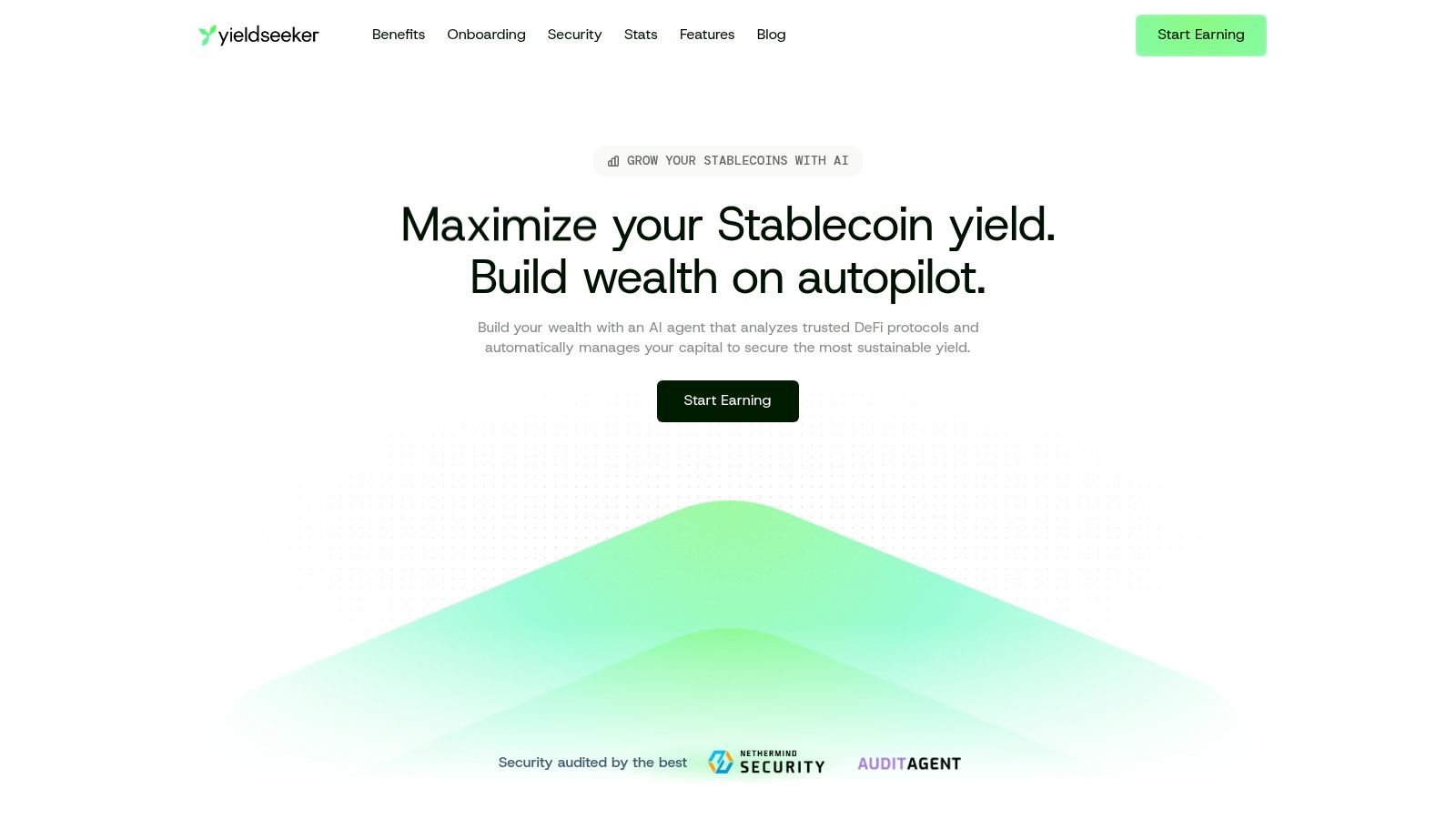
You bridge USDC to Base, open three tabs, compare rates, second-guess the risk, then leave the funds idle for another week. Yield Seeker is built for that exact problem. It automates stablecoin allocation with AI agents, so the work of monitoring markets and rotating between opportunities does not fall back on you.
That changes the job description. Instead of managing every protocol yourself, you set a risk posture and decide whether the convenience is worth giving up some manual control. For anyone comparing automated allocation against Aave or Compound, that is the core trade-off. Less operational effort, but more reliance on the system's routing logic and execution layer.
Why it stands out
Yield Seeker has a low starting balance, supports deposits from $10 USDC on Base, and keeps funds liquid with no lockups or withdrawal fees. The setup is non-custodial, with Coinbase Trusted Execution Environment isolated accounts, Nethermind audits, and automated checks through AuditAgent.
I like products in this category only when they are honest about what they are automating. Some tools are just dashboards with a nicer UI. Others ask for custody in exchange for convenience. Yield Seeker sits in the middle in a better way. It automates the repetitive allocation work while still giving users visibility into what the agents are doing.
Practical rule: If you know you will not monitor pool rates, vault changes, and chain-specific risk every week, use an automated tool with clear exit terms and visible strategy logic.
The other reason it earns a spot this high is category fit. Manual lending on Aave or Compound works well if you want direct control and do not mind checking utilization, incentives, and market conditions yourself. Yield Seeker makes more sense for operators, treasury managers, and active users who want stablecoin yield without turning position management into weekly maintenance.
What works and what doesn't
What works is the time-to-deployment. You can get capital active quickly, the dashboard is easy to follow, and the product explains the strategy layer better than many DeFi automation tools do. The team also publishes a risk-aware DeFi education hub that helps clarify how it approaches allocation rather than just showing a headline rate.
What does not work as well is scope. The current setup is strongest for USDC on Base, so it is less flexible if your stablecoin stack lives across Ethereum mainnet, Arbitrum, or multiple assets. That may be fine if your priority is efficient deployment. It is less attractive if you want broad asset coverage or full control over each underlying protocol choice.
Treat the advertised APY range as situational, not fixed. The actual return depends on market conditions, the strategies available at the time, and the risk setting you choose. If you want the platform's current quoted range, check the live rates shown in the app before depositing.
Best for beginners: guided setup instead of manual protocol selection
Best for busy professionals: less monitoring and fewer routine reallocations
Best for DeFi users with limited time: more automation, with the trade-off that you are delegating day-to-day optimization instead of doing it yourself
2. Aave V3
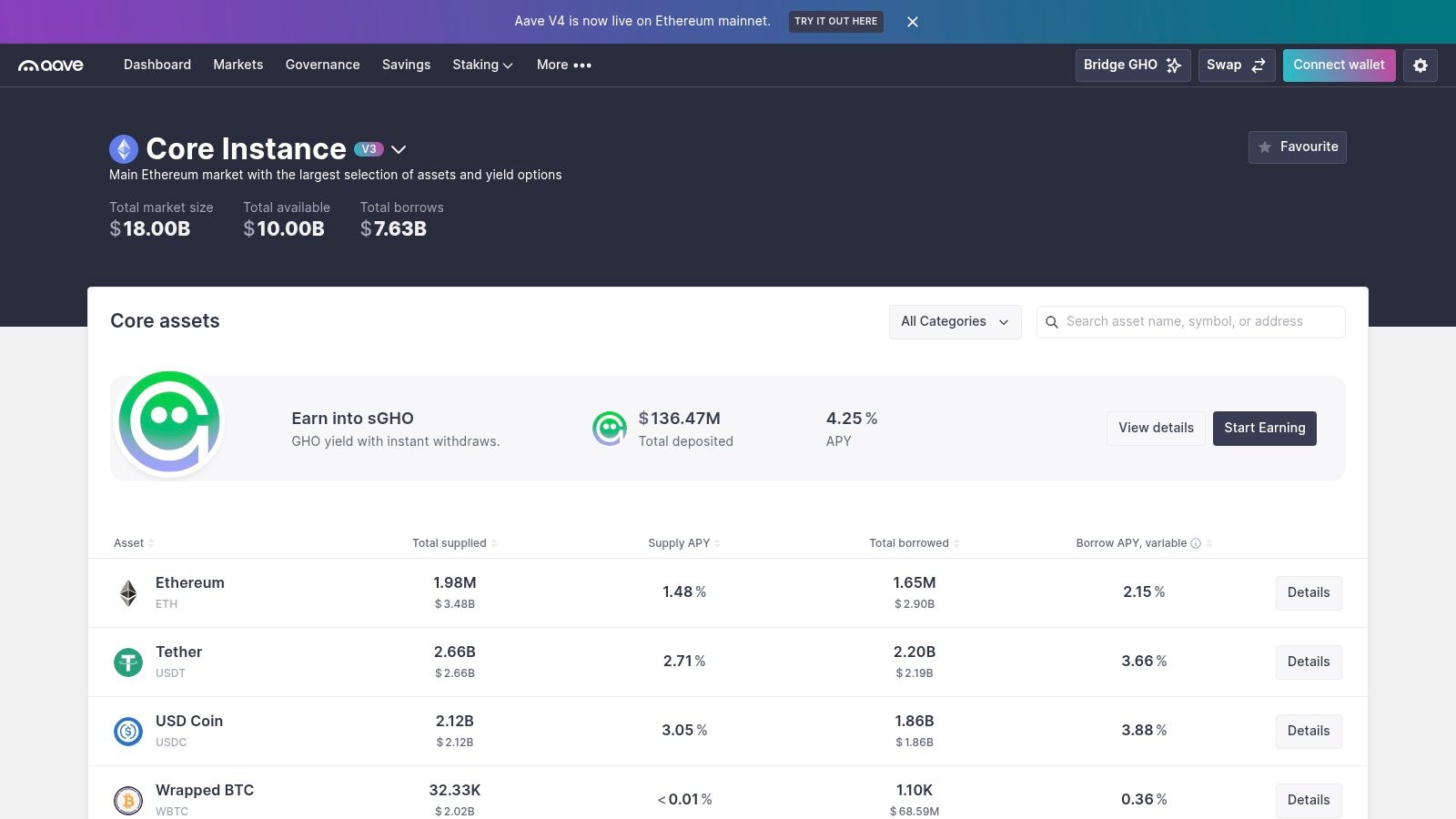
Aave V3 is the protocol many stablecoin holders choose after one bad week of chasing yield. You want somewhere liquid, familiar, and battle-tested. Aave usually sits near the top of that shortlist because the model is easy to understand. Supply USDC, USDT, or DAI to a lending pool, let overcollateralized borrowers pay for access to that liquidity, and earn a variable rate.
I use Aave as the manual benchmark for this category. If an automated product claims it can improve your stablecoin yield, Aave is one of the first places I compare against because it shows what plain lending returns look like without an extra strategy layer on top.
That clarity is the main advantage. You can see the asset, the chain, the current supply APY, and the utilization driving it. V3 also gives risk controls that matter in practice, including isolation mode for listed assets with tighter limits and e-mode for correlated assets. Those features do not remove risk, but they make the system easier to reason about than many higher-yield alternatives.
The trade-off is workload. Aave pays the market rate available in that pool at that moment. It does not rebalance you into better venues, and it does not protect you from the slow decay that happens when utilization falls after a busy borrowing period. If you are managing size, that means checking rates, comparing chains, and deciding whether the gas and bridge risk are worth the move. That is the fundamental split between manual protocols like Aave and automation tools like Yield Seeker. Aave gives you direct control. Automation saves time, but you give up some hands-on decision-making.
Aave also has a specific withdrawal risk profile that newer users miss. In normal conditions, stablecoin exits are straightforward. In stressed markets, available liquidity can tighten because your deposit is actively borrowed. You are still in a much more liquid venue than many niche farms, but "no lockup" is not the same as "instant exit under all conditions."
The common Aave mistake is treating a variable lending rate like a savings account rate. It can change fast, and your job is to notice.
Who should use it
Aave makes sense for users who want to stay close to the underlying risk and do their own monitoring. It is a strong fit if you care more about protocol maturity and liquidity than squeezing out every extra basis point.
Use Aave if you want: direct exposure to blue-chip DeFi lending, broad chain support, and clear pool-level risk.
Skip Aave if you want: a system that automatically chases better stablecoin opportunities for you.
Watch closely: utilization, available exit liquidity, incentive changes, and whether the chain you chose still offers enough net yield after fees.
3. Compound V3
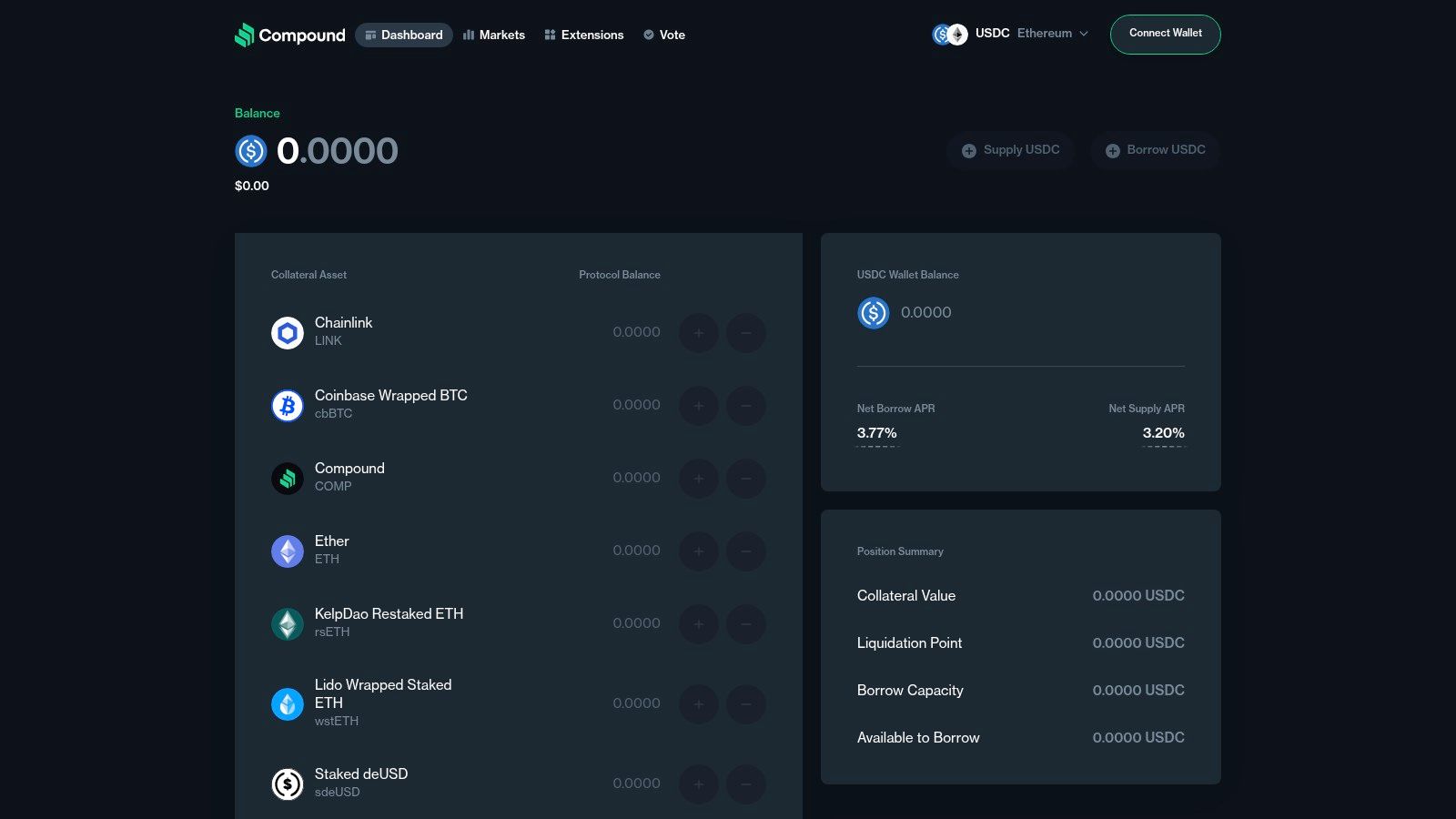
Compound V3, also called Comet, is one of the cleaner lending designs in DeFi. Each market centers around a single base asset, commonly USDC. That narrows the risk surface compared with older cross-asset pool designs and makes the mechanics easier to reason about.
If Aave feels like the broad, liquid default, Compound feels like the conservative engineer's choice. It doesn't try to do everything. It tries to do a smaller set of things with fewer moving parts.
The real trade-off
That simpler architecture is a strength, but it also limits flexibility. Only the market's base asset is borrowable, so if you want a more expansive multi-asset setup, Aave usually feels less restrictive. Compound is better when you value clarity over optionality.
I like Compound for users who want a baseline lending venue they can understand quickly. The interface is usually straightforward, and integrations across Ethereum and major L2s make it accessible without turning every action into a mainnet gas decision.
What it does well: Cleaner market design, mature codebase, fewer conceptual layers.
Where it falls short: Less flexible than multi-asset money markets.
Best fit: Stablecoin holders who want simple variable lending yield and don't need advanced routing.
4. Morpho Blue and Morpho Vaults
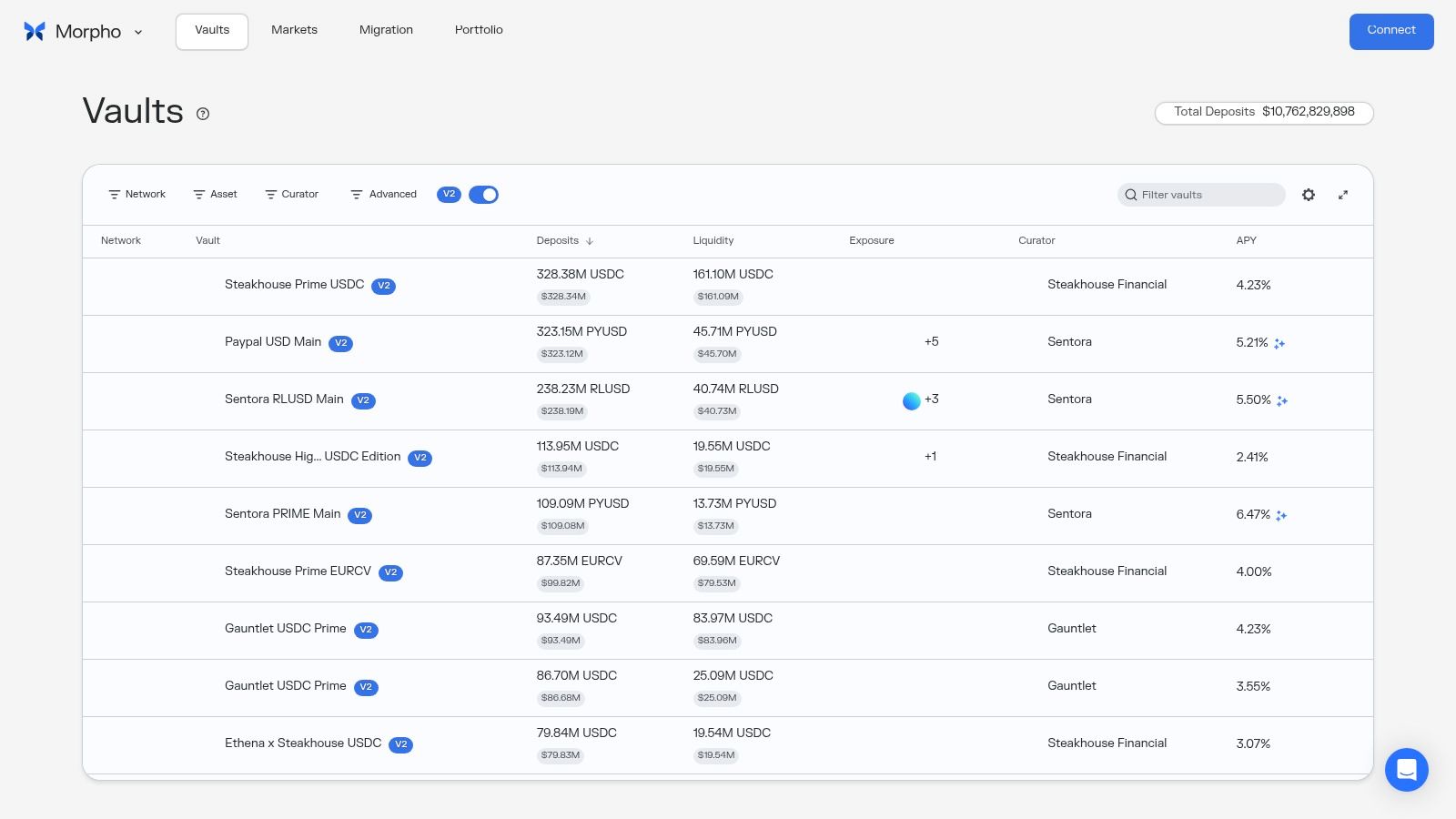
Morpho gives stablecoin lenders more control than the larger pool-based money markets. Morpho Blue is the base layer. Vaults add a curator on top who selects markets, sets allocation rules, and manages rebalancing. That design matters because your risk is tied to specific markets instead of a broad shared pool.
This is usually where I look once the default lending venues start to feel too generic. You can target tighter exposures and, at times, pick up better yield. The trade-off is simple. More precision means more diligence.
Where the extra yield comes from
Morpho can pay more than baseline lending markets because capital is allocated into isolated pairs with clearer parameters and curator-defined rules. For stablecoin depositors, that can be attractive if the underlying collateral, oracle design, and liquidation path all make sense.
But the work shifts to you. On Aave or Compound, a lot of the market selection is abstracted away. On Morpho, you need to judge the vault curator, the specific market mix, and whether the yield is coming from healthy borrow demand or from a setup that only looks good until conditions change.
What I check first: who curates the vault, what collateral backs the loans, how concentrated the exposure is, and whether I would still hold the position if incentives disappeared tomorrow.
That last point matters. A stablecoin vault yielding a bit more is not automatically better if you cannot explain the source of return in one or two sentences.
Best use case
Morpho fits users who want more control over risk segmentation and are willing to spend time reviewing vault construction. It also pairs well with automation tools like Yield Seeker, because curator monitoring and market rotation are exactly the tasks software can handle better than a manual weekly check.
Strong point: Isolated market design and more precise exposure selection.
Weak point: Curator risk, higher diligence burden, and more room for allocation mistakes.
Best fit: Active depositors, DAOs, and treasury operators who care how yield is produced, not just the headline APY.
5. Yearn V3 Vaults
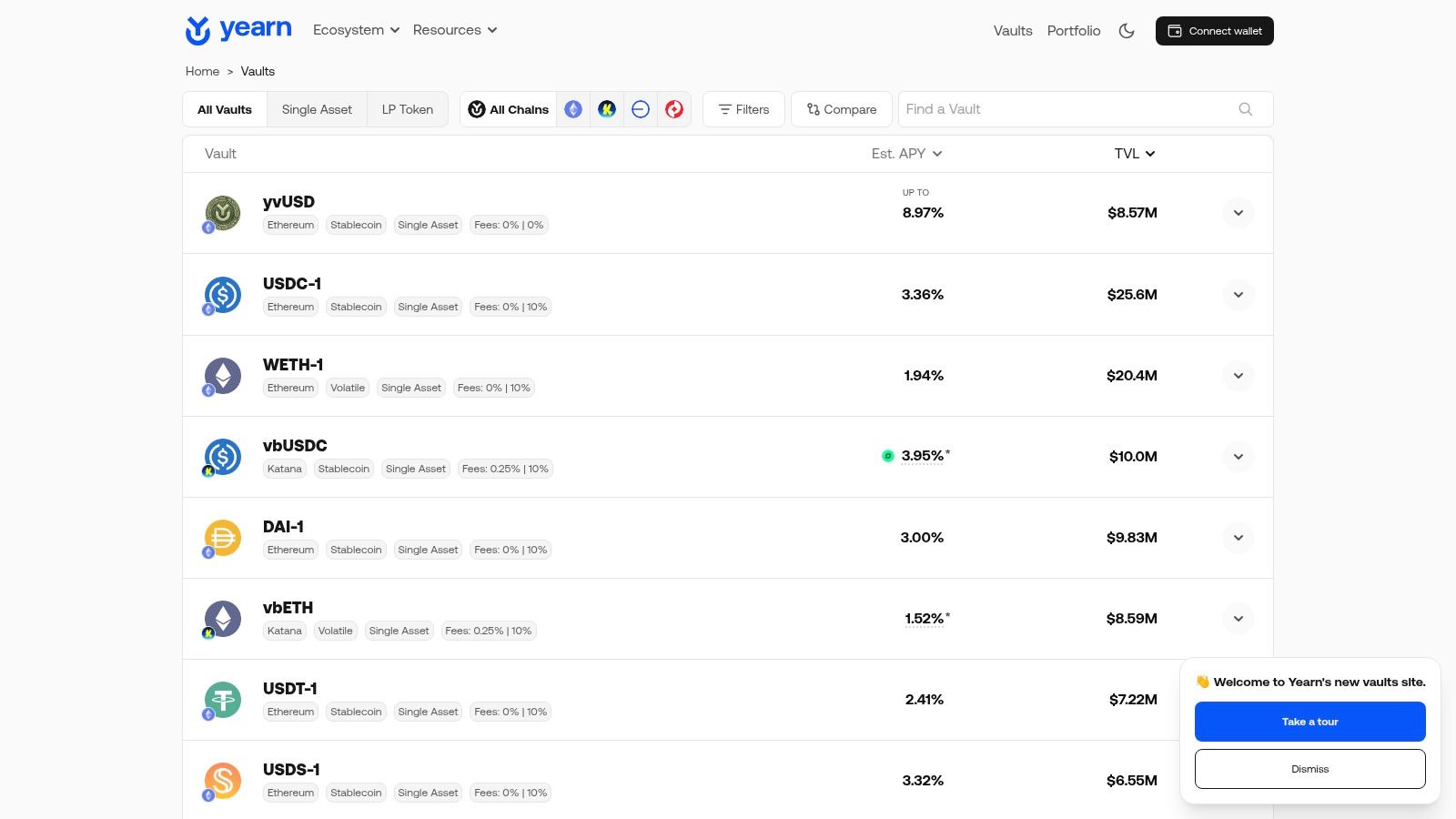
Yearn V3 fits a common stablecoin problem. You want on-chain yield, but you do not want to monitor lending rates, incentives, and reallocations across several protocols every week.
That convenience is real. So is the extra layer of risk.
Yearn packages strategy execution into vaults, which makes it easier to put capital to work without manually rotating between Aave, Curve, or other venues. For depositors with limited time, that trade-off can make sense. The catch is that you now need to underwrite two things at once: the underlying protocols and the vault logic sitting on top of them.
That is the part many users skip. They see an automated vault and assume the hard work has been abstracted away. In practice, you still need to check what the vault is allowed to do, how often strategy updates happen, what fees you are paying, and whether the yield comes from durable borrow demand or short-lived incentives. If you want a better frame for evaluating that stack, this guide to vault finance in crypto is a useful starting point.
I put Yearn in the middle of the spectrum. Manual options like Aave and Compound give more control and less strategy-layer risk, but they cost time and attention. AI-driven automation such as Yield Seeker reduces more of the monitoring and reallocation burden. Yearn sits between those two approaches. It is simpler than doing everything yourself, but usually less adaptive than systems built to respond faster across venues.
Where Yearn works well
Yearn works best for depositors who value time almost as much as APY. If the alternative is leaving stablecoins idle because active management will not happen, a well-understood vault is often the better choice.
I like it for users who can read a vault page, review the mandate, and accept that they are delegating execution. I do not like it for anyone who wants precise control over protocol selection or who is uncomfortable tracing risk through multiple layers.
Good choice for: Users who want on-chain stablecoin yield without managing every position by hand.
Less ideal for: Users who want full control over allocation decisions and direct exposure only.
Watch carefully: Strategy permissions, fee drag, underlying protocol exposure, and how the vault behaves when incentives drop.
6. Pendle Finance

Pendle Finance fits a different job than Aave, Compound, or a managed vault. It lets you trade future yield, not just collect it. For stablecoin users, that means a real choice between locking in a rate, buying more exposure to variable yield, or exiting yield exposure altogether.
That flexibility is the draw. It is also the trap.
Pendle splits an interest-bearing asset into Principal Tokens and Yield Tokens. In practice, you need to understand what backs the asset, how the position behaves as expiry gets closer, and what happens if you need liquidity before maturity. Supplying USDC to a lending market is simpler. Pendle asks for an actual rates view and much tighter risk control.
I use Pendle when there is a specific reason to shape cash flows, not when I just want passive stablecoin income. If the goal is predictable exposure around a known time horizon, Pendle can be useful. If the goal is low-maintenance yield, manual lending markets or an automated allocator such as Yield Seeker usually fit better because they remove the expiry and pricing layer.
The trade-off is straightforward. Pendle can offer better entry points or fixed-rate opportunities, but you are taking on market-structure risk on top of protocol and underlying asset risk. That extra complexity is not free. You earn it by handling basis risk, liquidity depth, and pricing changes before expiry.
For readers comparing strategy layers, this overview of how vault finance works in crypto gives useful context before trading Pendle markets.
Best and worst use cases
Pendle works best for users who already track rates and know why they want fixed or variable exposure. It works poorly as a set-and-forget stablecoin parking spot.
Best for: Advanced users with a clear view on rates, expiry, and the underlying yield source.
Worst for: Depositors who want simple cash-equivalent yield with minimal monitoring.
Main risk: Multiple stacked risks, including smart contract risk, wrapper risk, liquidity risk, and bad execution if you enter or exit at the wrong time.
7. Spark Protocol
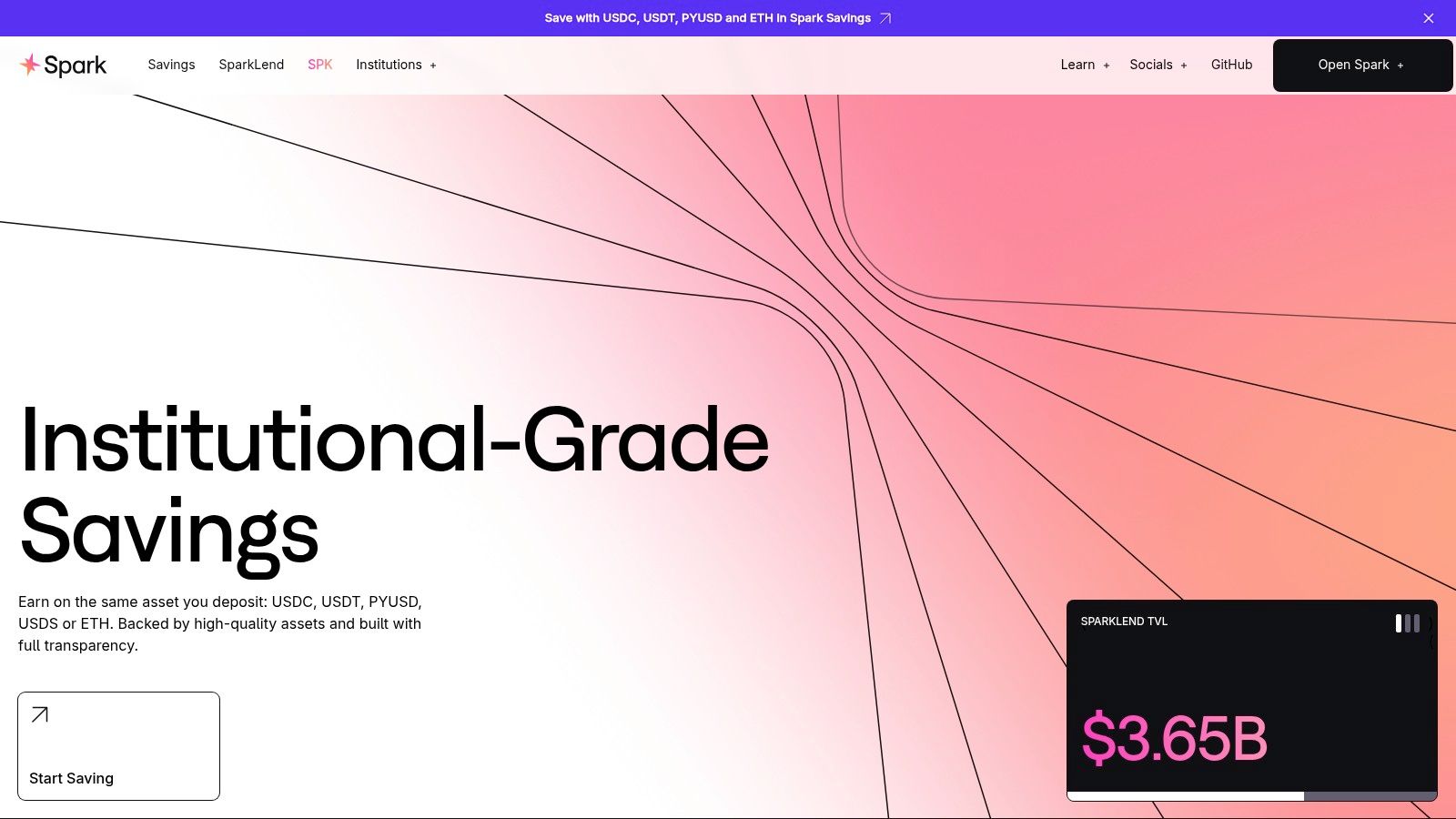
A common stablecoin problem is simple. You want yield that does not whipsaw every time borrower demand shifts across lending markets.
Spark Protocol is useful for that case because it sits inside the Sky ecosystem and gives you exposure to a different rate engine than Aave or Compound. Part of the yield profile comes from savings-style products connected to the Maker or Sky balance sheet and its real-world asset exposure, not just lending pool utilization. In practice, that can make Spark feel steadier, but the trade-off is that you are accepting more governance and system-level dependency.
Why Spark deserves a place here
Spark fits readers who want policy-shaped stablecoin yield and already understand the Sky stack. If Aave and Compound are manual money markets where rates react fast to usage, Spark is closer to a monetary system with a savings layer attached. That difference matters if you are choosing between active rate monitoring and a slower-moving framework.
I would not treat that as lower risk by default. I would treat it as different risk. With Spark, the key questions shift toward governance quality, reserve design, collateral management, and confidence in the stablecoin itself. If those assumptions weaken, the yield story changes with them.
That also makes Spark a useful comparison point against automation. Manual allocators using Aave, Compound, or Morpho can chase better market rates, but they usually ask for more monitoring. An automated system such as Yield Seeker can reduce that operational work by reallocating across markets for you. Spark appeals to a different user. Someone who prefers to stay inside one ecosystem and is comfortable underwriting that ecosystem's policy choices.
Who should consider it
Spark is a good fit for stablecoin holders who want savings-style exposure inside the Sky stack and do not need wide market coverage across many external protocols.
Use Spark if: You want yield tied more closely to Sky ecosystem policy than to short-term lending utilization.
Skip Spark if: You want to spread capital across multiple protocols and actively compare market rates.
Key question: Are you comfortable holding Sky-linked stablecoin exposure through governance changes and balance sheet shifts over time?
Top 7 DeFi Stablecoin Yield Comparison
Product | 🔄 Implementation complexity | ⚡ Resource requirements | ⭐📊 Expected outcomes | 💡 Ideal use cases | Key advantages |
|---|---|---|---|---|---|
Yield Seeker | Moderate, AI agents automate strategy setup and reallocation | Very low capital entry ($10 USDC); requires Base chain access and gas | 3–14% APY (variable); continuous AI optimization; proven agent volume/usage | Passive stablecoin yield for beginners, time‑constrained investors, and treasuries needing audit trails | AI-driven automation; non‑custodial + Coinbase TEE; beginner‑friendly UI; real‑time reallocations |
Aave v3 | Moderate, standard money‑market UX with advanced risk modes | Low capital; supports major stables across chains; deep liquidity needs on chosen chain | Variable yield tied to utilization; generally competitive for major stablecoins | Lenders/borrowers seeking deep liquidity and mature protocol tooling | High TVL/liquidity; isolation/e‑mode risk controls; multi‑chain and audited |
Compound v3 (Comet) | Low–moderate, single‑asset markets simplify operations | Low capital; gas‑efficient design; available on Ethereum + L2s | Variable yield; cleaner risk surface and efficient liquidations | Users preferring single‑asset exposure and lower gas costs | Simpler risk model; gas efficiency; mature audited codebase |
Morpho Blue (Vaults) | Moderate, permissionless primitive plus curated vault policy layer | Varies by market; requires selection due diligence; liquidity depth differs | Competitive rates in curated markets; targeted exposure but uneven liquidity | Advanced users seeking targeted market selection and curated yields | Isolated markets reduce contagion; curated vaults for layered risk management |
Yearn v3 (stable vaults) | Low for users, higher operational complexity under the hood | Moderate capital; fees apply; diversified interactions across protocols | Diversified hands‑off yield; net APY affected by management/performance fees | Passive investors wanting automated, diversified stablecoin strategies | Automated allocation/rebalancing; transparent vault accounting and fees; long track record |
Pendle Finance | High, tokenized future yield and interest derivatives are complex | Requires yield‑bearing wrappers (PT/YT); active market participation recommended | Enables fixed‑rate exposure or variable yield trading; pricing shifts toward expiry | Users seeking fixed‑rate positions or traders hedging/expressing rate views | Access to fixed yields; tradable interest exposure; composable rate products |
Spark Protocol (Maker/Sky) | Moderate, integrates money market, savings, and RWA pipelines | Depends on product; ties to Maker/Sky RWA and balance‑sheet mechanics | Savings/lending yields driven by Maker/Sky policy and RWA income | Users wanting exposure to Maker/Sky RWA yield or native on‑chain savings | Direct access to RWA‑sourced yield; product separation (savings vs lending); strong security posture |
Automate or Allocate? Choosing Your Path to Yield
You park USDC in a lending market on Sunday because the quoted yield looks strong. A few days later, utilization shifts, incentives change, a curator updates a vault, and the better-looking rate is somewhere else. By then, gas, slippage, and exit liquidity matter as much as the APY on the screen.
That is the actual choice.
It is less about picking a single protocol and more about deciding who will do the ongoing work. You, or an automated system.
Manual allocation works well for users who want full control and will monitor positions. Aave V3 is still the cleanest starting point for many people because liquidity is usually deeper and the mechanics are easy to follow. Compound V3 keeps the scope tighter and generally feels more conservative. Morpho can produce better results if you choose markets and curators well, but the extra flexibility creates more ways to make a bad allocation. Pendle is not a passive stablecoin parking spot. It is a rates product, and it only makes sense if you understand expiry, pricing, and how you plan to exit.
Time belongs in the risk model.
Managing stablecoin yield by hand means checking more than the headline rate. You need to watch liquidity, peg stability, incentive changes, governance or curator updates, and the actual cost of moving capital. For DeFi-native users, active treasury managers, and anyone already in the market every day, that can be a reasonable trade. For everyone else, manual yield often underperforms for a simple reason. The strategy depends on attention they do not plan to give.
That is where automation earns its place, and where Yield Seeker fits the article's main trade-off. It treats stablecoin yield as a portfolio allocation problem that changes over time, not a one-time deposit decision. The advantage is not magic and it is not "highest APY at all costs." The advantage is consistent reallocation, faster reaction to changing conditions, and less return leakage from delay, inactivity, or small risk signals that manual users tend to ignore.
I look at it this way. If you want to choose the venue, set the size, and review the position yourself, use Aave, Compound, Morpho, Spark, or Pendle directly. If your goal is stablecoin yield without turning weekly monitoring into a routine obligation, automation is often the better fit.
Both paths can work. The bad outcome is choosing a manual strategy with no time budget, then calling the result "passive" when it never was.