
Most DeFi platform comparisons still treat the highest APY as the winner. That advice is incomplete, and in many cases it points users toward the exact pools they should question most closely. A yield number without context can hide thin liquidity, temporary token incentives, recursive borrowing, or a smart-contract dependency that makes a modest return look attractive only until something breaks.
A useful DeFi platform comparison asks a harder question: what return remains after you account for protocol security, liquidity, fees, stablecoin quality, withdrawal conditions, and the time required to monitor the position? That shift matters in 2026, when conservative stablecoin strategies often sit close to conventional cash rates rather than offering effortless excess return. The opportunity is still real, but the work now lies in selecting and managing risk, not in sorting a table from highest to lowest APY.
Why Headline APYs Mislead in DeFi Platform Comparisons
The first mistake is treating APY as income rather than as a claim about a system. A displayed rate may combine base lending income, governance-token emissions, trading fees, and short-lived demand. Those components don't carry the same durability, liquidity, or risk.
Recent coverage places Aave USDC near 2% on a 30-day average, while 58% of stablecoin TVL on Ethereum and its L2s yields under 3% annualized, according to coverage of stablecoin yield conditions. Those figures don't prove that every low rate is safe, or that every higher rate is reckless. They do show why a small APY premium deserves investigation rather than automatic approval.
Separate base yield from incentive yield
A lending market can generate income from borrower demand. A liquidity pool can pay fees from trading activity. A protocol may also distribute its own token to attract deposits. The first two sources can persist when market conditions remain supportive, while the third depends on emissions, token demand, and governance decisions.
Recursive borrowing creates another distortion. A user can supply a stablecoin, borrow against it, resupply the borrowed asset, and display a higher gross rate. The position also carries liquidation, variable-rate, and smart-contract exposure. The headline figure describes activity layered on top of risk, not a free improvement in return.
Practical rule: Treat every yield premium as compensation for a specific risk until you can identify the source of the return.
Liquidity changes the calculation as well. A pool may advertise an appealing rate, yet a large withdrawal can face slippage or depend on available counterparties. Fees can also consume a meaningful portion of a small position, especially when funds move across chains or through several contracts.
Compare outcomes across market conditions
DeFi has already passed through sharply different market cycles. One independent market summary records TVL at roughly $15 million in 2016, below $1 billion through 2020, about $80 billion by November 2021, and around $180 billion in June 2026, implying an approximate 12x increase from 2016 levels. The same DeFi TVL market summary notes that the 2021 peak was followed by a major contraction after the 2022 shocks.
That history changes how a platform should be judged. A rate that looks stable during one expansion may depend on incentives or borrowing that disappear during stress. The better comparison records where yield came from, how withdrawals behaved, and whether TVL and revenue remained credible across cycles.
For a practical framework on separating headline rates from the return you keep, see this guide to yield versus rate.
Core Criteria for Evaluating DeFi Yield Platforms
A reliable comparison starts with a repeatable checklist. No single metric captures protocol quality, and TVL alone can mislead. An academic study of DeFi protocol valuations found strong associations between value and operational indicators including TVL, protocol revenue, total revenue, gross merchandise volume, and inflation factor, which is why the academic valuation research supports using several operating measures rather than one balance-sheet snapshot.
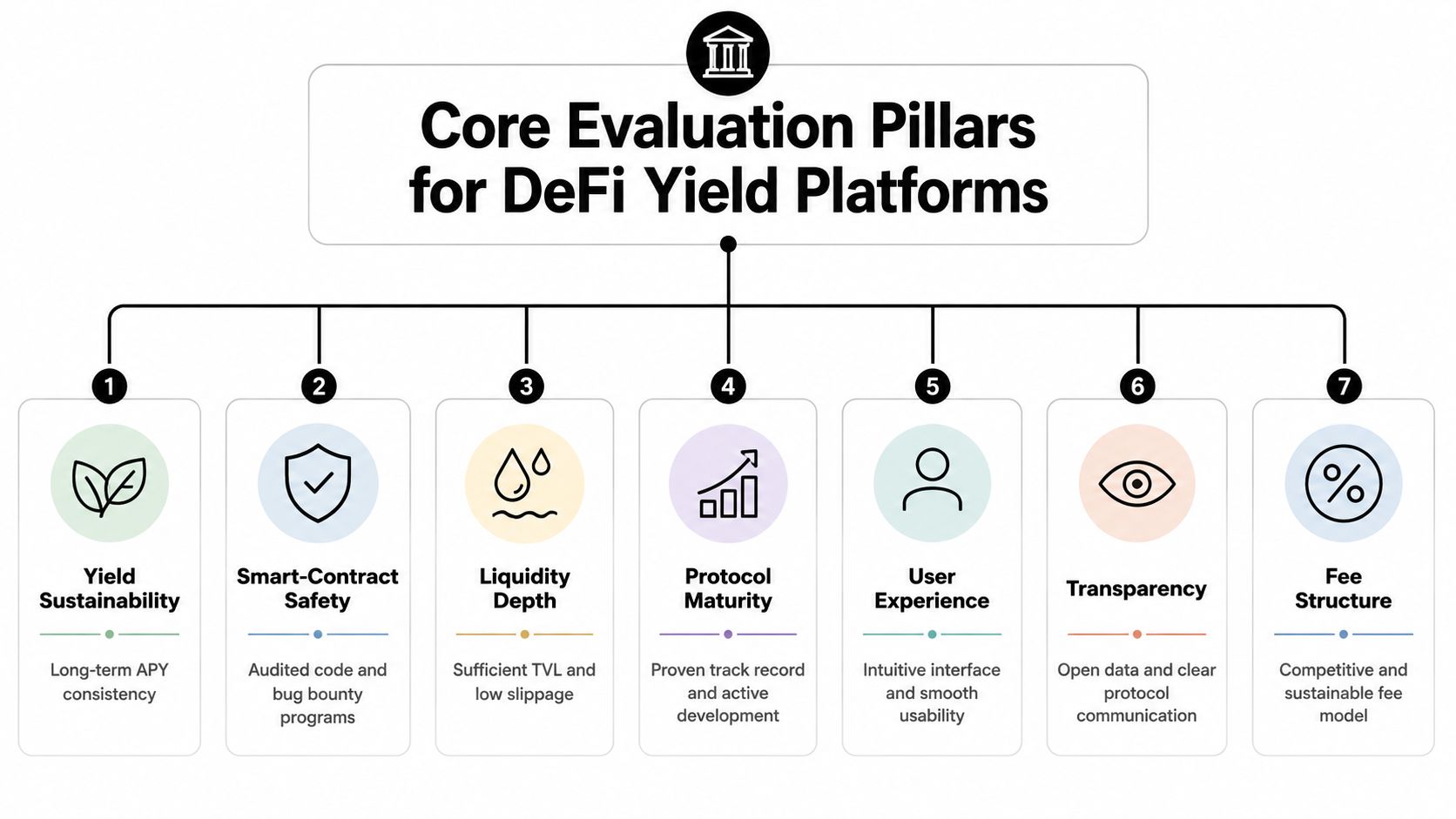
Yield sustainability
Ask whether the return comes from borrower interest, trading fees, staking income, or token emissions. Then check whether the protocol reports these components separately. A sustainable rate should have an understandable economic source, not merely an attractive dashboard label.
Smart-contract safety
Review audit history, published fixes, bug-bounty activity, upgrade permissions, oracle design, and emergency controls. An audit can identify defects, but it doesn't remove the possibility of new code, governance misuse, dependency failure, or user-interface compromise.
Liquidity depth
Check the available liquidity for the exact asset and market you plan to use. Look at withdrawal paths, pool composition, utilization, slippage, and whether liquidity depends on a small number of providers. Deep liquidity gives you more flexibility when conditions deteriorate.
Protocol maturity
Track TVL, revenue, and user activity across both strong and weak market conditions. A large balance can reflect temporary incentives, while consistent usage offers a better signal of product-market fit. Category matters too. A lending protocol and a stablecoin DEX solve different problems, so compare each with relevant peers.
User experience
A strategy that requires constant manual transactions can create operational risk. Test deposits, withdrawals, transaction previews, wallet permissions, network selection, and position reporting before committing meaningful capital.
Transparency and governance
Read the documentation and inspect on-chain activity where possible. Identify who can upgrade contracts, pause markets, change parameters, or redirect fees. Governance isn't automatically decentralized because a protocol uses a DAO interface.
Fee structure and chain support
Calculate deposit, withdrawal, swap, bridge, management, and performance fees together. Confirm that your preferred chain has dependable liquidity and that the strategy doesn't rely on an inconvenient bridge or an unsupported stablecoin route.
A useful scorecard should record these observations in writing. If you can't explain the yield source, withdrawal process, contract authority, and main failure modes in plain language, the position isn't ready for capital.
Comparing Major DeFi Platform Categories for Stablecoins
Stablecoin yield doesn't come from one uniform product category. Lending markets monetize borrowing demand, DEXs monetize swaps, liquid staking platforms issue representations of staked assets, and aggregators route capital among strategies. The category determines both the return engine and the risks you inherit.
Independent 2026 comparison tables list Lido at about $28.5 billion TVL, Aave at about $19.2 billion, Uniswap at about $8.7 billion, and Curve at about $4.2 billion, as shown in the 2026 platform comparison. These figures are useful context, not a ranking. Lido's liquid-staking model isn't a direct substitute for Aave's lending markets, and Curve's stablecoin specialization makes it a more targeted benchmark for stablecoin swaps than either platform.
Platform Category | Example Protocol | TVL (2026) | Typical Stablecoin Yield | Primary Risk |
|---|---|---|---|---|
Lending | Aave | About $19.2B | Plain lending yields often cluster near 2–6% | Smart-contract, oracle, utilization, and liquidation risk |
Stablecoin-focused DEX | Curve | About $4.2B | Conservative strategies often yield 4–7% APY | Pool imbalance, smart-contract, liquidity, and incentive risk |
Broad DEX | Uniswap | About $8.7B | Depends on trading fees and pool activity | Impermanent loss, volatility, and fee variability |
Liquid staking | Lido | About $28.5B | Not a direct stablecoin-income category | Staking, derivative, validator, and depeg risk |
Yield aggregator | Strategy-dependent | Varies by route | Depends on underlying protocols | Layered contract, strategy, and automation risk |
Lending markets
Aave is the clearest reference point for users who want relatively straightforward stablecoin lending. The return comes primarily from borrower demand, so utilization can push rates higher or lower. The trade-off is that you must understand reserve parameters, supplied-asset liquidity, oracle dependencies, and the consequences of a stressed market.
Stablecoin DEXs
Curve is more specialized for stablecoin swaps. That focus can improve capital efficiency for correlated assets, but pool design still matters. You need to examine whether the pool contains assets that can depeg, how liquidity is distributed, and whether incentives are doing more work than trading fees.
Liquid staking derivatives
Lido is a major liquid-staking example, but it shouldn't be placed beside a stablecoin lending market as though both produce the same type of income. Liquid staking exposes users to staking and derivative risks, and a liquid staking token can trade away from its expected value. It can support broader DeFi strategies, but it isn't a simple stablecoin cash substitute.
Aggregators and automation layers
Aggregators can simplify route selection, yet they add another layer of contracts and strategy logic. The benefit is convenience and allocation efficiency. The cost is that you must assess both the aggregator and every meaningful protocol dependency underneath it.
For stablecoin capital, specialization often beats breadth. Choose the category that matches the job, then compare protocols inside that category using net return, liquidity, security controls, and withdrawal flexibility.
The Rise of AI-Powered Yield Automation
Manual yield farming assumes you can monitor rates, incentives, liquidity, contract changes, and chain conditions throughout the day. Most investors can't, and pretending otherwise produces a fragile strategy. The practical role of AI isn't to remove risk. It's to reduce the delay between a changing opportunity and a deliberate allocation decision.
An AI-powered yield layer can scan opportunities across protocols and chains, compare APY with incentives and liquidity, apply a user's risk preferences, and surface changes through a single interface. That workflow addresses the fragmentation that makes DeFi difficult. It also separates the investment decision from the repetitive work of checking multiple dashboards.
Automation should preserve control
The strongest design doesn't hide the underlying protocols. It shows where funds sit, what strategy is active, what assumptions support the expected return, and how a user can withdraw. No-lockup access and transparent earnings views matter because automation becomes dangerous when convenience prevents inspection.
Yield Seeker is one example of this category. Its product information describes an AI agent that monitors and allocates stablecoin capital across DeFi protocols, with a Base-chain entry point, accessible deposits, no lockups, and no withdrawal fees. Those product details don't make the underlying DeFi risk disappear, but they illustrate how an automation layer can handle research and reallocation while leaving users with visibility and control.

AI isn't a substitute for due diligence
An agent can detect a rate change faster than a person, but it still operates within configured rules and data sources. It may not anticipate a novel exploit, understand a governance proposal perfectly, or protect a user from a compromised wallet. Users should ask what the agent can change, which contracts require approval, how allocations are constrained, and whether the dashboard reports gross or net yield.
The right mental model is a three-layer stack:
Base protocols provide lending, trading, or staking.
Automation systems monitor conditions and execute allocation rules.
The user sets boundaries, reviews risk, and controls custody decisions.
A good automation layer makes disciplined behavior easier. It doesn't turn volatile or experimental protocols into conventional savings products. For a deeper look at the operating model, read this explanation of an AI yield aggregator.
Persona-Based Recommendations for Different Investor Types
The right platform depends less on a universal ranking than on how much complexity, monitoring, and drawdown risk a user can handle. A beginner who needs a guided workflow should not copy the strategy of a treasury operator. A professional with limited time may value transparent automation more than a small additional rate.
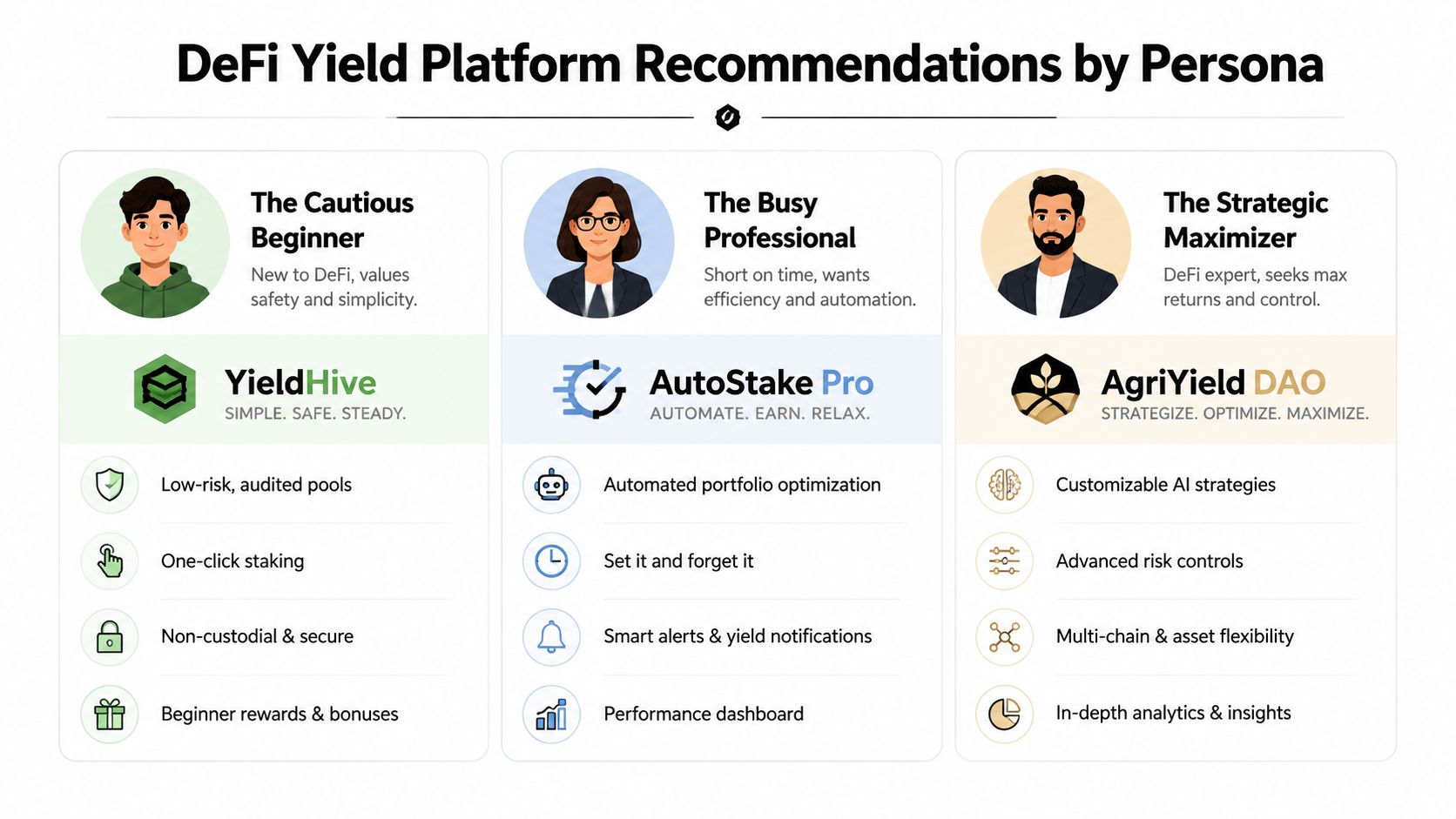
The cautious beginner
Start with a plain lending market or a guided automation layer that makes deposits, position review, and withdrawal mechanics clear. Avoid complex loops, unfamiliar stablecoins, and pools whose rate depends mainly on emissions.
Use a small test deposit first. Confirm that you can connect the wallet, approve the asset, see the position, and complete a withdrawal before scaling. The beginner's main objective isn't maximizing yield. It's building a reliable operating routine without making an irreversible mistake.
The busy professional
A professional with limited monitoring time should prioritize automation, liquidity, transparent risk controls, and accessible withdrawals. A stablecoin strategy that requires constant manual movement may create more work than its incremental return justifies.
Choose a platform that reports allocation decisions and lets you see the underlying venues. Set alerts for rate changes, contract updates, and unusual position behavior. If the system can't explain why it moved capital, treat that opacity as a material risk.
The strategic maximizer
Experienced users can compare lending, stablecoin liquidity pools, and carefully bounded multi-protocol strategies. The extra return should be evaluated against contract depth, incentive durability, stablecoin correlation, gas costs, and the possibility of rapid reallocation under stress.
Treasury teams should add approval policies, role separation, transaction limits, reporting, and documented emergency procedures. A high-yield strategy that depends on one signer or one bridge creates concentration risk regardless of its displayed APY.
The simplest matching rule is practical: beginners need clarity, professionals need reliable automation, and advanced operators need control over assumptions and execution. Capital size changes the consequence of slippage and operational mistakes, but it doesn't change the need to verify the underlying protocol.
Real-World Scenarios for Deploying Stablecoin Capital
A comparison becomes useful only when it changes how capital gets deployed. The following scenarios use qualitative allocations rather than promised returns because the correct position depends on market conditions, protocol parameters, and the user's need for liquidity.
A beginner building a repeatable habit
A new stablecoin holder might select a well-known lending market, make a small test deposit, and leave the position unlevered. The user checks the supplied asset, confirms the current rate source, performs a withdrawal test, and records the transaction path.
The main risk control is simplicity. One asset, one protocol, one wallet, and a clear exit route make it easier to identify what went wrong if the position behaves unexpectedly. The user can add a second venue later, but shouldn't begin with a strategy that combines bridges, swaps, and incentive tokens.
A professional prioritizing availability
A busy investor may prefer an automated allocation system that can compare several stablecoin opportunities and move capital when the configured conditions change. The investor reviews the approved protocols, checks whether withdrawals remain available, and uses alerts rather than manually refreshing rate pages.
This setup can reduce the monitoring burden, but it introduces dependence on the automation layer. The investor should understand permissions, allocation limits, fallback behavior, and the distinction between an agent's recommendation and an executed transaction.
A Web3 treasury managing operating funds
A treasury should separate near-term operating liquidity from capital that can tolerate protocol or withdrawal risk. The liquid portion belongs in the most understandable and accessible venue available to the team. A smaller strategic portion can explore diversified lending or liquidity strategies after signers approve the contracts and reporting process.
Treasury managers should document who can deploy, who can revoke permissions, and what conditions trigger an exit. They should also reconcile on-chain balances with internal records and avoid treating an attractive dashboard rate as a budget assumption.
Across all three scenarios, the discipline is the same. Define the purpose of the capital, select the narrowest strategy that meets that purpose, test the exit route, and scale only after the operating process works.
Managing Risk and Taking Action in DeFi Yield Strategies
DeFi remains a high-loss environment even when aggregate losses improve. Immunefi's 2024 report records approximately $769,287,055 in DeFi losses across 221 incidents, while another year-in-review methodology estimates roughly $1.5 billion across more than 200 documented incidents. A separate security summary reports that losses fell 40% year over year to $474 million in 2024 from $787 million in 2023. The methodologies differ, as shown in Immunefi's 2024 crypto-loss report, but the practical conclusion is consistent: security risk remains material.
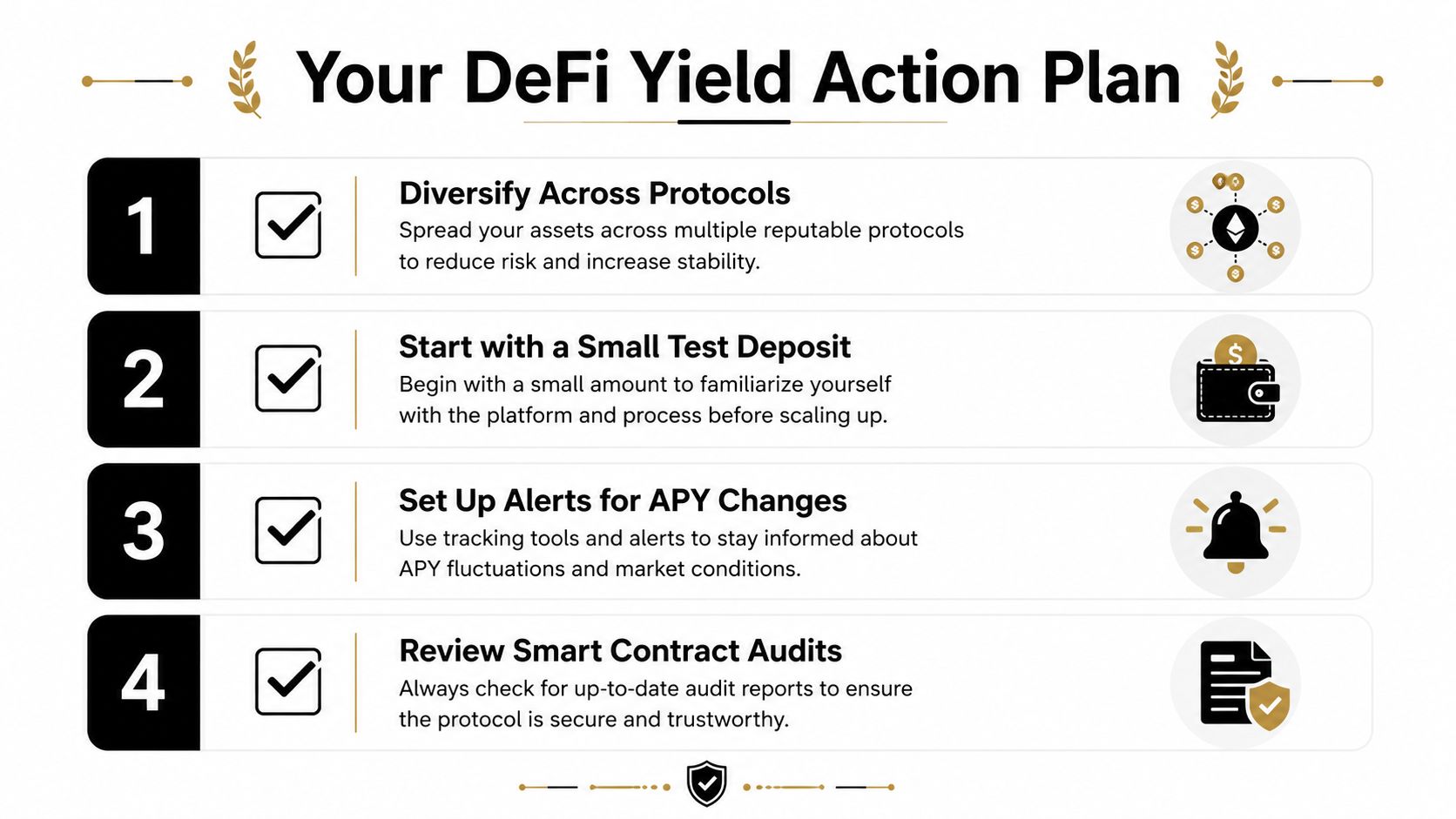
Use a staged process before committing meaningful funds:
Diversify Across Protocols: Avoid concentrating all stablecoin capital in one contract, oracle system, governance process, or chain.
Start with a Small Test Deposit: Verify approvals, deposits, withdrawals, fees, and transaction visibility before increasing exposure.
Set Up Alerts for APY Changes: A falling rate may be normal, but a sudden change can signal utilization stress, incentive expiry, or altered market conditions.
Review Smart Contract Audits: Check the audit scope, upgrade history, bug-bounty evidence, and administrator permissions rather than relying on an audit badge.
The comparison with traditional cash alternatives should be explicit. Conservative DeFi yields can sit near conventional rates, and a higher gross return may not compensate for smart-contract exposure, stablecoin risk, gas costs, and the user's time. DeFi makes more sense when you value on-chain access, composability, flexible movement, or automated allocation, not because a dashboard displays a larger number.
Before deploying, write down the asset, protocol, yield source, contract dependencies, withdrawal route, fee burden, and exit trigger. Then review the position on a schedule that matches its complexity. This DeFi risk-management guide can help turn that checklist into an operating routine.
Yield Seeker helps stablecoin holders compare and automate yield allocation across DeFi opportunities, while keeping balances visible and accessible without lockups. Visit Yield Seeker to review the AI-assisted workflow, start with a controlled deposit, and decide whether automated, risk-aware monitoring fits your strategy.