
Welcome to the world of decentralized finance, where the real pros know that lasting profits come from smart strategy, not just chasing the highest APY. This guide is all about navigating the exciting, and sometimes treacherous, world of stablecoin yield while keeping your capital safe. Forget the reckless 'degen' plays; we're here to master 'risk-aware' yield generation.
Why DeFi Risk Management Is Your Most Important Strategy
DeFi is packed with incredible opportunities, but it often feels like a high-wire act with no safety net below. Behind every juicy yield is an equal, and often hidden, amount of risk. This is where DeFi risk management becomes your most valuable skill—it’s the art of spotting, sizing up, and sidestepping potential losses in this wild, permissionless space.
It’s less about avoiding risk altogether and more about getting smart about pricing it. A 20% APY looks great on paper, but what if the protocol has a 10% chance of getting hacked? Suddenly, your real expected return isn't nearly as attractive. A solid risk framework helps you see past the advertised yield to the whole picture. If you want to get into the nitty-gritty of this, we have a whole guide on how to calculate risk-adjusted APY.
Building a Foundation for Sustainable Growth
Getting serious about risk isn't about being scared; it's about building a portfolio that can weather the storms. It gives you the confidence to jump into DeFi because you have a plan to protect your hard-earned cash. This really comes down to a shift in mindset:
From Passive Investor to Active Participant: You stop blindly depositing funds and start asking the tough questions about a protocol’s security, its team, and its economic design.
From Chasing Yield to Managing Risk: Your number one job becomes protecting your principal. The yield is just the reward for making smart, safe decisions.
From Guesswork to a Systematic Process: You swap emotional, gut-feel decisions for a clear, repeatable process for checking out new opportunities.
To really get a handle on this, it helps to zoom out and look at the bigger picture of managing risk in emerging technologies. At the end of the day, DeFi is a frontier technology, and its risks are just part of what makes it so innovative.
Ultimately, mastering DeFi risk management is what separates the gamblers from the strategists. It's the key difference between a few lucky short-term wins and building real, long-term wealth in this ecosystem.
The Core Risks in DeFi You Must Understand
Before you even think about chasing those juicy DeFi yields, we need to have a serious talk about risk. For all its promise, the world of decentralized finance is packed with unique and interconnected dangers that can turn a great opportunity into a total loss in a flash. Getting a handle on these core risks is the single most important step you can take to protect your capital.
I like to think of it like this: you're the captain of your own ship, and your capital is your cargo. You wouldn't set sail without a map of the reefs, a weather forecast for storms, or intel on where pirates might be lurking. In DeFi, the dangers are just as real.
Smart Contract and Oracle Risks
At the very heart of every DeFi protocol is a smart contract. It’s just a piece of code that automatically runs a service, like a digital vending machine. You put your tokens in, and it gives you something back—a loan, a yield-bearing token, whatever it’s programmed to do. But what happens when that code has a bug?
That’s smart contract risk in a nutshell: the danger that a flaw or exploit in the code could be used to drain all the funds. And trust me, this isn't just a theoretical problem. The battle against exploits is constant and brutal. Security breaches led to a staggering $3.1 billion in losses in 2025 alone, a 40% jump from the previous year. To date, DeFi users have lost over $12 billion to theft and fraud. Even with bug bounty programs and audits, the risk is always there.
Right alongside this is oracle risk. Oracles are the messengers that feed real-world data, like the price of ETH, to smart contracts. If a hacker manages to manipulate an oracle and feed it a fake price, they can trick a protocol into letting them buy valuable assets for pennies or take out massive loans with hardly any collateral.
Key Takeaway: A protocol is only as good as its code and the data it trusts. One tiny coding error or a single bad price feed can wipe out everyone's funds.
Liquidity and Protocol Governance Risks
Liquidity is the absolute lifeblood of DeFi. Without it, nothing works. Liquidity risk is what happens when you can't sell an asset quickly without tanking its price. This is super common in what we call "shallow" liquidity pools, where just a few big sellers can dump their tokens and crash the value, leaving everyone else holding a nearly worthless bag.
Imagine you’re in a small town trying to sell a rare antique, but there's only one collector who's interested. If that collector suddenly decides they're not buying, you're stuck. You can’t sell your antique for what it's worth. That's exactly what it feels like in a shallow pool. To get a better feel for this, you can check out our guide on liquidity pool risks.
Then you have protocol governance risk. A lot of DeFi protocols are run by people who hold a special "governance token," allowing them to vote on changes. It sounds democratic, right? But it becomes a huge risk if one person (a "whale") or a small group scoops up enough tokens to control the vote. They could change the rules to print a ton of new tokens for themselves, completely devaluing what you're holding.
This flowchart shows how a solid DeFi strategy has to balance making money with being aware of risks and protecting your capital.
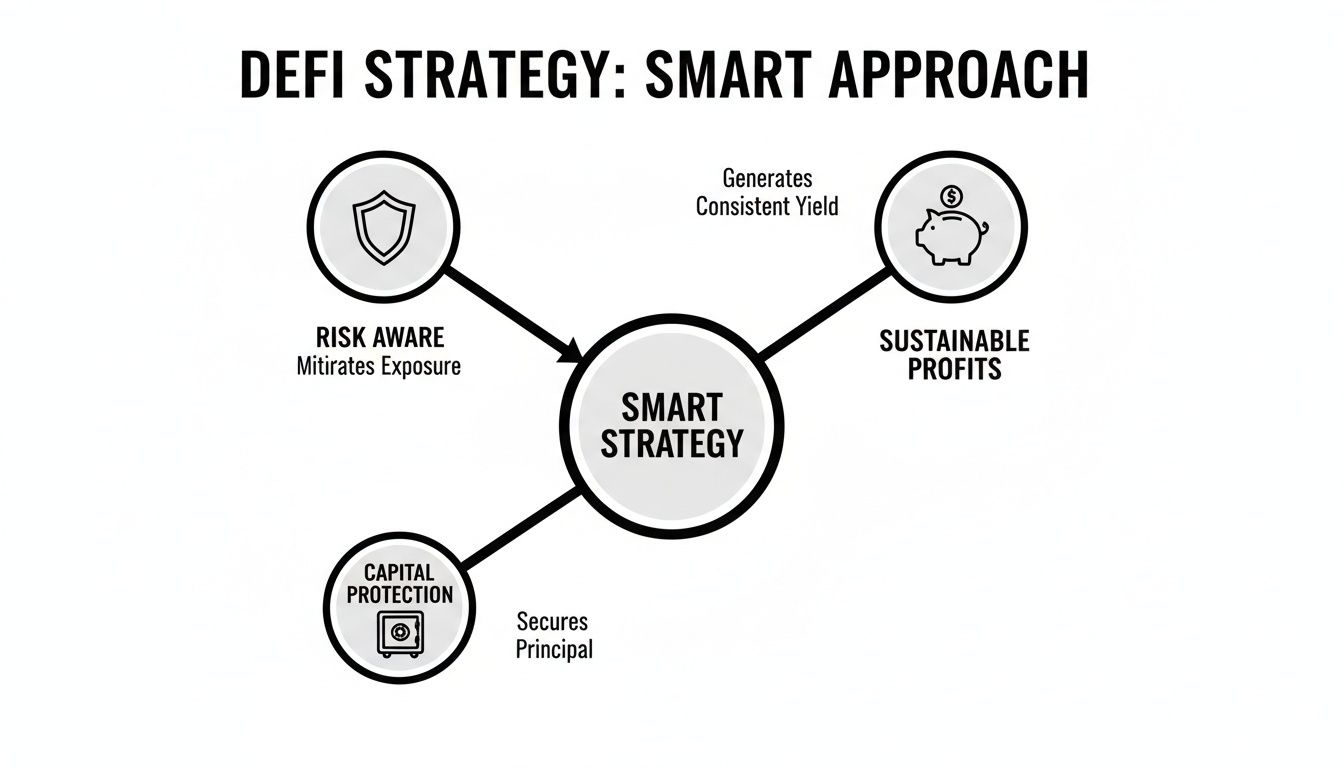
As you can see, if you ignore the risk-aware part of the equation, both your capital and your profits are on shaky ground.
Human and External Risks
Even in a world run by code, people and outside events still pose some of the biggest threats.
Counterparty Risk: DeFi is supposed to get rid of the middleman, but you're still exposed. When you lend assets on a platform, the protocol itself is your counterparty. If it gets hacked or fails, your money is gone. In some cases, especially with newer or more centralized platforms, you're really just trusting the people who run it.
Operational Risk: This one's all on you. It's the risk of losing your funds because of a personal mistake—clicking a phishing link, losing your private keys, or having your wallet hacked. It doesn't matter how secure a protocol is if your own setup isn't safe.
Regulatory Risk: Governments around the globe are still trying to figure out what to do with DeFi. A sudden ban, a new tax rule, or a heavy-handed compliance demand could make a protocol illegal or unprofitable overnight, sending its token value into a nosedive.
Stablecoin-Specific Risks: Remember, not all stablecoins are built the same. Algorithmic stablecoins can lose their dollar peg during a market panic—an event known as de-pegging—and become almost worthless. Even stablecoins backed by real-world assets have risks tied to the quality and transparency of their reserves.
Your Practical Framework for Assessing DeFi Risk
Knowing the types of risk is one thing, but actually putting that knowledge to work is what separates successful DeFi users from the rekt. You need a consistent way to size up any new protocol or yield farm that catches your eye.
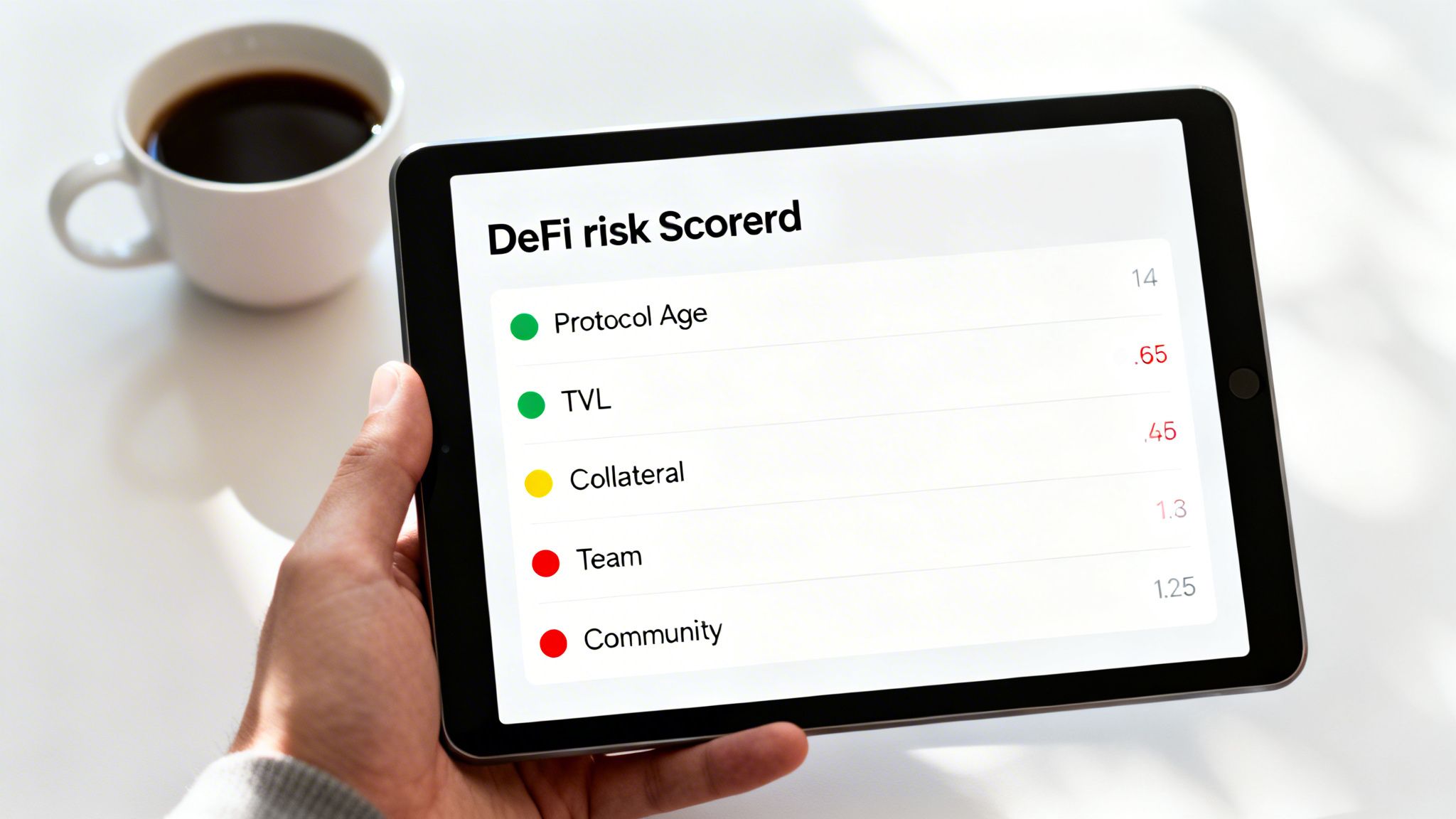
Think of it as your personal "risk scorecard" for every opportunity. Before you even think about connecting your wallet, you run through a checklist. It's about turning those fuzzy, abstract risks into something you can actually measure and make a solid decision on.
This approach boils down to five core pillars. By focusing on these, you can cut through the hype and get a real sense of what you're getting into.
Pillar 1: Protocol Age and Audits
In DeFi, age isn't just a number—it’s a badge of honor. A protocol that’s been running for a few years, has weathered a bear market or two, and processed billions in volume without a major hack is what we call battle-tested. It’s survived real-world chaos, and that’s a level of assurance a brand-new project just can't offer.
This doesn't automatically mean new protocols are a no-go, but they come with a big dose of "unknown unknowns." This is where security audits become non-negotiable. An audit is like hiring a professional inspector to check a house's foundation before you buy it; they're looking for bugs and potential exploits in the smart contracts.
So, what should you ask? How many top-tier, independent firms have audited the code? And did the team actually fix the critical issues they found?
A single audit is the absolute minimum. Seeing multiple reports from well-known security firms like Trail of Bits, OpenZeppelin, or CertiK shows the team is serious about security.
Expert Tip: Don't just tick the "audited" box. Go find and skim the actual reports. See what kinds of issues were flagged and, more importantly, how the team responded. A transparent, detailed response to fixing bugs is a massive green flag.
If you want to go deeper on this, we've put together a full guide on protocol safety analysis.
Pillar 2: Total Value Locked (TVL)
Total Value Locked (TVL) is the total amount of money users have deposited into a protocol. While some people dismiss it as a vanity metric, I see it as a strong form of social proof. A high and growing TVL tells you that a lot of other people have kicked the tires and decided it's a safe enough place for their capital.
But you have to look at TVL with the right context. A $500 million TVL on a newer chain like Base is a huge deal, but on Ethereum, it might not even crack the top 20. Also, be careful with TVLs that are pumped up by the protocol's own, often volatile, native token.
Pillar 3: Collateralization Health
For any lending protocol, this is absolutely critical. You need to know how the loans are backed up. Collateralization health looks at the quality and amount of the assets that secure all the debt in the system. The best protocols force users to overcollateralize—meaning you have to deposit more value than you borrow.
In the wild west of DeFi lending, these ratios tell a story. Back in 2024, it was common to see collateralization ratios around 163%. By 2025, better risk models let that number dip to about 151%. Some protocols get aggressive with minimums as low as 110%, but be warned: those tight margins put borrowers at a 70% or higher risk of liquidation when the market gets choppy. You can dig into more of these DeFi lending statistics on sqmagazine.co.uk.
Pillar 4: Team Transparency
Anonymity is a big part of the crypto culture, but when your money is on the line, a transparent and accountable team is a huge plus. Are the founders public? Do they have a solid history of building things that don't break or get hacked?
A public team is putting their personal and professional reputation on the line. That gives them a powerful reason to do the right thing. Anonymous teams can—and often do—simply vanish after an exploit, leaving users with no one to hold accountable.
Pillar 5: Community and Communication
Finally, take the temperature of the project’s community. A lively, smart, and engaged user base is one of the best signs of a healthy protocol.
Active Governance: Are people actually discussing and voting on proposals in the DAO, or is it a ghost town?
Developer Engagement: Is the team constantly communicating updates, answering tough questions, and hanging out with users on Discord and Twitter?
A strong community is like a neighborhood watch for your funds. They're often the first to spot trouble and are great at holding the developers' feet to the fire. If you jump in the Discord and it's crickets, that’s a big red flag.
Quick DeFi Risk Assessment Checklist
Before you deposit, run through this quick mental checklist. It's a simplified version of the pillars above to help you make a faster, smarter first-pass judgment on a protocol's risk level.
Risk Factor | What to Look For (Low Risk) | Warning Signs (High Risk) |
|---|---|---|
Audits & Age | Multiple audits from reputable firms; been live for 1+ years. | No audits or a single, low-quality one; brand new project. |
TVL | High and stable/growing TVL from major assets (ETH, USDC). | Low TVL, or a high TVL mostly from its own native token. |
Team | Public, experienced team with a proven track record. | Anonymous or pseudo-anonymous team with no history. |
Collateral | High overcollateralization requirements (e.g., >150%). | Low collateral ratios (e.g., <120%) or risky collateral assets. |
Community | Active Discord/Telegram, regular developer updates, active governance. | Inactive community, no recent communication from the team. |
This checklist isn't foolproof, but it's an excellent starting point. It forces you to pause and think critically instead of just chasing the highest APY, which is a habit that will serve you well in DeFi.
Alright, we’ve mapped out the minefield. Now, how do we actually walk through it without getting blown up? Just knowing the risks isn't enough; you need a game plan to actively defend your capital.
Think of it less like a rigid checklist and more like setting up layers of security for a vault. Each strategy is another lock, another tripwire, making it that much harder for a single mistake or exploit to drain your funds. Let's get into the practical, actionable steps you can take to build a more resilient portfolio.
Diversify Everything
You’ve heard the old saying, "don't put all your eggs in one basket," a million times. In DeFi, that advice is amplified by a factor of ten. But real diversification here is much more than just buying a few different tokens. It’s about thinking in layers.
Protocol Diversification: Instead of dumping all your USDC into one lending protocol, why not split it between two or three you've thoroughly checked out? If one gets hit, your entire stack isn't on the line.
Chain Diversification: Every blockchain has its own quirks—its security model, its oracle setup, how it handles congestion. Spreading your funds across established chains like Ethereum, Arbitrum, and Base helps insulate you from a chain-specific meltdown.
Asset Diversification: Even stablecoins aren't all the same. Mixing it up between fiat-backed coins like USDC, over-collateralized ones like DAI, and other models means a single de-peg event won’t be a catastrophe for you.
Doing this immediately shrinks your "blast radius." It ensures that one bad day in one corner of DeFi doesn't wipe out your entire portfolio.
Prioritize and Understand Security Audits
Putting money into a protocol that hasn’t been audited is like skydiving with a parachute you packed yourself with zero training. It’s just not worth the risk. Audits are a non-negotiable first pass in your due diligence, and good projects will show them off.
But don't just see the "audited" stamp and call it a day. You have to dig a little deeper.
Look for Multiple Audits: Serious projects don’t just get one audit for marketing. They get audited by different firms, over and over again, showing a real commitment to security.
Check the Findings: You don't have to be a developer. Just skim the report for anything labeled "Critical" or "High-Severity." These are the bugs that can lead to a complete loss of funds.
Verify the Fixes: This is the most important part. Did the team actually fix the problems the auditors found? A team that brushes off critical warnings is a massive red flag.
A protocol that's upfront about its audit results—even the scary parts—and clearly explains how they fixed the issues is far more trustworthy than one pretending to be perfect. That kind of transparency tells you a lot about the maturity and integrity of the team behind it.
Use DeFi Insurance as a Strategic Backstop
For your bigger, more important positions, you should seriously consider buying smart contract cover. Think of it as decentralized insurance that pays out if a specific protocol you're using gets hacked and you lose your money. Platforms like Nexus Mutual let you pay a premium for coverage on specific protocols.
It's just like your home insurance. You don't expect your house to burn down, but you pay for the policy anyway. DeFi cover works the same way. It's a calculated cost that provides a vital safety net against those catastrophic, black-swan events that can and do happen.
Set Your Own Rules with Automated Tools
Let's be honest, one of the biggest risks in any market is you. Fear makes you sell the bottom, and greed makes you ride a position all the way back down to zero. This is where you need to set clear rules ahead of time and use tools to make sure you stick to them.
On-Chain Monitoring: Set up alerts for things like massive, unusual withdrawals from a protocol or strange governance votes. This can be the early warning you need to pull your funds out before everyone else is rushing for the exit.
Personal Stop-Losses: Before you even enter a position, decide on the maximum loss you’re willing to stomach. If your investment hits that point, you're out. No second-guessing, no emotion.
Profit-Taking Targets: It's just as important to know when to cash in your chips. Set a target APY or price for taking profits and actually do it. This is how you turn paper gains into real, spendable money in your wallet.
DeFi Risk Management in Action
Theory is one thing, but seeing DeFi risk management actually work in the wild is where it all clicks. The best way to understand this is to walk through a couple of real-world scenarios.
Think of these as mental models you can borrow. Whether you're trying to grow your own savings or manage a project's entire treasury, the thought process is what matters.
Case Study 1: The Cautious Yield Seeker
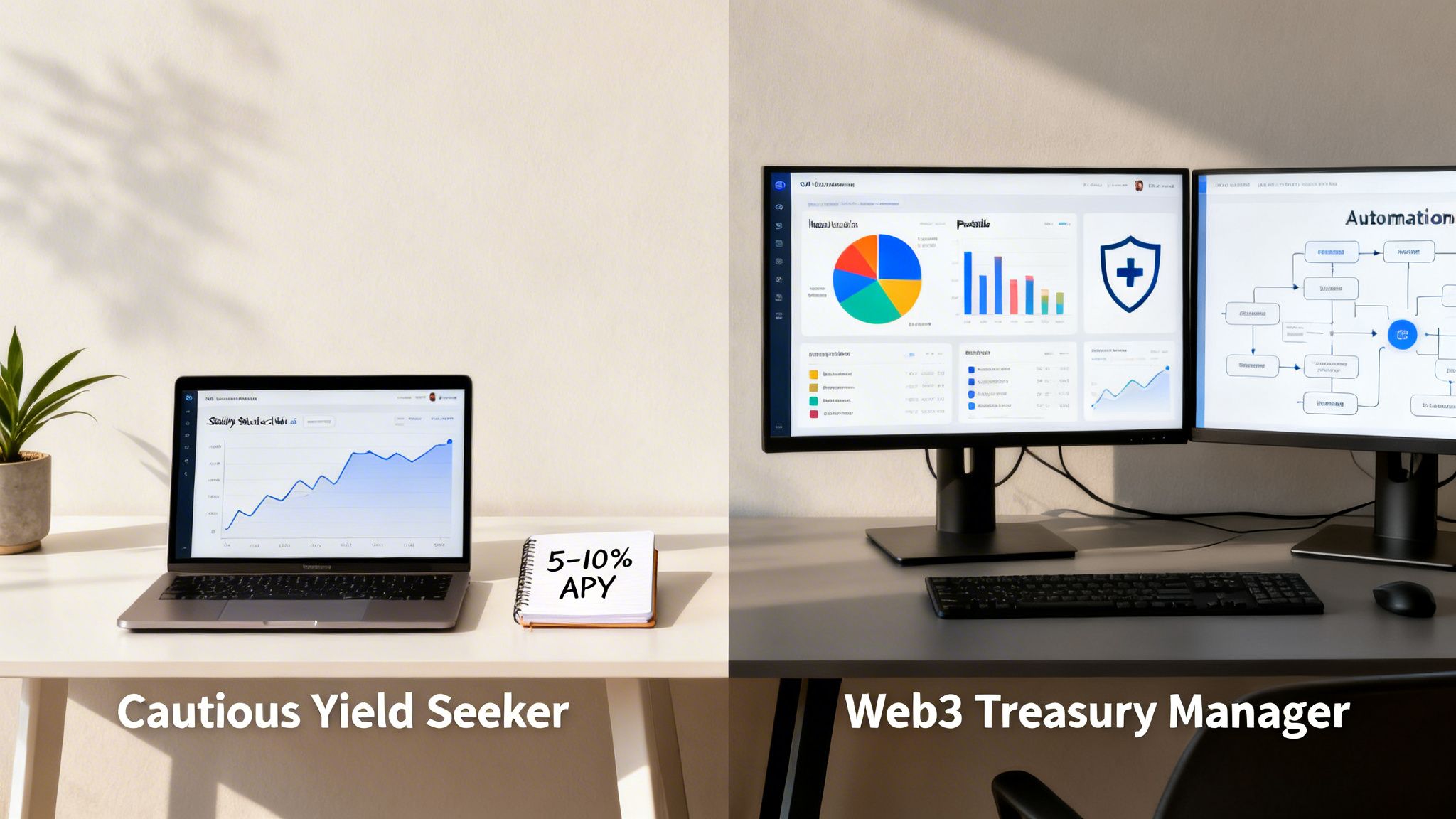
Let's imagine someone we'll call Alex. Alex is a professional who wants to put their stablecoins to work, aiming for a steady 5-10% APY. They aren't trying to hit a home run; capital preservation is their number one rule.
Alex has two lending protocols on their radar.
Protocol A: A newer platform on a trendy L2, flashing a tempting 12% APY on USDC.
Protocol B: A well-known, battle-tested protocol on Ethereum Mainnet, offering a more grounded 6% APY.
Using our risk scorecard, Alex starts digging. Protocol A is only six months old and has just one audit from a firm nobody’s really heard of. Its TVL is shooting up, sure, but it's mostly propped up by its own token rewards. Plus, the team is completely anonymous.
Protocol B, on the other hand, has been around for over three years. It’s weathered several nasty market downturns and has audits from three top-tier security firms. Its TVL is in the billions, mostly from blue-chip assets like ETH and USDC, and the founders are public and well-respected.
The Decision: For Alex, this is a no-brainer. That extra 6% from Protocol A just isn't worth the massive jump in smart contract risk, operational risk, and the mystery-meat team. Alex parks their funds in Protocol B, feeling good about a durable and reliable 6% return. This is a classic case of pricing risk, not just chasing yield.
Case Study 2: The Web3 Treasury Manager
Now, let's look at Sarah. She’s managing the treasury for a growing Web3 startup, and her main job is to protect their runway—$2 million in USDC that keeps the lights on and developers paid. A huge loss is simply not an option, making her risk tolerance incredibly low.
Sarah's strategy is way more buttoned-up than Alex's. She can't just 'pick a winner,' no matter how safe it seems. Her approach is all about diversification and building multiple layers of defense.
Sarah's Treasury Management Strategy:
Diversification: She splits the $2 million treasury across four different, heavily vetted protocols on two separate chains (Ethereum and Arbitrum). No single protocol ever holds more than 25% of the total funds.
Asset Mix: The treasury isn't just in one stablecoin. It's a blend of 70% USDC and 30% DAI to protect against the risk of a single stablecoin de-pegging.
Insurance: For the two biggest positions, Sarah buys smart contract insurance from a platform like Nexus Mutual. It's a calculated business expense—a premium paid to slash the risk of a catastrophic hack.
Automation: Juggling four positions manually is a recipe for mistakes and missed opportunities. Sarah uses an automated platform like Yield Seeker to monitor her positions and rebalance capital according to her preset risk rules. This cuts down on manual work and the potential for human error.
After all is said and done, Sarah's blended APY works out to around 4.5%. It's lower than what she could get by apeing into a single, higher-risk protocol, but her primary goal isn't maximizing yield—it's guaranteeing security.
Her sophisticated, multi-layered approach protects the project's treasury from a single point of failure. This is what institutional-grade DeFi risk management looks like in practice.
How to Safely Evaluate AI-Powered Yield Platforms
AI-powered platforms that promise to generate DeFi yield on autopilot are everywhere these days. They look tempting, offering to do all the complex, time-consuming work of finding the best returns for you.
But handing your funds over to an algorithm adds a whole new layer of risk you need to think about. It requires a different kind of due diligence, one that’s all about separating the genuinely useful tools from the risky black boxes.
Think of it like hiring a financial advisor. You wouldn't just hand over your life savings without asking about their strategy, checking their background, and making sure you can pull your money out if you get a bad feeling. The same logic applies here. The AI should be your co-pilot, not a black-box pilot you can't talk to.
Before you even think about depositing a single dollar, you have to vet the platform itself. It all comes down to asking the right questions to make sure the AI is actually helping you, not just blindly steering your funds into the next disaster.
My 4-Point Checklist for Vetting AI Platforms
When I look at an automated yield platform, I run it through a simple four-point check. If it fails on even one of these, it’s a huge red flag for me, and I’ll walk away, no matter how juicy the advertised APY is.
1. Strategy Transparency
Does the platform actually tell you how it makes money? Vague promises about “proprietary algorithms” are a classic red flag and just not good enough. You need to know what kinds of strategies it’s using (like lending, liquidity providing, etc.) and what risk settings it’s operating under.
A platform I'd trust will give you a dashboard or at least some clear documentation showing where it's putting funds and which protocols it's using. This is crucial because it lets you do your own homework on those underlying protocols.
2. User Control and Liquidity
This one’s simple: can you get your money out whenever you want? Your capital should never be locked up in a strategy you can’t exit. Platforms that hit you with long lock-up periods or have fuzzy withdrawal rules are just adding a massive layer of liquidity risk you don’t need.
Crucial Question: If you see trouble brewing in the market or just change your mind, can you get your funds out fast? If the answer isn't a clear and immediate "yes," it's a hard pass.
3. Platform Security
It’s not just about the security of the DeFi protocols the AI uses. The platform itself has to be rock-solid. I’m talking about the platform's own smart contracts—the ones that take your deposit and move it between strategies. These need to be audited, period.
Look for Audits: Have they been audited by well-known security firms?
Check the Reports: Don't just take their word for it. Look at the audit report yourself and see if the team actually fixed any critical issues that were found.
4. Founder Reputation and Accountability
Who’s behind the project? An anonymous team building an AI platform that wants to manage your money is a dealbreaker. You want to see founders who are public, have a real track record in Web3, and are actually talking to their community.
When a team is public, their reputation is on the line. It gives them a very strong reason to do the right thing and keep user funds safe. For me, their accountability is a non-negotiable part of the risk assessment. Stick to these four points, and you'll be in a much better position to use these automated tools safely.
Your DeFi Risk Management Questions Answered
As you dig deeper into DeFi, you're bound to have some questions. I get them all the time. Let's run through a few of the most common ones I hear, cutting through the noise to give you some straight answers.
What Is the Single Biggest Risk for a DeFi Beginner?
For anyone just starting out, the biggest risk is almost always operational risk. It’s not the scary, complex stuff you see on Twitter; it’s the simple human errors.
We're talking about falling for a clever phishing scam, misplacing your private keys, or just fumbling a transaction and sending your funds to the wrong address. While smart contract hacks grab the headlines, it's these basic mistakes that trip up new users most often.
Coming in at a close second is smart contract risk. It’s so tempting to chase those juicy high yields on new, shiny platforms. But if they haven't been properly audited, you're basically gambling on code that could have a critical flaw just waiting to be exploited. My advice? Stick to the well-known, battle-tested protocols when you're finding your feet.
Are Smart Contract Audits a 100% Guarantee of Safety?
Absolutely not. An audit is not a 100% guarantee of safety, and anyone who tells you otherwise is selling something.
Think of it like getting a home inspection before you buy a house. It’s a crucial step that can spot existing problems, but it’s not an ironclad warranty against a future leak or a novel break-in method. Audits find known bugs, but they can't predict brand-new types of attacks. A protocol can have a perfect audit report and still get hacked.
That said, audits are a non-negotiable part of your homework. A project with multiple audits from respected firms shows they're serious about security. It lowers the risk dramatically, but it never, ever eliminates it completely.
Key Insight: A single audit is just a starting point. Look for multiple audits, active bug bounty programs, and a long track record of operating without major incidents. These are much stronger signs of a secure protocol. Always layer your analysis.
How Much Can I Realistically Earn on Stablecoins?
If you’re trying to earn a solid yield without taking on a crazy amount of risk, you should be looking in the 4-10% APY range. These kinds of returns typically come from the big, established lending protocols like Aave or Compound that have been around the block and proven their resilience.
When you start seeing yields advertised above 15%, your risk alarm bells should be ringing. That extra return is almost always compensation for taking on significant, and often hidden, danger. This could be anything from relying on volatile farm tokens, using brand-new and unaudited smart contracts, or interacting with riskier types of stablecoins.
A core principle of DeFi is understanding that there’s no free lunch. Exceptionally high APY is the market paying you to take a risk someone else won't. You can draw parallels to how traditional finance uses technology to price risk, like the use of AI in insurance for smarter risk and claims management.
Ready to put these principles into practice with a tool that does the hard work for you? With Yield Seeker, you can deploy a personalized AI Agent that finds and manages risk-aware stablecoin yields on your behalf. Start earning smarter, not just chasing bigger numbers, with as little as $10 USDC. Get started with Yield Seeker today.