
If you're asking is crypto investing safe, you're already asking a better question than is often posed. But it's still incomplete.
The core issue is this: people often treat safety as if it's a property of the asset alone. It isn't. A stablecoin in a well-understood setup with tight limits, clean custody, and constant monitoring is not the same as a meme token on a thinly traded chain held on a shaky platform. Calling both “crypto investing” hides the part that matters, which is risk design.
That shift matters because crypto doesn't hand you a built-in safety net. In traditional finance, a lot of safety is structural. In crypto, much of it is behavioral and operational. Your wallet setup, your platform choice, your position sizing, your protocol selection, and your ability to react all affect the outcome.
So the useful question isn't “safe or unsafe?” It's how do I make my crypto investing safer than it would be by default?
That framing changes everything. It moves you from passive consumer to active risk manager. It forces you to separate price risk from platform risk, protocol risk from custody risk, and yield from the hidden cost of chasing it. It also leads to a more practical conclusion: some crypto activity is reckless, some is manageable, and some can be made materially safer with the right controls.
Rethinking the Question of Crypto Safety
A lot of investors want a yes-or-no answer because it feels decisive. Crypto doesn't work that way.
Safety in investing sits on a spectrum. Treasury bills sit at one end. Uninsured DeFi positions involving high financial exposure sit much farther out. Most crypto products aren't “safe” in the way a bank account is safe. But that doesn't mean every crypto decision is equally dangerous, or that the only sensible move is to avoid the space completely.
The better lens is risk layering. Ask what can hurt you, how badly it can hurt you, and whether you can reduce that risk before you deposit a dollar. Once you think that way, the conversation gets more useful fast.
Three investors can all buy into crypto and get very different outcomes because they took different risks:
One investor buys and stores assets on a platform they don't understand.
Another self-custodies well but takes smart contract risk they can't evaluate.
A third limits exposure, uses simple products, and keeps liquidity available.
All three are “in crypto.” Only one may be operating with a coherent safety framework.
Safety in crypto isn't something you receive. It's something you build.
That's especially important for stablecoin holders. Many people move into stablecoins because they want less price volatility, then take on hidden protocol, custody, or counterparty risk while hunting yield. They reduced one form of risk and implicitly accepted another.
That doesn't mean yield is a bad idea. It means the word “safe” has to be unpacked before it means anything.
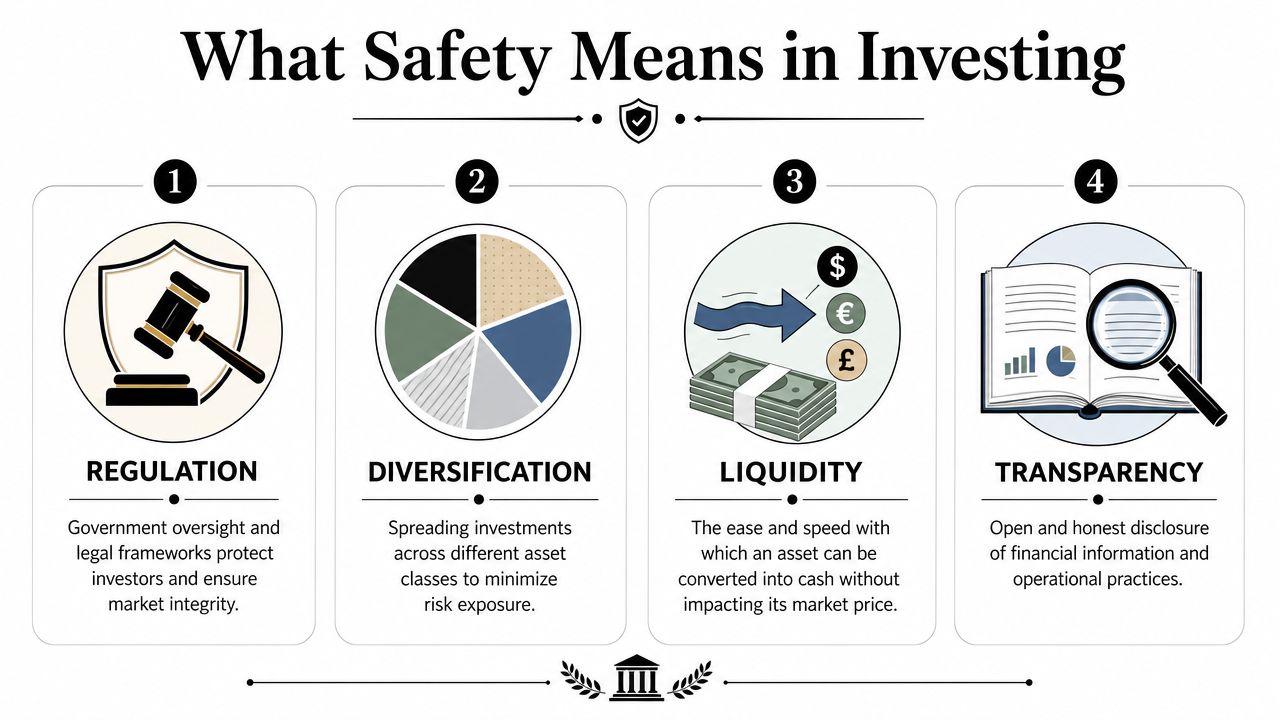
What Safety Means in Investing
In traditional markets, safety usually comes from a mix of product design, regulation, and backstops. Investors don't just rely on the asset. They rely on the system around it.
The baseline in traditional finance
A “safer” investment environment usually includes four things:
Pillar | What it does |
|---|---|
Regulation | Sets rules for conduct, disclosure, custody, and market behavior |
Diversification | Reduces the damage from any single position failing |
Liquidity | Lets you exit without being trapped in a frozen or thin market |
Transparency | Gives investors usable information before they commit capital |
That doesn't eliminate losses. Stocks still fall, funds still fail, and bad decisions still happen. But the system gives you clearer disclosures, defined legal recourse, and in some cases formal insurance or investor protection.
Crypto often doesn't.
Safe cars and safe driving
The easiest analogy is driving. A modern car can be safer than an older one because it has airbags, braking systems, and stronger design. But a reckless driver can still wreck it. A careful driver in a worse car can still reduce risk. Investing works the same way.
Crypto usually offers fewer built-in protections than traditional finance, so investor behavior matters more. Public confidence reflects that gap. 63% of U.S. adults say they have little to no confidence that current methods to invest, trade, or use cryptocurrencies are reliable and safe, according to Pew Research Center's 2024 survey summary. The same source notes that crypto assets aren't backed by any federal entity or insured, which means investors may have no recourse if a platform fails.
What that means in practice
If you're evaluating crypto safety, stop asking only whether the asset might go up or down. Ask these instead:
Who holds the assets: Are you self-custodying or trusting a platform?
What legal protections exist: If something breaks, who owes you what?
How transparent the setup is: Can you understand where risk sits?
How quickly you can exit: Can you withdraw when markets get stressed?
For a practical checklist on day-to-day protection, this guide on how to keep your crypto safe is a useful companion to the broader risk discussion.
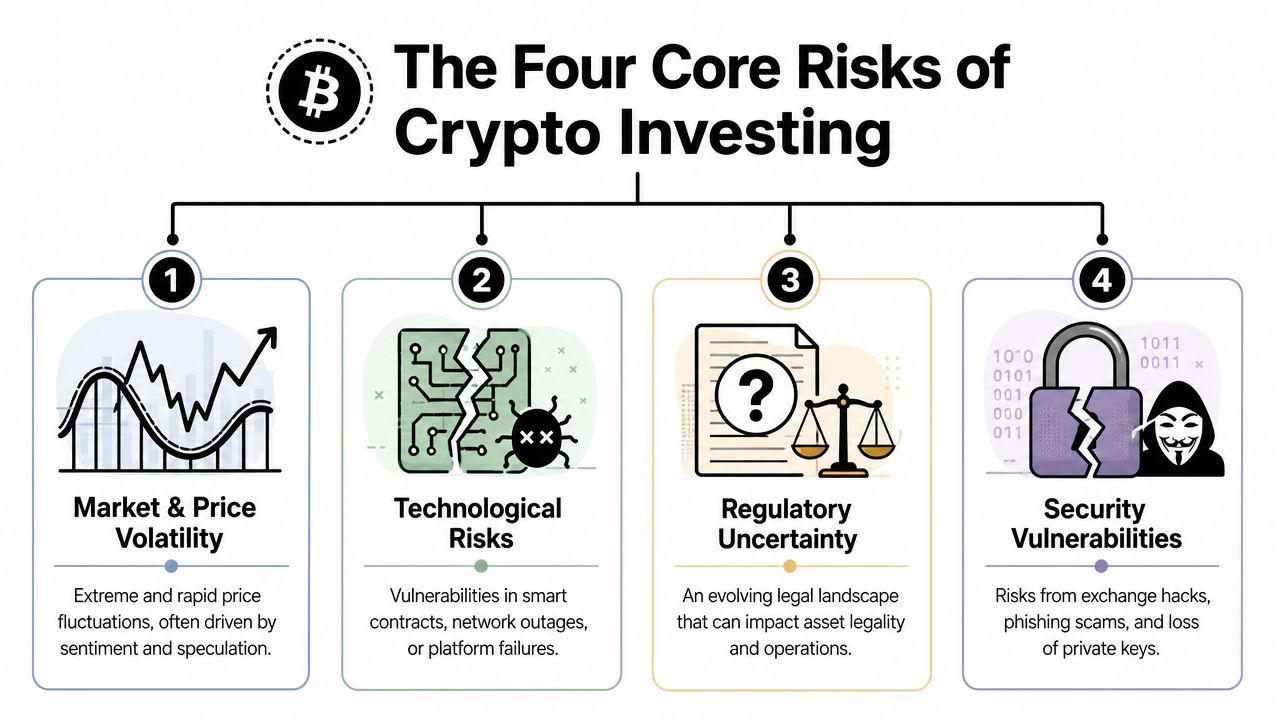
The Four Core Risks of Crypto Investing
What makes crypto unsafe. The asset itself, the code, the platform, or the rules around it?
Usually, more than one at once. That is why "crypto is risky" is too vague to help. Safer investing starts by separating the risks so you can control the ones that are controllable.
Market and price risk
Market risk is the easiest one to see and the easiest one to underestimate. Crypto can reprice fast, liquidity can thin out, and correlations can jump when traders rush for the exit at the same time.
That changes practical decisions. Position size matters more. Entry timing matters more. Cash or stablecoin reserves matter more. The old habit of saying "I'll just hold through it" only works if the position is small enough that you can follow the plan under stress.
For active investors, market risk and trade risk should be measured, not hand-waved. This explainer from Colibri Trader on managing trading risk is useful because it treats exposure as something to size, cap, and review before the market forces the decision.
Technical and protocol risk
Crypto runs on software. Software fails.
A token can keep trading while the smart contract it depends on gets exploited, an oracle feeds bad data, a bridge breaks, or a protocol's collateral logic fails under pressure. In practice, that means you are often underwriting code quality, audit quality, and system design, not just price direction.
That is a different skill from picking coins. It requires reading documentation, checking audits, understanding what the protocol depends on, and asking what happens during abnormal conditions instead of ideal ones. This DeFi risk management guide is a useful reference if you want a clearer process for reviewing protocol-level risk before depositing funds.
Here's a useful overview before the next point:
Custody and counterparty risk
A lot of crypto losses have nothing to do with being wrong on the asset. The failure happens at the platform layer.
If an exchange freezes withdrawals, a lender rehypothecates deposits, or a yield product takes risks you did not consent to, your balance can become an IOU instead of an asset you control. That distinction matters more in crypto because legal protections are often weaker, disclosures are thinner, and recovery can take years.
Celsius is a useful example. In its bankruptcy filing, the company said it had a roughly $1.2 billion hole in its balance sheet, according to Reuters' reporting on the filing. The lesson is straightforward. Counterparty risk can destroy capital even when the market eventually recovers.
When you deposit assets for yield, ask a harder question than "what is the APY?" Ask who controls the assets, what they are allowed to do with them, and where you stand if the entity fails.
Regulatory and legal risk
Legal risk is easy to dismiss until it blocks access to your money.
A token may trade widely while its status remains disputed. A platform may serve users in one jurisdiction, then change terms, restrict products, or exit the market after pressure from regulators. Sometimes the product still works at a technical level, but the user loses access, loses banking support, or faces tax and reporting problems that were never obvious at signup.
This risk matters because it changes what "safe" means. A strategy is safer when the structure is simple, disclosures are clear, and your rights are easier to understand and enforce. That is one reason many investors eventually shift from broad crypto speculation toward narrower strategies, such as conservative stablecoin yield setups, where the main job is reducing avoidable risk instead of chasing the highest return.
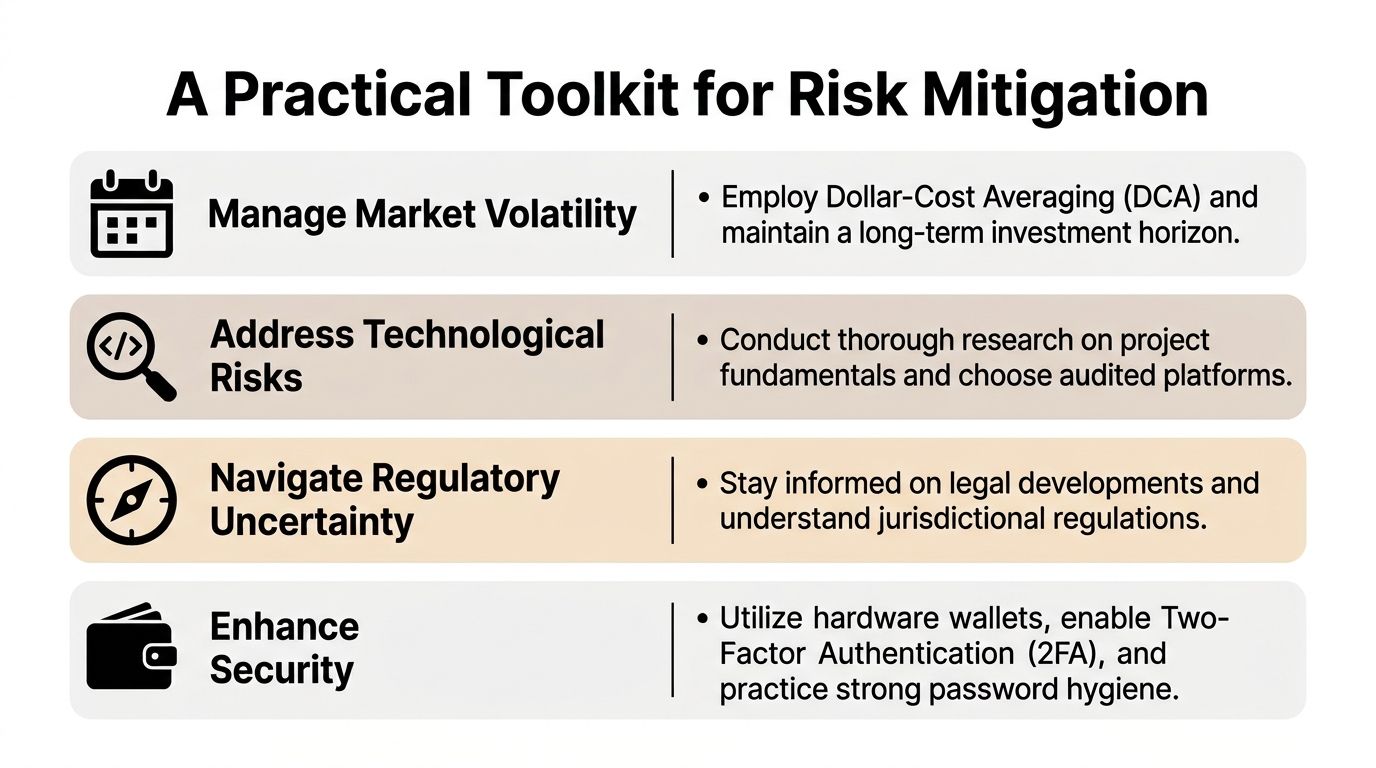
A Practical Toolkit for Risk Mitigation
Once you stop treating crypto as one giant risk blob, your decisions improve. Each major risk has different controls. Some are simple habits. Others require using better infrastructure and accepting lower upside in exchange for cleaner downside.
Start with exposure, not excitement
A lot of bad crypto outcomes begin with oversizing. Investors make a small research mistake and pair it with a large position.
Use simple limits:
Cap position size: Don't let one asset, protocol, or platform decide your entire outcome.
Separate core and experimental capital: Keep your “learning money” distinct from your capital preservation bucket.
Hold dry powder: Liquidity is part of safety. If all your assets are deployed, you lose flexibility when conditions change.
For volatile assets, this usually means slower entry and smaller sizing. For stablecoins, it means remembering that lower price volatility doesn't remove platform or protocol risk.
Treat DeFi like software, not like a savings account
A situation frequently arises in which many people get careless. A clean interface and a familiar “earn” button can make complex risk feel ordinary.
The Connecticut Department of Banking warns that in DeFi, smart contract vulnerabilities, protocol insolvency, and oracle failures can cause total capital loss without insurance, and that crypto payments and wallet holdings don't have the same legal protections or government insurance associated with traditional payment methods and bank deposits, as outlined in its consumer guidance on cryptocurrency risks.
That leads to a stricter checklist:
Use battle-tested protocols: New code carries more uncertainty than mature systems that have survived market stress.
Read risk disclosures: If a platform can't explain where yield comes from, don't supply capital.
Check dependency chains: A simple-looking strategy may depend on several external systems you never intended to trust.
Tighten your operational security
Security failures are often mundane. Phishing, device compromise, reused passwords, weak recovery practices, and poor account isolation do more damage than many investors expect.
A few habits help immediately:
Use hardware wallets for larger balances when self-custody makes sense.
Turn on strong two-factor authentication anywhere it's available.
Use separate wallets for separate jobs. One for long-term holdings, one for active DeFi, one for testing.
Reduce personal data exposure. If you need a compartmentalized setup for account creation or verification workflows, this crypto phone number guide from SMS Activate is worth reviewing as part of broader operational hygiene.
Practical rule: Don't just evaluate the investment. Evaluate the path your funds take to reach it.
Build a repeatable process
Good crypto risk management is boring by design. You want a system that still works when you're tired, busy, or distracted.
That usually includes a written routine:
Entry criteria: What must be true before you deposit?
Exit criteria: What would make you leave?
Monitoring cadence: How often do you review platform, protocol, and wallet exposure?
Concentration rules: How much can sit with one provider or strategy?
For a deeper operating model focused on DeFi decisions, this guide to DeFi risk management is a practical next step.
Risk Frameworks for Different Investors
The same advice doesn't fit everyone. A good setup for a curious beginner would frustrate a treasury manager. A treasury playbook would be excessive for someone learning with a small amount of stablecoins.
The curious beginner
This investor wants exposure without creating a second job. Their biggest risk isn't missing upside. It's making an avoidable mistake before they understand the moving parts.
A sensible path is narrow and simple. Start with a small amount, avoid borrowed funds for speculation, avoid obscure tokens, and avoid stacking too many new tools at once. If stablecoin yield is the goal, choose clarity over headline returns. Know which wallet you're using, which protocol you're using, and how to withdraw before you deposit.
Their safest move is often to spend the first phase learning custody and transaction hygiene, then add yield strategies later.
The busy professional
This investor has capital but limited time. Their problem isn't curiosity. It's operational overload.
They can usually understand risk at a high level, but they don't have time to monitor every protocol update, market shift, or wallet warning. For them, the largest danger is delegating attention without realizing it. They think they're taking stablecoin risk. In reality, they're taking hidden process risk because nobody is watching closely enough.
A better approach is fewer platforms, tighter concentration limits, and a standing review process. If they use outside vendors or internal teams to support access, treasury, or account security, adjacent controls matter too. That's where infrastructure like white-label cyber risk management from GoSafe Dark Web monitoring can fit into a broader operational stack, especially for teams that need visibility into account exposure and credential-related risk.
The Web3 treasury manager
This investor doesn't get to think like a retail speculator. Capital preservation comes first.
They usually care less about maximizing yield and more about avoiding operational surprises. That means documented counterparties, explicit wallet permissions, policy-based allocations, withdrawal readiness, and clear reporting. They also need to think in portfolio layers. Idle reserves, short-horizon liquidity, and productive stablecoin capital should not all sit in the same risk bucket.
The right treasury question isn't “Where is yield highest?” It's “Which risks are we being paid for, and which are we taking for free?”
For this profile, the discipline is institutional even if the tools are onchain. The process has to survive turnover, urgency, and market stress.
Automating Safer Stablecoin Yield
What if the safer question is not "Is stablecoin yield safe?" but "How do I set it up so one bad decision does less damage?"
That framing matters. Stablecoin yield sits closer to cash management than speculative trading for many investors, but the risk does not disappear because the asset is pegged to the dollar. The work is in reducing avoidable risk: bad protocol selection, poor diversification, weak monitoring, and slow reactions when conditions change.
Why automation matters
Manual yield management sounds simple until the inputs start shifting. A pool that looked conservative a few weeks ago may add incentive risk, lose liquidity, or become less attractive relative to safer alternatives. The investors who get hurt are often not reckless. They are busy, they check too infrequently, and they assume stablecoin strategies need less oversight than they require.
Automation helps by turning risk management into a system instead of a streak of good habits.
That matters in crypto because there is no default safety net comparable to what many investors expect from traditional accounts. As CIRO's overview of crypto asset risk explains, crypto assets generally fall outside standard investor protection frameworks, and platform oversight remains uneven. If funds are placed in the wrong venue, "I thought it was low risk" does not help much after the fact.
What risk-aware automation should actually do
Good automation should be conservative in the right places. It should:
Track changing conditions continuously: yields, liquidity, smart contract exposure, and concentration all change faster than many investors can review manually.
Favor risk-adjusted allocation over headline APY: the highest rate is often paying for a problem.
Spread exposure with clear limits: one protocol issue should not put the full allocation at risk.
Preserve access to capital: liquidity is part of safety, especially when market conditions change fast.
Reduce human error: rushed wallet actions, stale assumptions, and missed rebalancing windows cause a lot of preventable losses.
I have found that the practical value of automation is consistency. A decent system will not make crypto safe. It can make your process stricter, faster, and less dependent on whether you remembered to check three dashboards before lunch.
One example is Yield Seeker's secure yield automation approach, which uses AI to monitor and allocate stablecoin capital across DeFi opportunities while keeping the process visible and funds accessible. The useful standard here is simple: automation should help you choose better, size exposure carefully, and react sooner. If it only makes yield chasing easier, it is not improving safety.
Conclusion Your Journey to Safer Investing
Crypto investing isn't safe in the way many new investors hope. It doesn't come with default guardrails comparable to traditional banking or brokerage systems. But that doesn't make the entire category uninvestable.
It means you need a different standard. Stop looking for a binary answer. Start building a risk framework.
That framework begins with naming the risks clearly: market volatility, technical failure, custody and counterparty exposure, and legal uncertainty. Then it gets practical. Size positions conservatively. Favor transparency over hype. Treat DeFi like software infrastructure, not a savings product. Tighten wallet and account security. Keep liquidity available. Use tools and workflows that reduce the odds of human error.
The most important shift is psychological. Safer crypto investing comes from deliberate constraints. Not confidence. Not slogans. Not chasing the highest number on the screen.
If you approach crypto that way, the question changes from “Is this safe?” to “What risks am I taking, which ones can I reduce, and which ones am I being paid for?” That's a much stronger place to operate from.
If you want a lower-friction way to apply that mindset to stablecoin yield, Yield Seeker offers an AI-powered workflow for monitoring and allocating capital across DeFi strategies while keeping funds accessible and the experience easier to manage.