
The largest stablecoin isn't automatically the safest, and the highest advertised yield isn't automatically the best opportunity. A useful ranking has to separate market presence, peg design, reserve or collateral quality, on-chain liquidity, chain fit, protocol dependence, and practical use. Those factors answer different questions. A token can be excellent for trading but less suitable as a long-term treasury asset, or attractive inside one protocol while carrying risks that make it a poor general-purpose holding.
The market is concentrated enough to make that distinction important. The Federal Reserve reported aggregate stablecoin capitalization of $317 billion as of April 6, 2026, after more than 50% growth since early 2025 (Federal Reserve market overview). Yet popularity has two meanings. USDT still leads by supply, while USDC has become especially strong in adjusted settlement activity, according to KuCoin's June 2026 volume summary.
The ranking below focuses on practical usefulness for DeFi, not market size alone. It distinguishes a core holding, a liquid trading asset, and a specialized position whose value depends heavily on a particular protocol or incentive system.
1. USDC
USDC ranks first because it offers the most balanced starting point for many DeFi users. Circle issues it as a dollar-pegged stablecoin, and its reserve model is designed around cash and short-duration U.S. government obligations held through financial institutions. That structure gives USDC a more familiar reserve profile than crypto-collateralized or algorithmic designs, although users still face issuer, regulatory, smart-contract, and depeg risks.
Its practical advantage is distribution. USDC is available across major networks, including Ethereum, Polygon, Arbitrum, Optimism, and Base, and it appears throughout lending markets, decentralized exchanges, payment applications, and automated yield products. USDC also has strong measured settlement utility. In June 2026, it represented about $1.21 trillion, or roughly 67%, of adjusted stablecoin settlement volume, while USDT handled about $573 billion (KuCoin's adjusted-volume report).
Best fit for a core DeFi position
USDC works well as anchor collateral on Aave, as a base asset for Uniswap liquidity, and as one side of Curve's major stablecoin pools. Those integrations matter because yield depends on more than a token's advertised rate. Borrowing demand, withdrawal depth, swap liquidity, and the ability to move across chains all affect the quality of an opportunity.
Practical rule: Treat USDC as a strong default, not as a risk-free dollar substitute. Check Circle's current reserve disclosures and the exact chain and protocol before depositing.
Users on Base have a particularly straightforward route. Native USDC can reduce reliance on third-party bridges, and Yield Seeker's USDC yield guide explains how a Base-focused workflow can connect the asset to automated DeFi opportunities. For a risk-adjusted strategy, USDC is best suited to users who want broad protocol access and a relatively simple starting position, rather than maximum incentive exposure.

2. DAI
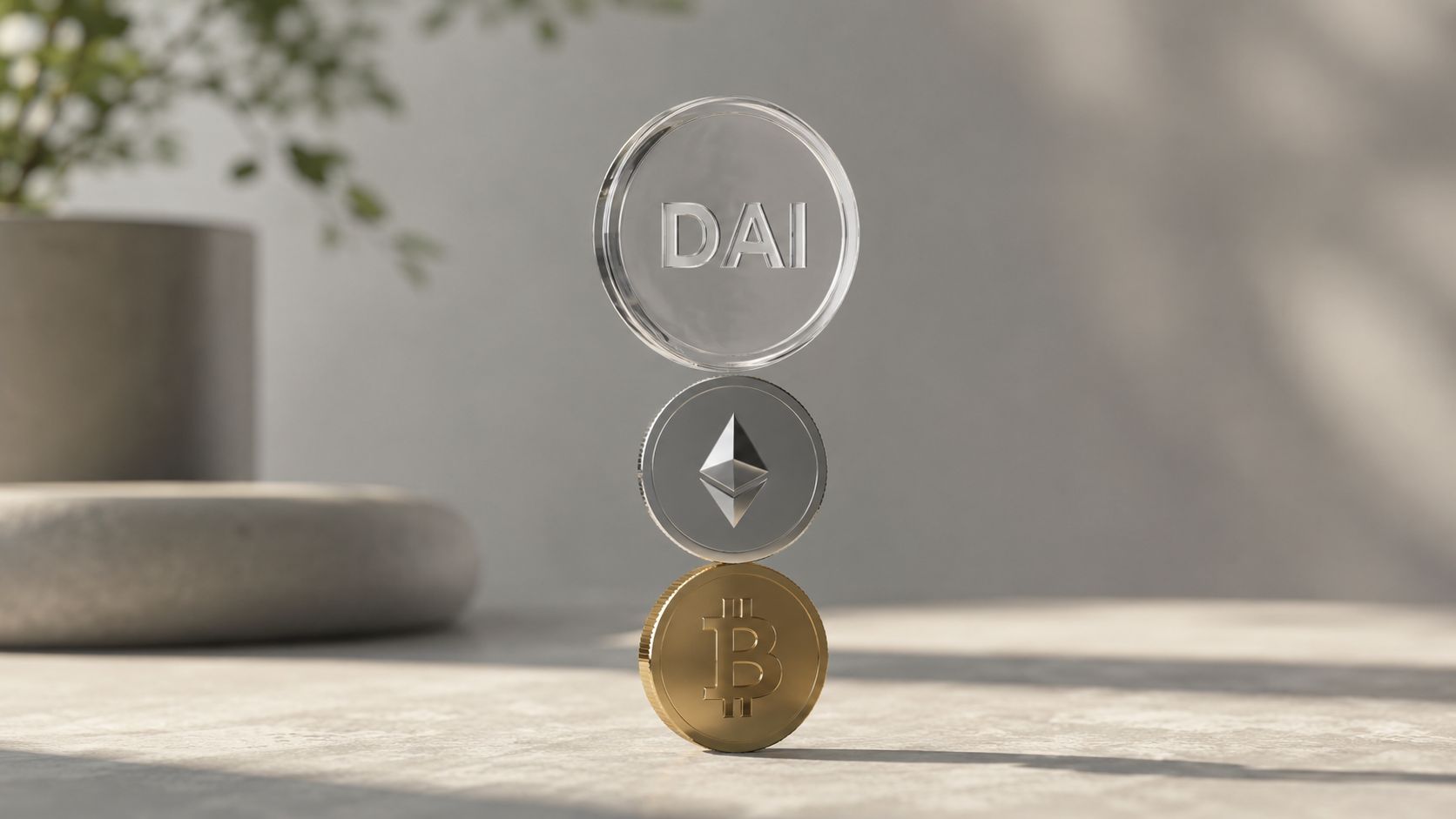
DAI earns second place because it provides something the leading centralized stablecoins don't: a crypto-native monetary system governed through MakerDAO. Users create DAI by locking collateral in Maker's lending system, and the protocol manages the relationship between collateral value, debt, liquidation, and the dollar target. That gives DAI a different risk profile from a token whose stability depends primarily on an issuer's reserve management.
The trade-off is complexity. DAI users indirectly depend on collateral quality, liquidation processes, oracle inputs, governance decisions, and the composition of assets accepted by the system. DAI can also have exposure to centralized collateral, including other stablecoins, so “decentralized” doesn't mean independent of every centralized component.
Where DAI is most useful
DAI is compelling for users who prioritize governance-based issuance and want access to several DeFi-native routes. A holder can use the Dai Savings Rate when it offers the most efficient risk-adjusted return, lend DAI through Aave, or provide liquidity in a DAI, USDC, and USDT pool. The right comparison isn't the highest displayed APY. It's the net return after considering smart-contract exposure, utilization, liquidation risk, and whether rewards are paid in volatile governance tokens.
DAI also fits collateral strategies. A user might hold ETH or wrapped Bitcoin, borrow DAI against that position, and deploy the borrowed asset elsewhere. That can increase capital efficiency, but it also creates a liquidation path that doesn't exist for an stablecoin deposit.
DAI makes the most sense when decentralization is part of the objective, not merely a label attached to a yield strategy.
Before using DAI for financial operations, review the collateral ratio and liquidation terms in the specific Maker market. For passive holdings, compare the native savings route with external lending markets instead of assuming that protocol complexity produces better returns. DAI belongs near the top because its design expands strategic choice, but that choice requires more monitoring than a simple reserve-backed holding.
3. USDT
USDT ranks third for practical DeFi usefulness, despite remaining the largest stablecoin by supply. In mid-2026, its supply was roughly $187 billion, compared with about $75 billion for USDC. The two assets together accounted for around 83% of total stablecoin supply, according to Reap's 2026 stablecoin market summary.
Supply alone does not make USDT the best holding. Its advantage is access. USDT is integrated into centralized exchanges, cross-chain transfers, legacy DeFi pools, and trading pairs. That network effect can matter more than reserve simplicity when execution size, exchange availability, or regional liquidity determines the outcome.
USDT's reserve portfolio is broader than a cash-only model. Users should therefore review Tether's disclosures and asset mix instead of treating all fiat-backed tokens as equivalent.
The liquidity-first choice
USDT works best as a trading and settlement asset. It supports large swaps, exchange collateral, and strategies connected to the Tron ecosystem, where inexpensive transfers may affect the practical return. It is also available across Curve pools and Aave markets, although depth, rates, and support differ by chain and utilization.
The relevant risk is not limited to the peg. Holders depend on Tether's reserves, redemption arrangements, compliance decisions, and the market used to sell the token. Chain choice adds another operational variable. The same ticker can represent a native asset on one network and a bridged or wrapped asset on another, with different contract and bridge risks.
Decision point: Choose USDT when liquidity and access matter most. Its market size alone is not a reason to use it as a long-term yield position.
USDT can complement USDC in a diversified DeFi portfolio. Holding both separates issuer exposure and preserves access to different venues, while increasing the assets and operational details that require monitoring. For a Base-focused workflow such as Yield Seeker's USDC approach, USDT may serve as a venue-specific or trading balance rather than an automatic replacement. Higher liquidity can improve execution, but it does not make every USDT yield opportunity safer.
USDT is indispensable in many markets. Its most defensible role is often transactional, not as the sole stablecoin in a long-term yield allocation.

4. FRAX
FRAX is a specialized choice because its stability model combines collateral and protocol mechanics rather than relying on a straightforward full-reserve structure. That hybrid design aims to use capital more efficiently, but it makes the user's analysis more demanding. The relevant question isn't only whether FRAX trades near its target today. It's how collateral composition, governance, incentives, and the FXS token interact during stress.
This makes FRAX better suited to experienced DeFi users than to someone looking for a simple cash equivalent. Its ecosystem offers routes through Frax's own products, Curve liquidity pools, Aave markets, and Convex strategies. Those opportunities can be attractive when incentives align, but rewards may depend on governance decisions and token emissions, while liquidity can change as incentives change.
Yield requires a systems view
A FRAX position should be evaluated as a package of exposures. The stablecoin itself has a peg and collateral profile. A liquidity position adds impermanent-loss and pool risk. A strategy using FXS rewards adds volatility and exit risk. Borrowing against FRAX adds liquidation risk. A high displayed return can therefore reflect compensation for several risks rather than a free improvement over USDC or DAI.
Before deploying capital, inspect the current collateral arrangement and the protocol's active governance parameters. Yield Seeker's explanation of algorithmic stablecoins provides useful background for distinguishing a protocol-stabilized asset from a reserve-backed one.
FRAX is a yield instrument first for many users, and a general-purpose dollar holding second.
That doesn't make it unsuitable. It means the correct allocation is usually one you can monitor and explain. FRAX can work in a diversified Curve or Convex strategy when the investor understands the relationship between FRAX, FXS, pool liquidity, and protocol incentives. It shouldn't be presented as interchangeable with a fully collateralized stablecoin.
5. PYUSD
PYUSD sits lower in the ranking because institutional recognition doesn't automatically create deep DeFi liquidity. PayPal's stablecoin benefits from a familiar consumer-finance brand and operates on Ethereum and Solana, giving it a route into both established and high-throughput ecosystems. Its reserve design is described as dollar-backed through cash and short-term Treasury assets, which makes its structure familiar to users who prefer an issuer-backed token.
The practical limitation is protocol depth. PYUSD can be useful in selected Uniswap pools, Aave deployments, Solana applications, and payment flows, but users should verify the exact market before moving funds. A stablecoin can have a credible issuer and still offer less efficient execution, fewer lending venues, or thinner exit liquidity than USDC and USDT.
A bridge between payments and DeFi
PYUSD is most relevant for users who already interact with PayPal or who want to test a mainstream-finance-linked asset without abandoning on-chain settlement. It may also appeal to treasury users who value a recognizable issuer, but that preference should be balanced against concentration in one company and the token's still-developing DeFi footprint.
A practical strategy is to keep PYUSD as a measured satellite position rather than making it the sole stablecoin reserve. Compare its swap depth and lending terms with USDC on the same chain. Check whether the pool is supported natively or through a representation that introduces bridge risk.
Use case over headline: PYUSD is interesting when PayPal connectivity or a specific Ethereum or Solana application matters. It isn't automatically the best yield asset simply because a large payments company stands behind it.
The asset's future usefulness depends on continued integrations, reliable liquidity, and user demand. For now, PYUSD is better suited to targeted payment and DeFi experiments than to the default position for a yield-focused portfolio.
6. crvUSD
crvUSD is built for users who already understand Curve. Its lending and liquidation design uses Curve's automated-market-making infrastructure to manage collateral transitions as prices move. That creates a distinctive experience compared with a conventional collateralized debt position, but it also means users must understand how the system can rebalance their exposure during market stress.
The strongest case for crvUSD is inside the Curve ecosystem. A user may mint it against crypto collateral, interact with crvUSD pools, and pursue additional strategies through Convex or Yearn. That composability is valuable for DeFi specialists, but it creates protocol dependence. If you don't use Curve's liquidity, governance, and incentive architecture, much of crvUSD's practical appeal disappears.
Powerful inside its home ecosystem
crvUSD can support strategies involving assets such as ETH or wrapped Bitcoin that magnify both the intended exposure and the consequences of a price move. LLAMMA's soft-liquidation behavior may gradually change the composition of a position, which is different from holding a stablecoin without borrowed funds and waiting for a withdrawal.
Users should study the liquidation bands, collateral requirements, pool depth, reward source, and withdrawal route before opening a position. Read the mechanics behind an automated market maker before treating a crvUSD pool as a simple savings account.
A short explainer can help clarify the model:
crvUSD ranks below broad-purpose assets because it's highly ecosystem-specific. It can be useful for advanced Curve participants seeking integrated strategies, but it carries more mechanism and smart-contract risk than a plain reserve-backed holding.
7. GHO
GHO is Aave's protocol-native stablecoin, so its main advantage is alignment with Aave's lending environment. Users can mint GHO against collateral supplied to Aave, and the asset's parameters, borrowing conditions, and incentives are connected to Aave governance. That integration can reduce friction for existing Aave users, who may prefer to stay within one lending system rather than move between unrelated issuers.
The same integration creates concentration risk. GHO isn't merely an asset with an independent reserve manager. Its stability depends on collateral supplied through Aave, governance decisions, oracle infrastructure, smart contracts, and the liquidity available in the markets where users want to trade or exit. An Aave user may find that acceptable, while a user seeking issuer diversification may not.
A protocol position, not a neutral dollar
GHO can be useful when borrowing against existing Aave deposits, particularly if the borrowing terms and rewards compare favorably with alternatives. Curve and Uniswap pools can provide routes into USDC and other stablecoins, but liquidity and incentives should be checked at the time of use rather than assumed from the token's association with Aave.
A sensible approach is to evaluate GHO against the cost of borrowing USDC or DAI in the same environment. Include governance risk and exit liquidity in that comparison. If the position depends on rewards paid in AAVE or another volatile asset, calculate the result after considering the reward token's price movement.
GHO's strongest feature is composability with Aave. Its weakest feature is that the same composability concentrates the user's exposure in Aave's design and governance.
GHO belongs in a diversified DeFi allocation for users who already use Aave and understand its collateral system. It is less compelling as a standalone cash reserve for someone who doesn't need the protocol-specific features.
8. USDM
USDM represents the world-asset route to stablecoin utility. Its model emphasizes backing connected to U.S. Treasury securities and other traditional financial assets, rather than relying only on crypto collateral or purely algorithmic stabilization. That can appeal to users who want their stablecoin exposure linked to familiar fixed-income instruments.
The key analytical challenge is transparency. Users need to understand the legal structure, custody arrangements, redemption process, asset eligibility, jurisdictional restrictions, and how income from the underlying assets reaches the protocol. “Treasury-backed” describes an asset category, not a guarantee that every user can redeem immediately at the target value under every market condition.
Useful when the RWA thesis matters
USDM may suit a long-term holder who specifically wants a real-world-asset structure and accepts a newer liquidity profile. It can also appeal to institutions exploring tokenized financial products, provided their compliance and custody requirements are satisfied. DeFi users should still compare its pool depth, supported chains, borrowing markets, and exit routes with those of USDC and USDT.
RWA exposure introduces a different set of dependencies. The user may face issuer risk, custodian risk, legal and regulatory risk, valuation timing, and smart-contract risk at the same time. Those risks aren't necessarily worse than crypto-collateral risk, but they're different, so the portfolio shouldn't treat USDM as a perfect substitute for a decentralized stablecoin.
Keep the position sized according to the liquidity you can verify, and review changes to collateral allocation and governance before adding funds. USDM ranks eighth because its specialized design may be valuable, but its practical usefulness remains more dependent on market access and documentation than that of the leading stablecoins.
Top 8 Stablecoins Comparison
Stablecoin | Implementation Complexity 🔄 | Resource Efficiency ⚡ | Expected Outcomes ⭐ | Ideal Use Cases 💡 | Key Advantages / Impact 📊 |
|---|---|---|---|---|---|
USDC (USD Coin) | Low 🔄 | High ⚡⚡⚡ | ⭐⭐⭐⭐⭐, Deep liquidity, low slippage | DeFi yield, treasury, Base-native deposits | Institutional backing; multi-chain; monthly attestations |
DAI (Decentralized Stablecoin) | Medium 🔄🔄 | Moderate ⚡⚡ | ⭐⭐⭐⭐, Decentralized stability, DSR yields | Decentralized treasury, censorship-resistant holdings | Native DSR yield; governance-led; collateral diversity |
USDT (Tether) | Low 🔄 | Very High ⚡⚡⚡⚡ | ⭐⭐⭐⭐⭐, Unmatched trading liquidity | Large swaps, arbitrage, CEX/DEX flows | Highest volume; deepest pools; low borrow costs |
FRAX (Fractional Algorithmic) | High 🔄🔄🔄 | High ⚡⚡⚡ | ⭐⭐⭐⭐, Capital-efficient yields, token incentives | Capital-efficient LP strategies, incentive-focused farming | Hybrid collateral/algorithmic model; FXS rewards; attractive APYs |
PYUSD (PayPal USD) | Low 🔄 | Moderate ⚡⚡ | ⭐⭐⭐, Institutional on-ramp, growing integrations | Mainstream user onboarding; PayPal fiat rails | PayPal backing; seamless on/off ramps; auditor attestations |
crvUSD (Curve Stablecoin) | High 🔄🔄🔄 | High ⚡⚡⚡ | ⭐⭐⭐⭐, Curve-native yield, leverage-friendly | Advanced yield farmers, Curve LP and leverage strategies | LLAMMA soft-liquidation; deep Curve integration; CRV incentives |
GHO (Aave-native) | Medium 🔄🔄 | Moderate ⚡⚡ | ⭐⭐⭐, Protocol-aligned yield and borrow mechanics | Aave users, protocol-native borrowing + yield stacks | Native Aave integration; minting rewards; governance alignment |
USDM (RWA-backed) | High 🔄🔄🔄 | Moderate ⚡⚡ | ⭐⭐⭐, RWA-backed stability with potential yield | Long-term institutional holdings; RWA exposure via DeFi | Real-world asset yields; institutional collateral diversification |
Choose the Peg Before You Chase the Yield
The best stablecoin depends on the job. If you need the deepest global liquidity, USDT remains difficult to ignore. Its supply was roughly $187 billion in mid-2026, and it represented about 59% of total stablecoin supply, while USDC represented about 24%, according to Reap's market data summary. If you need a broadly integrated DeFi base asset with a reserve-backed structure and strong Base support, USDC is the more balanced starting point. If decentralization and governance-based issuance matter most, DAI deserves closer attention.
The lower-ranked assets aren't automatically bad choices. FRAX, crvUSD, GHO, PYUSD, and USDM address different preferences. Some emphasize protocol integration, some connect stablecoins to traditional assets, and others seek capital efficiency or specialized incentives. The mistake is treating every token that targets the dollar as the same risk category.
A practical review should cover:
Peg health: Check current trading behavior, liquidity, collateral conditions, and the mechanism used to restore the target.
Reserve or collateral evidence: Review issuer attestations, protocol dashboards, custody disclosures, and governance changes before committing meaningful capital.
Protocol exposure: Identify the smart contracts, oracles, bridges, pools, and lending markets that can affect your position.
Yield quality: Separate base lending income from temporary incentives, volatile reward tokens, and liquidity-provider risk.
Exit conditions: Confirm withdrawal timing, available liquidity, slippage, redemption requirements, and whether the asset is native or bridged on your chosen chain.
Concentration limits: Avoid allowing one issuer, protocol, chain, or collateral type to determine the result of your entire stablecoin strategy.
Market popularity can help identify where liquidity and integrations are likely to exist, but it can't replace diligence. Visa's 2026 analysis found unique holder addresses grew from about 40,000 in January 2023 to more than 1.2 million by February 2026, while monthly active senders rose from roughly 6,000 to 135,000 over the same period (Visa's stablecoin adoption analysis). Growing usage supports the case for stablecoins as financial infrastructure, but it doesn't guarantee the safety of a particular issuer, chain, or yield contract.
For users starting with native USDC on Base, Yield Seeker can fit the simplest version of this framework. Its AI Agent monitors eligible DeFi opportunities and can reallocate capital as conditions change, while the user retains access to the deposited funds. Automation reduces the burden of tracking fragmented markets, but it doesn't remove stablecoin, smart-contract, counterparty, liquidity, bridge, or market risk. The same decision rules still apply, especially around supported assets, protocol exposure, withdrawal conditions, and concentration.
If you want the broader context for how stablecoins connect financial products and user experiences, this embedded finance explained simply guide provides a useful starting point. The central lesson is straightforward: select the peg and risk structure first, then evaluate whether the yield compensates you for the risks you're taking.
Yield Seeker helps stablecoin holders deposit native USDC on Base and use an AI-powered agent to monitor and allocate across eligible DeFi yield opportunities. Visit Yield Seeker to review the workflow, track your balances, and explore an automated approach without manually juggling multiple protocol dashboards.