
Imagine earning interest on your savings, but with one massive upgrade: you never have to lock them up. That’s the core idea behind no-lockup crypto yield. It’s a way to generate passive income on your digital assets—especially stablecoins—that offers competitive returns with the freedom to pull your funds out whenever you want.
What Is No-Lockup Crypto Yield and Why It Matters
Think of your typical high-yield savings account, but built for the crypto world. Instead of the tiny percentages banks offer, you can earn a much healthier return on your crypto. The key difference here is liquidity. Your funds are never frozen for a fixed term, which is a huge deal in a market that moves as fast as crypto.
This flexibility means you can stay nimble. If a better opportunity pops up or you need to react to a sudden market shift, your capital is ready to go. You’re not stuck watching from the sidelines, missing out because your money is tied up for 30, 60, or 90 days like it is with most locked-yield products.
To really get a sense of the trade-offs, it helps to see the two approaches side-by-side. Here’s a quick breakdown of how no-lockup yield stacks up against traditional locked yield.
No-Lockup vs Locked Crypto Yield At a Glance
Feature | No-Lockup Yield | Locked Yield |
|---|---|---|
Liquidity | Instantly accessible | Locked for a fixed term |
Flexibility | High (move funds anytime) | Low (penalties for early withdrawal) |
Typical APY | Good, but often slightly lower | Can be higher to reward commitment |
Opportunity Cost | Low | High (can't access funds for new opportunities) |
Best For | Active investors, emergency funds, short-term goals | Long-term holders, set-and-forget strategies |
This table gives you the high-level picture. No-lockup is all about control and access, while locked options aim to give you a slightly better rate in exchange for a firm commitment.
The Shift Toward Financial Flexibility
It wasn't that long ago that earning the best returns in crypto meant you had to lock up your assets for a set period. But as the market has grown up, especially heading into 2026, users have made it clear they want flexibility. The whole paradigm has shifted from rigid, long-term commitments to liquid, on-demand yield.
This user-first approach has taken hold across both DeFi (decentralized finance) and CeFi (centralized finance). Platforms are now competing to offer the most attractive Annual Percentage Yields (APY) without forcing you into a lockup, because they know modern crypto users value control just as much as returns.
For example, it's not uncommon to find platforms offering up to 5.2% APY on stablecoins like USDC, complete with instant 24/7 withdrawals and daily auto-compounding. That structure means your earnings from today start earning their own yield tomorrow, boosting your returns over time. You can dive deeper into how these flexible withdrawals work in DeFi to see the mechanics behind it.
The core idea is simple but powerful: Your money should be available when you need it. No-lockup crypto yield turns this principle into a practical earning strategy, blending the passive income potential of investing with the on-demand access of a checking account.
In this guide, we'll walk through everything you need to know. We’ll look at how these returns are actually generated, weigh the pros and cons, and talk about the real risks involved. By the end, you’ll have a clear roadmap for safely earning liquid yield on your crypto.
How No-Lockup Yield Actually Works
So, where does the money for no-lockup crypto yield actually come from? It might seem a bit like magic, but the core idea is surprisingly simple. Think of it like a souped-up version of old-school peer-to-peer lending, just way faster and all run by code.
At its heart, you're playing the role of a mini-bank. When you deposit your stablecoins, like USDC, into a yield protocol, you’re adding them to a massive pool of capital. This pool then becomes the go-to source for other people who need to borrow funds.
Those borrowers pay interest for the loans they take out, and—you guessed it—that interest is what generates your yield. The protocol gathers up all this interest and shares it out amongst everyone who supplied funds, including you. It's a straightforward system where your idle crypto gets put to work.
The Lending and Borrowing Engine
The most common engine driving no-lockup crypto yield is a decentralized lending market. Picture platforms like Aave or Compound as automated banks that run entirely on smart contracts. They connect people with money to lend (suppliers like you) with people who need to borrow, all without a middleman.
This handy flowchart breaks down the simple flow of how your assets generate interest every day without being locked away.
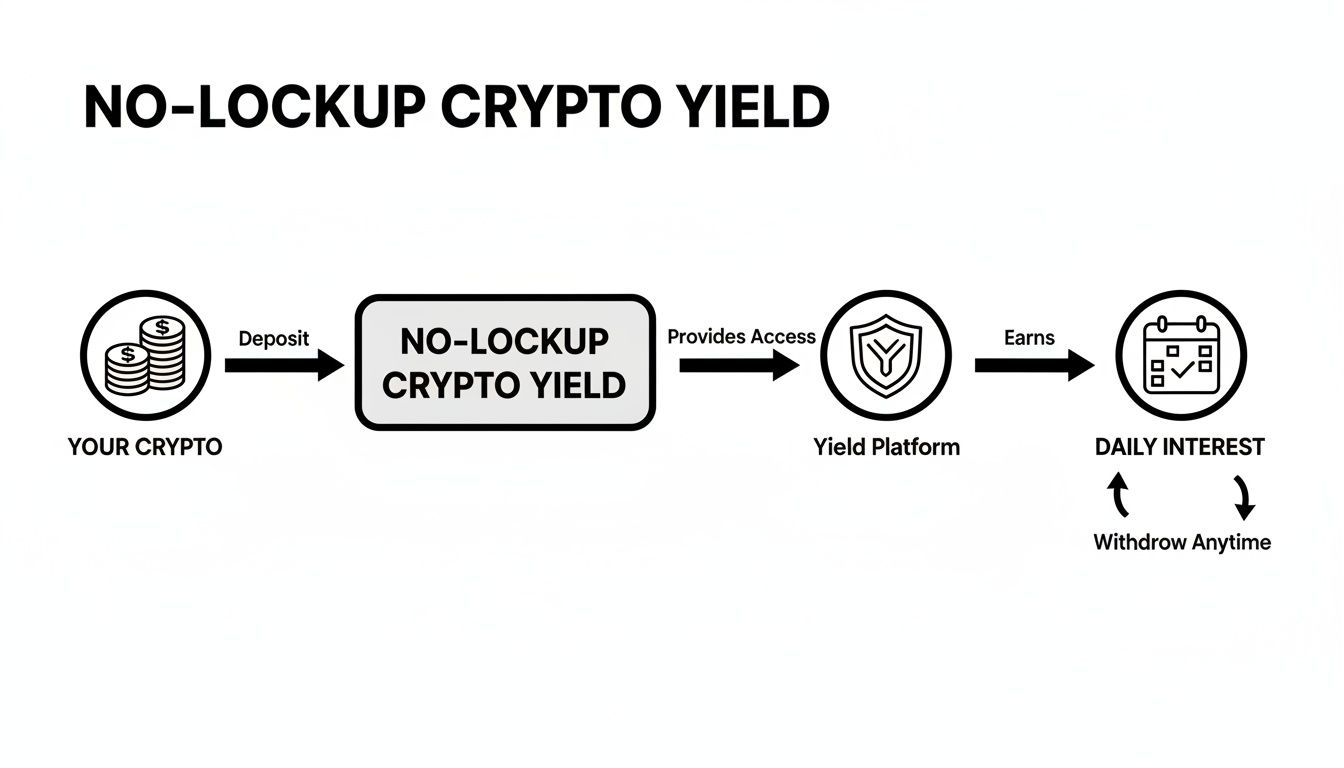
As you can see, it's a constant cycle: you supply your crypto, the protocol puts it to work by lending it out, and you earn interest on your deposit, which you can pull out at any time.
But what stops a borrower from just taking the money and running? The secret sauce is something called over-collateralization. To get a loan, a borrower has to deposit their own crypto as collateral first, and the value of that collateral has to be much higher than the loan amount. For example, to borrow $100 worth of USDC, they might have to lock up $150 worth of an asset like Ethereum.
This over-collateralization is a critical safety net. If a borrower can't repay their loan, or if their collateral's value dips too low, the protocol automatically sells off the collateral to make sure the lenders get their money back. It’s a system designed to keep your funds as safe as possible.
How Interest Rates Fluctuate
A key thing to understand about no-lockup crypto yield is that the APY is never set in stone. The rates you earn are dynamic, changing in real-time based on the simple laws of supply and demand within the lending pool.
When demand to borrow is high and there isn't much money in the pool, interest rates shoot up to attract more lenders.
When demand to borrow is low and the pool is overflowing with capital, interest rates drop to make borrowing more attractive.
This whole process is managed by an algorithm that looks at the utilization rate—the percentage of all the money in the pool that's currently being borrowed. It’s a totally transparent market, driven purely by what users are doing.
DeFi protocols have become the backbone for this, powering billions in Total Value Locked (TVL) with lending that’s self-custodial and always accessible. By mid-2025, the TVL in DeFi lending had already soared past $55 billion, with giants like Aave V3 alone managing over $26.5 billion in collateralized loans. You can read more about stablecoin yields and how platforms like Aave offer rates around 3-5% APY without any lockups.
Other Sources of No-Lockup Yield
While lending is the main game in town, it's not the only way to earn flexible returns. A few other strategies also keep your assets liquid and productive:
Liquidity Providing: You can add a pair of assets (like USDC and ETH) to a decentralized exchange (DEX). In exchange, you get a slice of the trading fees every time someone swaps between those two tokens.
Liquid Staking: This lets you stake an asset like Ethereum to help secure the network. Instead of your ETH being locked up, you get a special "liquid staking token" (like stETH) that represents your staked position. You can trade this token or use it elsewhere in DeFi, all while still racking up staking rewards.
Each of these methods offers a different flavor of no-lockup crypto yield, but they all stick to the same core principle: keeping your assets working for you without tying them down.
Weighing the Pros and Cons of Staying Liquid
The dream of earning yield without locking up your funds sounds amazing, but no-lockup crypto yield isn't some magic bullet. Just like any other strategy in crypto, it comes with its own set of pros and cons. You need to go in with your eyes wide open before putting your capital to work.
The biggest win here is, without a doubt, flexibility. Crypto markets move at lightning speed, and conditions can flip in just a few hours. Having immediate access to your funds in that environment is a superpower. You're never stuck on the sidelines when a better opportunity pops up.
This instant liquidity means you’re far less likely to miss out. If a new protocol launches with killer rates or you see a juicy dip in an asset you've been eyeing, your capital is ready to go. You don't have to bite your nails waiting for a 30, 60, or 90-day lockup to finish, long after the opportunity has sailed.
The Power of Immediate Access
For a lot of people, the peace of mind that comes from knowing their funds are accessible 24/7 is just as important as the financial upside. Being locked into a position during a crazy market swing can be seriously stressful. No-lockup strategies take that anxiety off the table.
This also makes them a fantastic starting point for DeFi beginners. The learning curve can be steep, and being able to pull your funds out easily is a huge safety net. You can start with small amounts, get a feel for how things work, and yank your money out if you get nervous, all without getting hit with penalties.
The Tradeoffs for Total Flexibility
Of course, that kind of freedom doesn't come for free. The most obvious tradeoff is a slightly lower APY compared to what you’d get with a long-term lockup. Protocols are happy to pay you more when you lock funds because it gives them stable, predictable capital to work with.
Think of it like this: you're paying a small premium—in the form of a lower yield—for the massive benefit of staying liquid. For many, that's a trade worth making, but it's something you have to weigh when looking at different yield options.
Beyond just the yield, you have to accept that the rates on no-lockup products are almost always variable. They bounce around based on supply and demand in the underlying lending markets.
A 7% APY today isn’t a promise of 7% APY tomorrow. While rates on big, established stablecoin pools are usually pretty steady, they can and do change, which will affect what you actually earn over time.
Understanding the Inherent Risks
Staying liquid doesn't mean you've dodged all the risks; it just changes what they look like. When you use these platforms, you're still exposed to a few key dangers you need to be aware of.
Here are the main ones to keep on your radar with no-lockup strategies:
Smart Contract Risk: These DeFi protocols are all built on code. A bug or an exploit in a smart contract could lead to a loss of funds. This is a fundamental risk across all of DeFi, period.
Platform Risk: Whether it's a centralized exchange or a DeFi protocol, you're trusting that platform to be secure and run properly. A hack, failure, or shady management can put your assets in danger.
Market Risk: Even stablecoins aren't 100% risk-free. It's possible for a stablecoin to lose its peg to the dollar, or for a major market crash to cause chaos across the whole ecosystem.
These risks are real, but they shouldn't scare you away from no-lockup yield entirely. What they should do is remind you to do your homework. Sticking to established, well-audited platforms and spreading your assets around are the best ways to manage these risks. By balancing the incredible flexibility against these known tradeoffs, you can make a smart decision that fits your goals and how much risk you're comfortable taking on.
Key Risks in Liquid Yield and How to Manage Them
The freedom of no-lockup crypto yield is incredibly appealing, but it’s not a free pass on risk. It just changes what you need to watch out for. While you get to avoid the risk of having your funds stuck, you still have to navigate the usual challenges of DeFi.
Getting a handle on these potential traps is the first step to managing them. I find it easiest to break the risks down into three main buckets. By looking at each one, you can build a solid safety checklist before you ever deposit a single dollar.

Smart Contract Risk
Every single DeFi protocol is built on smart contracts—code that executes automatically on the blockchain. This is the bedrock of the whole system, but if that code has a bug, it can create an opening for hackers to exploit. This is probably the biggest risk in the space.
The good news is you don't need to be a developer to check for basic safety. The single best defense is to look for a security audit.
What is it? This is when a specialized, independent firm goes through a protocol's code line-by-line, hunting for vulnerabilities.
Who does it? You want to see audits from well-known firms like Trail of Bits, OpenZeppelin, or Quantstamp. Their name carries weight.
Where do you find it? Good projects are proud of their audits and will link to the reports on their website or in their docs. If you can't find one, that's a huge red flag.
An audit isn't a 100% guarantee of safety, but it shows the team cares enough to invest in security and have experts double-check their work. Using a protocol without a public audit is like driving a car without knowing if it’s passed a safety inspection.
Platform and Counterparty Risk
The next layer up is the platform or protocol itself. Even with flawless code, you’re still placing some trust in the people or governance system running the show. This is called counterparty risk—the danger that the other side of the deal won’t follow through.
The best way to manage this is to focus on reputation and transparency. Ask yourself a few simple questions:
Is the team public? An anonymous team is a major risk. I always look for projects with public founders who have a real track record in the industry.
How long has it been running? Time is the ultimate stress test. Protocols that have been operating for years without major issues, like Aave or Compound, have proven their reliability.
What’s the community saying? Check out their social media and forums. You'll always find a few complaints, but be on the lookout for consistent, unresolved problems or a team that’s gone quiet.
If you want to go deeper, our guide on comprehensive DeFi risk management provides some great frameworks for evaluating platforms. It's a critical read for anyone serious about keeping their capital safe.
Market and Asset Risk
Finally, even with secure code and a reputable platform, you're still exposed to the wider market. Your no-lockup crypto yield strategy is only as good as the assets you’re using and the overall health of the market.
A key risk here is stablecoin de-pegging. While stablecoins like USDC aim for a solid 1:1 peg to the US dollar, they aren't bulletproof. A major crisis of confidence could cause a stablecoin to lose its value, which directly impacts your holdings.
Also, remember that the yields themselves aren't fixed. A sudden drop in borrowing demand can cause the APY on your position to crater. While that's not a loss of your initial capital, it’s a risk to the returns you were hoping for.
You can lower these risks by:
Sticking to high-quality stablecoins: Use assets with a long, proven history of stability and transparent reserves, like USDC.
Diversifying your capital: Don't go all-in on a single protocol or asset. Spreading your funds around minimizes the damage if any one thing fails.
Automate Your Strategy With an AI Yield Agent
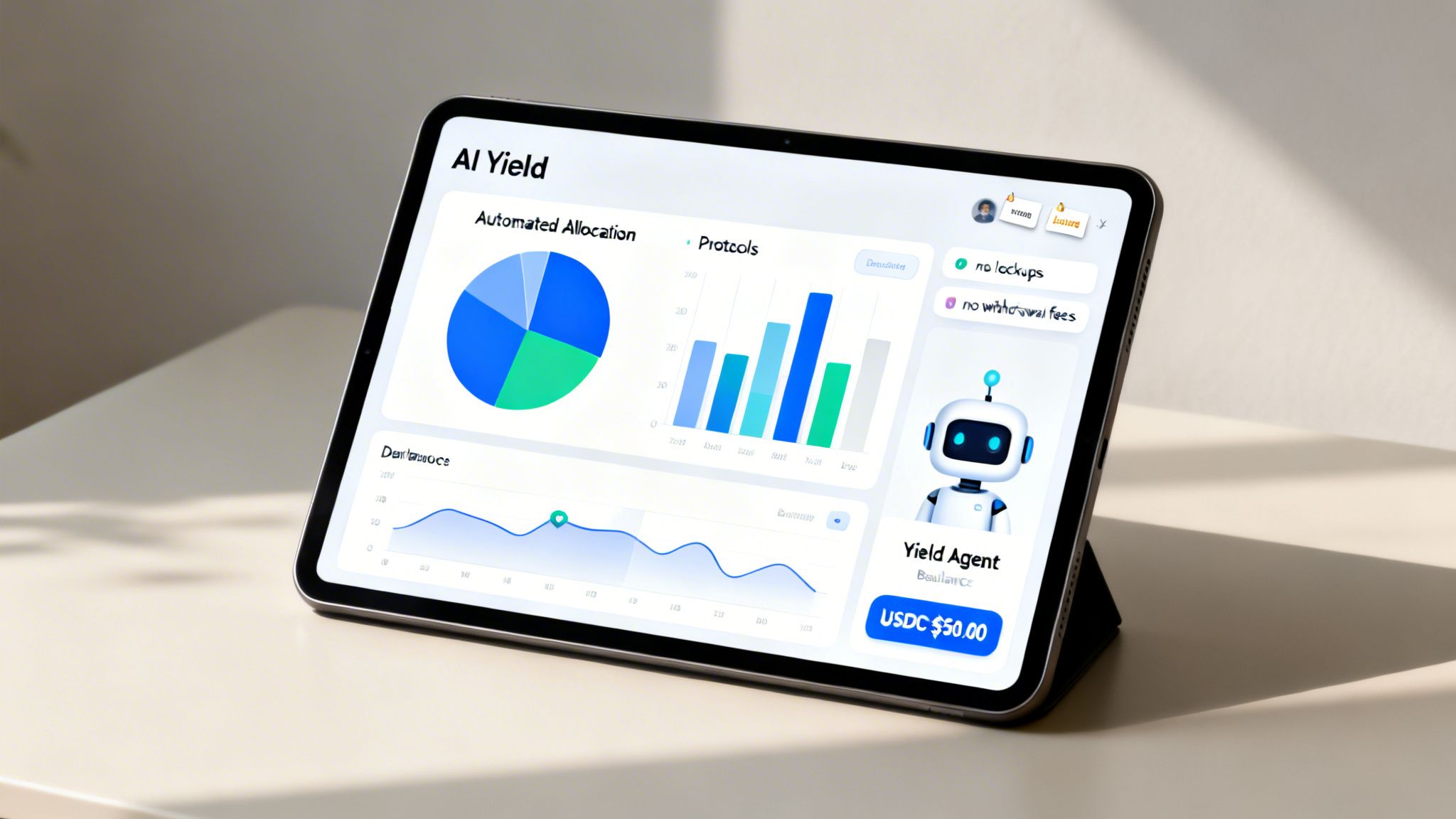
Let's be honest: manually chasing the best yield opportunities, weighing the risks, and constantly moving funds between different protocols is a full-time job. This is where automation stops being a nice-to-have and becomes an absolute necessity for anyone serious about earning efficiently.
Enter the AI Yield Agent. Think of it as your personal, automated portfolio manager for DeFi, built to do all the heavy lifting for you.
Imagine having a dedicated agent working for you 24/7, hunting down the best risk-adjusted no-lockup crypto yield for your stablecoins. That’s exactly what a platform like Yield Seeker does. It takes a dizzyingly complex process and turns it into a simple, set-and-forget experience.
How an AI Agent Makes Yield Farming Simple
An AI Yield Agent is designed to tackle the two biggest headaches in DeFi: its sheer complexity and the massive time commitment it demands. Instead of you needing to become an expert on every hot new protocol, the agent does the work behind the scenes. The core idea isn't that different from an AI coding agent that automates software development, just applied to your portfolio.
This is what makes generating real yield accessible to everyone, from busy professionals to people just dipping their toes into DeFi for the first time. The system is always on, monitoring the market, sniffing out the top-performing (and properly vetted) protocols, and then allocating your capital to get the best returns within a set risk framework.
The Real-World Edge of AI Agents
No-lockup crypto yield is a game-changer for modern treasury strategies, offering a perfect blend of flexibility and solid returns. With stablecoin yields on no-lockup platforms hitting 7% APY with instant access, traditional finance just can't keep up.
This flexibility means you avoid the painful opportunity costs seen in more rigid strategies. Think back to the volatile markets of February 2026, which saw a staggering $3-4 billion in liquidations—no-lockup lets you pull your funds out anytime to avoid that kind of chaos.
For Yield Seeker users, this means depositing as little as $10 USDC on Base and letting the AI optimize for risk-aware yield, all without fees or freezes. It’s an approach trusted by crypto natives and pros who want effortless passive income.
What Are the Core Benefits?
The real magic of using a dedicated AI agent is how it optimizes for performance and safety while delivering a genuinely simple user experience.
Here’s what that looks like in practice:
Automated Diversification: The agent automatically spreads your funds across multiple vetted DeFi protocols. This is a critical risk management move, making sure you’re not overexposed to any single point of failure.
No Lockups or Platform Fees: Your funds are always yours and always accessible. With Yield Seeker, you can deposit or withdraw your stablecoins whenever you want, with no platform-side fees to worry about.
Effortless Onboarding: Getting started is dead simple. You can begin with as little as $10 USDC, which makes it a super low-barrier way for anyone to start earning passive income in DeFi.
The Ideal Tool for Today's Investor
An AI Yield Agent bridges the gap between powerful DeFi opportunities and the everyday person who just doesn't have the time or deep expertise to chase them down manually. It’s a solution that works for different types of investors.
For beginners, it’s a safe and simple on-ramp to earning their first real DeFi yield. The automated system and low entry point take away a lot of the initial intimidation.
For more experienced users, it’s a way to optimize both their time and their returns. It lets them step back from the daily grind of yield farming to focus on bigger-picture strategy. If you want to see exactly how it works, check out our guide on how to use AI agents.
Getting Started With No-Lockup Yield Today
Alright, so we've covered the what, why, and how of no-lockup crypto yield. You've seen the benefits and the risks to keep an eye on. At the end of the day, it all boils down to a powerful mix of earning passive income without ever losing control of your money—a combination that's tough to find anywhere else.
Ready to put some of that theory into practice? Your next move really depends on where you're starting from. The key is to jump in at a level that feels right for you, so you can start earning with confidence.
Your Personal Roadmap to Earning
No matter if you're a seasoned degen or just dipping your toes into DeFi, there's a clear path forward. This isn't some exclusive club for crypto wizards; it's a straightforward strategy for anyone looking to put their stablecoins to work.
Here’s a simple game plan based on your experience level:
For DeFi Newcomers: Start small, keep it simple. Your best bet is to use a platform that handles all the complicated stuff for you. This lets you get a feel for how it all works without needing to become an expert overnight. A first deposit of $50 or $100 is a perfect way to learn the ropes without any pressure.
For Experienced DeFi Users: You already know the landscape, so your goal is optimization. Manually shifting funds between Aave, Compound, and Morpho to chase the best rates is a grind. An automation tool can take that off your plate, freeing you up to focus on bigger-picture strategy instead of constant micro-management.
For Busy Professionals: Your time is your most valuable asset. Think of this as the ultimate 'set-it-and-forget-it' financial tool. A platform that automatically handles allocation, risk, and compounding lets your capital work for you 24/7, no active management required. It's hands-off income, plain and simple.
The big idea is the same for everyone: no-lockup crypto yield puts your money to work for you, but on your terms. It’s about getting competitive returns while keeping the freedom to pull your funds out whenever you want.
The Future Is Liquid
Earning a passive income in crypto has come a long way. The old days of having to choose between good returns and having access to your funds are pretty much over. As we head through 2026, the tools available have made liquid yield easier and safer to access than ever before.
Whether you're making your first $50 deposit or automating a sophisticated strategy, the path is clear. You can now step into one of the most exciting corners of digital finance, knowing your assets are working for you but are always just a click away. The opportunity is here, and you've got everything you need to get started.
Got Questions? Let's Answer Them
Even after getting the hang of the mechanics and risks, a few common questions usually pop up. Let's run through them so you feel totally confident about earning no-lockup crypto yield.
Is No-Lockup Yield Safe for a Beginner?
Yes, it absolutely can be. In fact, it's one of the best ways for a beginner to get their feet wet in DeFi, as long as you're smart about it.
The biggest advantage is flexibility. Since your funds are never locked away, you can pull them out the second you feel nervous or just need the cash. Think of it as your "eject button" while you're still learning the ropes.
To keep things safe, just stick to two simple rules:
Use Reputable Platforms: Stick to the big names—protocols with a long track record, solid security, and public audits. Steer clear of brand-new projects promising crazy-high returns.
Start Small: You don't need to go all-in. Start with a small amount, like $50 or $100. This lets you see exactly how it works without putting much on the line.
What's a Realistic APY to Expect?
The Annual Percentage Yield (APY) for no-lockup strategies is always changing. It moves up and down based on market supply and demand, so it's important to have realistic expectations. If you see a platform promising sky-high, fixed returns with no lockups, be very suspicious—that's a major red flag for hidden risks.
For top-tier stablecoins like USDC on well-respected DeFi lending protocols, a healthy and sustainable APY usually lands somewhere between 3% to 7%. Sure, rates can spike higher when everyone wants to borrow, but they'll also drop when the market cools off. Your real return is the average of these ups and downs over time.
Can I Lose My Initial Deposit?
Yes, you can, and it's crucial to understand this. While the flexibility of no-lockup yield is a great safety feature, it doesn't magically erase the core risks of DeFi.
The number one risk is a smart contract failure. If a hacker finds a vulnerability in the protocol's code, they could potentially drain the lending pool. This is the most direct way you could lose your initial capital.
The best way to guard against this is to only use protocols that have been through multiple security audits by well-known firms. Spreading your funds across a few different top-tier platforms also helps, as it means you're not exposed to a single point of failure.
How Are My Earnings Taxed?
This is a big one that a lot of people miss. In most places, the yield you earn from crypto is considered regular income and is taxed at your standard income tax rate. That means you need to keep a good record of your earnings and their value when you received them.
However, crypto tax laws are a mess. They change all the time and vary wildly from one country to another. Because of this, it's absolutely essential to consult with a qualified tax professional in your area. They can give you advice tailored to your situation and make sure you're staying on the right side of the law. Don't take chances with generic advice you find online.
Ready to put this all into practice without the headache of manual research? Yield Seeker uses an AI agent to automatically find and manage the best risk-adjusted yield opportunities for you. Start earning smarter with as little as $10 USDC, no lockups, and no platform withdrawal fees.