
You've probably had this moment already. You open a DeFi app on Ethereum, line up a stablecoin deposit, check the expected yield, and then see the network fee. Suddenly the whole trade feels smaller, slower, and harder to justify.
That friction is why Layer 2s matter. Not as a buzzword, and not as a purely technical upgrade, but as a way to make ordinary DeFi actions feel usable again. Optimism is one of the clearest examples. It keeps you close to Ethereum's security model while making everyday actions like lending, swapping, and rebalancing much cheaper.
If your practical question is, “How can this help me earn yield safely?”, that's the right place to start. Optimism matters because lower transaction costs change what strategies are realistic, especially for stablecoin users who want steady yield without watching gas prices all day.
Why Pay Less for More on Ethereum
A common Ethereum experience goes like this. You hold USDC, find a lending market you like, approve the token, make the deposit, maybe claim rewards later, then rebalance into a different protocol a week after that. None of those steps are unusual. The problem is that each one can carry a fee.
For larger portfolios, that's annoying. For smaller balances, it can make a decent strategy feel pointless. If you're trying to earn a conservative yield on stablecoins, losing money on setup and maintenance is the opposite of the outcome you want.
The problem isn't DeFi itself
Ethereum's base layer is valuable because it's secure and widely used. But that popularity creates congestion. When lots of people want block space at the same time, simple actions become expensive.
That's why people spend so much time trying to optimize your ethereum gas costs. Timing matters, but timing alone doesn't solve the bigger issue. The structure of the network is what creates the bottleneck.
Practical rule: If a strategy requires frequent deposits, claims, or reallocations, fees matter almost as much as yield.
Layer 2 networks were built to remove that bottleneck for everyday use. They let you keep using Ethereum-based apps and assets while moving the high-frequency activity to a cheaper environment.
Where Optimism changes the math
Optimism is one of the best-known Ethereum Layer 2 networks. Its value becomes obvious the first time you compare the same action on mainnet and on L2. By batching thousands of transactions, Layer 2 networks like Optimism can reduce transaction fees by up to 100x compared to making the same transaction directly on the Ethereum mainnet, often bringing costs down from dollars to mere cents (l2fees.info).
That fee difference changes behavior. On mainnet, you might avoid small rebalances, skip claiming rewards, or decide a yield opportunity isn't worth touching. On Optimism, those actions become much more practical.
If you're still getting oriented, this overview of Layer 2 scaling solutions is useful because it frames the bigger picture without drowning you in jargon.
Why this matters beyond one chain
Optimism also matters because it's part of a broader direction in Ethereum scaling. You'll often hear people talk about the Superchain, which is the idea that multiple chains can share common technology and feel more connected over time.
That's relevant even if you don't care about infrastructure. Many users already move between ecosystems such as Optimism and Base depending on where the best stablecoin opportunities are. If chains start to feel more like connected neighborhoods than isolated islands, finding yield gets easier and cheaper.
For a yield-focused user, that's the key takeaway. Optimism isn't interesting because it sounds advanced. It's useful because it makes routine DeFi actions cheap enough to do sensibly.
What Is Optimism The Express Lane for Ethereum
The easiest way to understand Optimism is to stop thinking about it as a separate world.
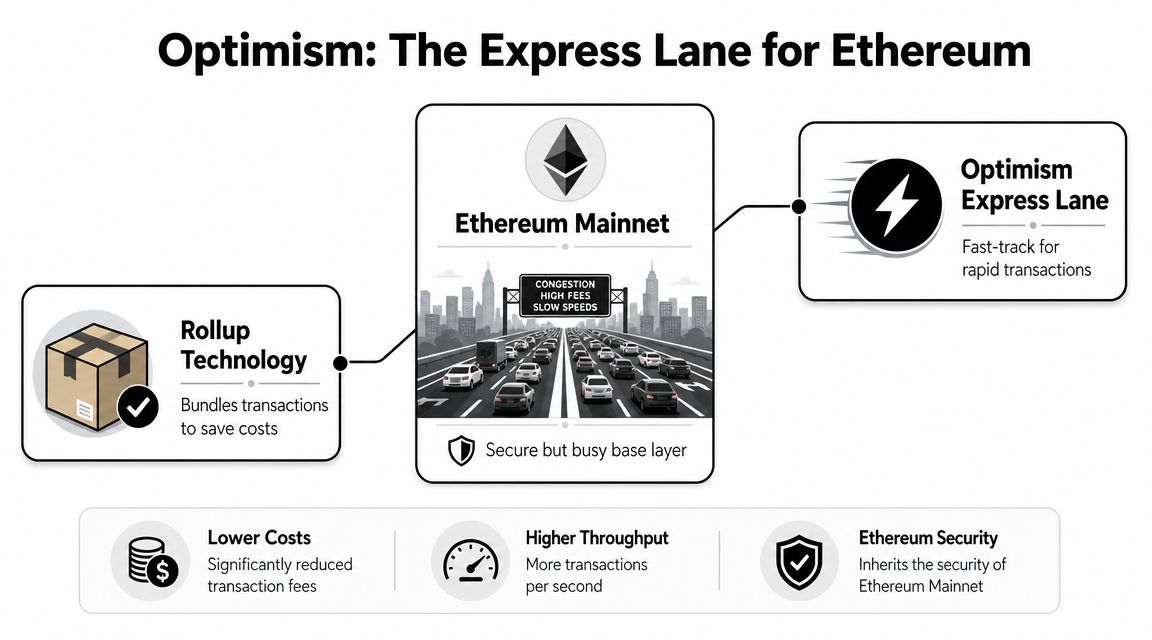
Think of Ethereum mainnet as a busy highway that everyone trusts. It's the main route, the most established road, and the place where final settlement matters most. But it's crowded. Cars move, just not always quickly or cheaply.
Optimism is the express lane built next to that highway. It still connects to the same destination, but it handles traffic more efficiently.
What you do on Optimism
From a user's perspective, Optimism often feels familiar. You connect the same wallet, use many of the same asset symbols, and interact with versions of the same DeFi categories you already know.
You can:
Swap tokens on decentralized exchanges
Lend stablecoins in money markets
Provide liquidity to trading pairs
Bridge assets back to Ethereum or to other ecosystems
That familiarity is one reason optimism adoption has been strong among ordinary DeFi users. You don't need to learn an entirely new mental model to get started.
What an Optimistic Rollup means in plain English
Under the hood, Optimism is an Optimistic Rollup. The name sounds technical, but the idea is pretty simple.
Start with the word rollup. Instead of sending every single transaction to Ethereum one by one, Optimism bundles many transactions together and posts the summary back to Ethereum. That bundling is what makes the system more efficient.
Now the word optimistic. The network assumes those bundled transactions are valid unless someone proves otherwise. It's an honor system with a referee standing nearby.
Here's the plain-language version:
Users transact on Optimism. Swaps, deposits, and transfers happen there.
Optimism groups those actions together. Instead of asking Ethereum to process each one separately, it packages them.
Ethereum stores the result. That keeps the system tied to Ethereum's base security.
Watchers can challenge bad data. If someone posts something invalid, the system gives others a way to contest it.
Think of it like a store receipt. You don't carry every shelf interaction to the cashier one at a time. You check out once, and the receipt summarizes what happened.
That's the basic magic. Faster local activity, then secure settlement on Ethereum.
Why users care about the OP ecosystem
If you spend time on Optimism, you'll also run into the OP token. It's tied to governance and ecosystem participation rather than replacing ETH's role as the broader settlement foundation.
For many users, OP matters in two ways. First, governance can shape how incentives and grants support apps in the ecosystem. Second, market participants often watch the token as a rough signal of network attention and sentiment. If you want a simple dashboard for that, you can track OP token performance without needing to dig through multiple tabs.
The deeper point is this: Optimism isn't trying to replace Ethereum. It's trying to make Ethereum usable at a lower cost for people who want to do things onchain.
Optimism vs Other Layer 2 Solutions
Once you understand the express-lane idea, the next question is usually practical. Why use Optimism instead of Arbitrum, or instead of a ZK-rollup like zkSync Era?
The short answer is that all three aim to make Ethereum more usable, but they make different trade-offs around proof systems, ecosystem style, and user experience. For someone chasing stablecoin yield, those differences affect how easy it is to move funds, how quickly withdrawals settle, and what protocols are available.
The user-level difference
Optimism and Arbitrum belong to the same broad family. They use an optimistic approach, where transactions are accepted unless challenged. zkSync Era uses a validity proof approach, where cryptographic proof plays a more central role before final acceptance.
If that sounds abstract, here's the practical version:
Optimistic rollups feel straightforward and Ethereum-aligned, but native withdrawals can take longer because there's a challenge period.
ZK-rollups are often associated with quicker final confirmation at the protocol level, but the underlying systems can feel more specialized depending on the app and tooling.
Neither model is automatically better for every user. If you're mostly parking stablecoins in lending markets and don't need constant exits back to mainnet, Optimism's trade-off can make plenty of sense.
Layer 2 At a Glance
Feature | Optimism | Arbitrum | zkSync Era |
|---|---|---|---|
Core approach | Optimistic rollup | Optimistic rollup | ZK-rollup |
Security style | Assumes validity unless challenged | Assumes validity unless challenged | Relies on validity proofs |
Native withdrawal feel | Slower because of challenge period | Slower because of challenge period | Often perceived as faster at the proof level |
Ecosystem identity | Strong focus on OP Stack and Superchain vision | Broad DeFi presence and strong app variety | ZK-focused scaling path |
Best fit for | Users who want Ethereum-like UX and access to Superchain ecosystems | Users comparing a mature optimistic L2 alternative | Users interested in ZK-based scaling design |
Where Optimism stands out
Optimism's biggest differentiator isn't just that it's cheap to use. It's that the network is tied to a larger OP Stack vision. That matters because more chains built on similar architecture can reduce fragmentation over time.
For a yield user, ecosystem shape matters as much as technical purity. You want enough lending markets, enough liquidity, and enough stablecoin activity to deploy capital without jumping through hoops. Optimism has become one of the core places where that activity lives.
Different L2s don't just compete on speed. They compete on where developers build, where liquidity settles, and where users can actually execute a full strategy.
So when people compare Optimism to other L2s, the best question isn't “Which one wins?” It's “Which one gives me the cleanest path to the strategy I want to run?” For many stablecoin users, Optimism is near the top of that list because it combines familiar DeFi primitives with low enough costs to make active maintenance realistic.
How Optimism Secures Your Funds
Cheap fees are nice. They don't matter if users don't trust the system holding their assets.
Optimism's security model is easier to understand if you think about how a check clears at a bank. The bank may show the deposit before every final verification step is complete, but there's a review window behind the scenes. That delay exists to catch fraud, not to annoy you.
Optimism works with a similar logic. Transactions are treated as valid unless someone proves they aren't.

The innocent until proven guilty model
When activity happens on Optimism, the network posts data back toward Ethereum. The system doesn't require every transaction to be pre-proven before moving forward. Instead, it allows a challenge period where invalid state transitions can be disputed.
That's the role of fraud proofs in simple terms. They're the referee mechanism. If someone tries to sneak in an incorrect result, the system gives others time to challenge it.
This is why people say Optimism inherits security from Ethereum. The final trust anchor is still Ethereum's base layer, not a random side system making unchecked claims.
Why withdrawals can feel slow
The most confusing part for new users is the withdrawal delay from Optimism back to Ethereum mainnet. People often see the waiting period and assume something is broken.
It isn't. The delay is part of the security design.
If the network gives challengers time to dispute invalid submissions, then native withdrawals can't be instant. That waiting period is what allows the “assume valid unless challenged” system to work safely.
A better way to think about it is this:
Fast onchain actions inside Optimism
Delayed native exit to Ethereum for security review
Optional third-party routes if you need faster liquidity
The withdrawal wait isn't dead time. It's the cost of having a challenge window that protects users from invalid state updates.
What users actually do in practice
Most users don't spend their day withdrawing directly back to Ethereum mainnet. They usually stay within the L2 ecosystem, move between apps on the same network, or use third-party bridges when speed matters more than the native path.
That doesn't remove risk. It changes where the risk sits. A third-party bridge may offer convenience, but it adds another layer of trust and smart contract exposure. That's why risk management still matters even on a well-known L2.
A good rule is to separate risks into buckets:
Protocol risk from the app where you deposit funds
Bridge risk if you move assets across systems
Operational risk from wallet mistakes, wrong networks, or fake sites
If you want a practical framework for that last two-thirds of the problem, this guide to managing DeFi smart contract risk is worth reading before you move meaningful capital.
Optimism's security story is strong because it doesn't ask you to trust magic. It asks you to trust Ethereum-backed settlement plus a challenge mechanism. That's much easier to reason about.
Finding Yield on Optimism A Practical Guide
Optimism becomes more than a scaling concept. It becomes a place to put stablecoins to work.
The ecosystem is large enough that you can usually find more than one style of strategy. As of early 2026, the Optimism ecosystem holds over $10 billion in Total Value Locked, with DeFi applications like lending protocols and decentralized exchanges accounting for more than 60% of that value (DefiLlama data for Optimism). That matters because yield opportunities need liquidity, borrowers, traders, and active protocols to function.

Step one is getting funds onto Optimism
Users often begin with stablecoins such as USDC or USDT on another chain or on an exchange. To use them on Optimism, you bridge them over.
In practical terms, that means:
Choose your route. The official bridge is the simplest trust model for many users, while third-party bridges may offer different speed and liquidity trade-offs.
Confirm the destination network. Double-check that your wallet is set to Optimism before approving anything.
Bridge a test amount first. This catches wallet or interface mistakes before they become expensive.
Verify the token you received. Make sure you're dealing with the expected stablecoin version inside the apps you plan to use.
Often, new users get tripped up. They think bridging is an investment decision. Usually, it's an operational one. The investment decision comes after your assets land on the network.
Three common yield paths
Once your stablecoins are on Optimism, most yield strategies fall into a few buckets.
Lending markets
Protocols like Aave let you deposit stablecoins into a lending pool. Borrowers pay to access that liquidity, and lenders earn based on pool utilization and protocol design.
This is often the cleanest starting point for beginners because the position is easier to understand. You deposit the asset, receive a tokenized claim, and monitor the rate. There's no need to manage price ranges or LP rebalancing.
A simple checklist helps here:
Asset quality: Stick to stablecoins you understand.
Market depth: Deeper markets tend to be easier to enter and exit.
Collateral context: Know what kinds of borrowing activity support the yield.
DEX liquidity provision
Protocols such as Velodrome can offer stablecoin-related opportunities through liquidity pools. Here, you provide assets that traders use for swaps, and in return you may earn trading fees and, in some cases, protocol incentives.
This route can be attractive, but it's not automatically “safe yield.” Pool structure matters. If the pair isn't stable-stable, price movement can change your exposure. Even stable pairs can involve smart contract and incentive risk.
If you can't explain where the yield comes from in one sentence, don't size the position aggressively.
Aggregated vault strategies
Some users prefer vaults and automated managers that route funds across lending, liquidity, and incentive programs. The appeal is obvious. You spend less time monitoring markets and less time manually chasing shifts in rates.
The trade-off is that you need to understand the vault's rules, underlying protocols, and withdrawal behavior. Automation saves time, but it doesn't eliminate due diligence.
For readers comparing ecosystems, this overview of Base Layer 2 yield opportunities gives useful context on how neighboring OP Stack environments can present similar, but not identical, choices.
A safe way to think about stablecoin yield
The safest mindset isn't “find the highest APY.” It's “find yield I can understand, monitor, and exit.”
That usually means asking:
What activity generates this return? Borrowing demand, trading fees, incentives, or some mix.
What could go wrong? Smart contract bugs, depegs, bridge problems, or incentive changes.
How quickly can I leave? Onchain liquidity and withdrawal mechanics matter.
This walkthrough gives a decent visual sense of how people approach Optimism-based activity in practice:
Optimism helps because it lowers the cost of managing these decisions. You can test with smaller amounts, rebalance more rationally, and avoid burning yield on transaction fees. That doesn't make every strategy safe. It makes careful strategy execution more realistic.
The Future Is Superchain Is Optimism Worth It?
Optimism is worth learning because it solves a real user problem. It makes Ethereum-based DeFi cheaper to use while keeping security anchored to Ethereum's broader trust model. For stablecoin holders, that means ordinary actions like depositing, rebalancing, and exiting no longer feel reserved for large accounts.
The bigger story is the Superchain direction. If more chains share similar infrastructure and become easier to move across, users won't have to treat every ecosystem as a separate maze. That's powerful for yield seekers because good opportunities rarely stay in one place forever.
Optimism also sits in a useful middle ground. It's accessible enough for newer users, but deep enough for more advanced strategies. You can start with plain lending and grow into more active DeFi if you want to. Or you can stay conservative and still benefit from lower fees.
Optimism isn't just a cheaper place to click buttons. It's part of a shift toward making onchain finance usable for normal portfolio management.
If your goal is to earn yield safely, optimism as a network helps most when you pair it with discipline. Use known protocols. Bridge carefully. Keep position sizes sensible. Understand the source of the return. The chain can improve the economics of your strategy, but you still decide whether the strategy is sound.
If you want a simpler way to put stablecoins to work without manually checking rates, moving funds across apps, and babysitting every yield change, Yield Seeker offers an AI-powered approach built for hands-off, risk-aware stablecoin yield. You can start with USDC, keep funds accessible, and let the platform handle the ongoing monitoring and allocation work that usually eats up your time.