
The popular advice is to start with smart-contract audits. That's necessary, but it's an incomplete starting point for risk management documentation in DeFi yield operations. A clean audit report won't tell you whether a signer can be phished, whether an operations analyst can mis-tag a treasury wallet, or whether anyone has authority to move capital when a stablecoin loses its peg.
Recent EBA and ESMA material identifies a practical blind spot: attacks against DeFi arrangements appear more successful when they exploit off-chain vulnerabilities, while pseudonymous and self-custodial structures make oversight harder. For a stablecoin treasury, the audit-ready question isn't only “Is the code reviewed?” It's also “Can the team prove who can act, what they monitor, when they escalate, and how they learned from the last failure?” (EBA and ESMA DeFi factsheet)
Why Most DeFi Risk Documentation Misses the Real Attack Surface
A protocol-focused risk register usually looks reassuring. It lists reentrancy, oracle manipulation, upgrade keys, liquidity risk, and audit findings, often with links to Solidity repositories and security reports. The weakness is that it can describe the protocol while saying almost nothing about the operating system around it.
That operating system includes signer devices, wallet inventories, treasury approvals, monitoring dashboards, escalation routes, and human judgment. If a team can't connect those activities to named controls and retained evidence, its documentation describes theoretical risk rather than operational risk.
Three gaps that shorten the response window
A phishing attack against a multisig signer requires more than a key-management policy. The policy should identify approved hardware-wallet workflows, prohibited browser extensions, transaction-simulation requirements, signer replacement steps, and the evidence retained after each approval. Without those details, an auditor can't distinguish a real control from a statement that says “use secure custody.”
Wallet mis-tagging creates a different problem. If an analyst labels a treasury wallet as a strategy wallet, the team may apply the wrong limit or fail to include the address in daily reconciliation. A wallet-inventory register should record the chain, address, purpose, owner, signer set, approval threshold, connected protocols, permitted transaction types, and last verification date.
Depeg response exposes the gap between monitoring and action. A peg-monitoring runbook needs defined data sources, alert conditions, a responder, withdrawal or reallocation authority, communication rules, and an after-action record. It should also explain what happens when the normal monitoring path is unavailable.
Root Cause Category | Share of Dollar Loss | Typical Documentation Gap |
|---|---|---|
Smart-contract and protocol code risk | Not specified in the verified data | Audit findings aren't connected to treasury limits, deployment decisions, or response actions |
Off-chain compromise, including phishing and signer failure | Recent EBA and ESMA material says these vulnerabilities appear more successful in recent DeFi attacks, but it doesn't quantify their share | Missing key-management procedures, device attestations, and signer replacement records |
Treasury operations and governance failure | Not specified in the verified data | Incomplete wallet inventories, unclear approval authority, stale escalation paths, and absent review evidence |
The practical shift is simple: begin the threat model with the people and processes that can authorize capital movement. Protocol reviews remain essential, but they're one input into a broader record of how the treasury operates.
The Core Risk Management Framework You Can Anchor Everything To
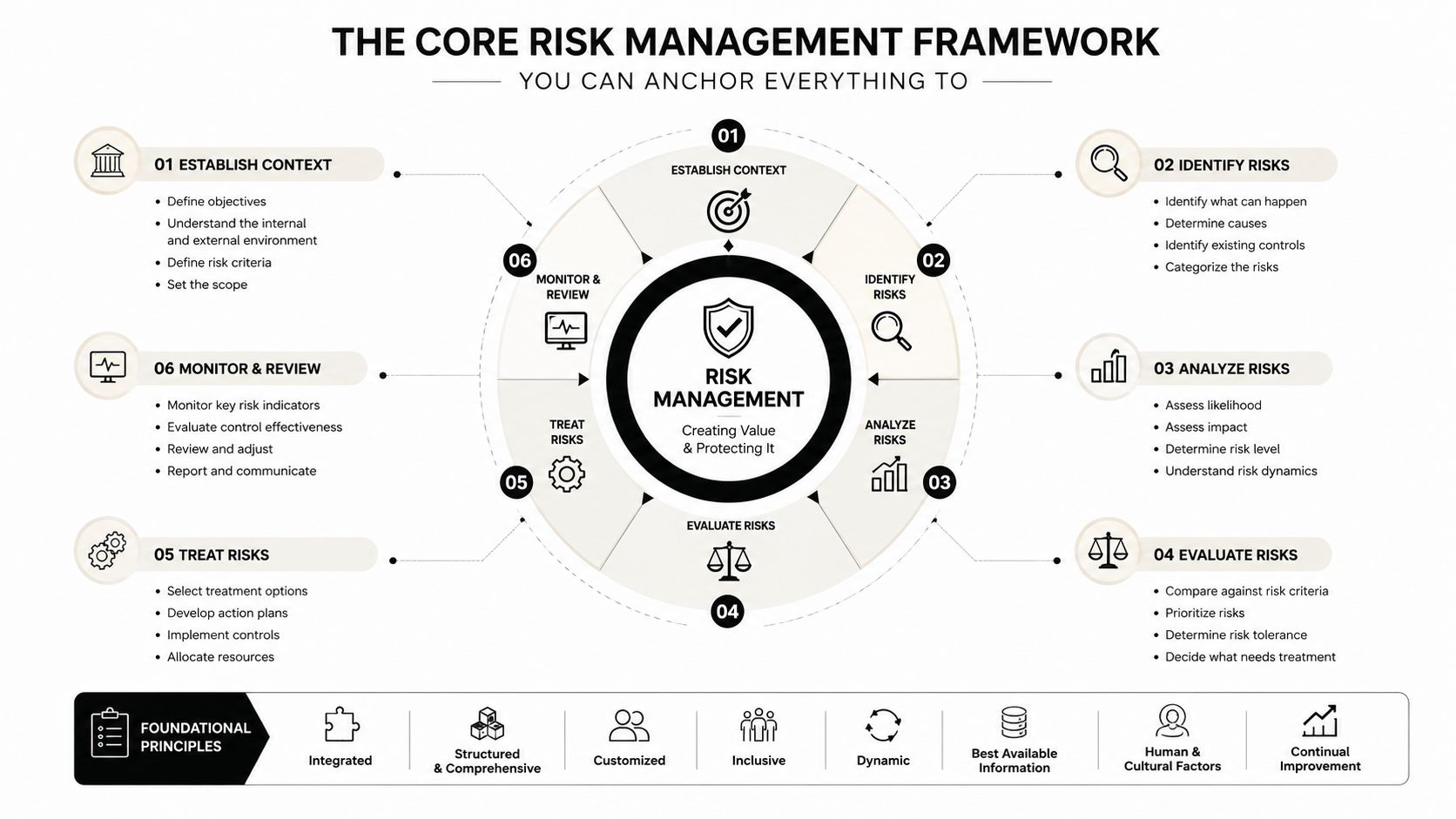
ISO 31000 provides a credible foundation because it treats risk management as part of governance, leadership, decision-making, monitoring, review, recording, and reporting. ISO first published the core reference in 2009 and revised it as ISO 31000:2018 in February 2018. The current edition is a concise 16-page international standard, and its scope applies across organizations, industries, and sectors. (ISO 31000:2018)
For a stablecoin yield operation, the framework becomes useful when every principle points to a document.
Turn the framework into operating records
Scope and context: The policy defines which stablecoins, chains, protocols, bridges, custodians, wallets, and service providers fall inside the program. It also states the operation's objectives, such as preserving liquidity while seeking yield.
Risk criteria: The risk appetite statement defines acceptable exposure, prohibited activities, escalation triggers, and who can approve an exception.
Identification: The risk register records threats across market, operational, technology, custody, third-party, and governance categories.
Analysis and evaluation: The register captures likelihood, impact, assumptions, existing controls, residual risk, and the decision to accept, mitigate, avoid, or transfer.
Treatment: The controls matrix connects each material risk to preventive, detective, or corrective measures and names the evidence those measures produce.
Monitoring and review: Monitoring exports, incident tickets, review minutes, and updated risk ratings show whether the control environment remains current.
Communication and reporting: Committee packs, board minutes, incident notifications, and exception reports prove that the right people received and acted on risk information.
This is why a recognized framework matters. “Best practice” is an opinion. A documented mapping to ISO 31000 gives legal, compliance, engineering, and treasury teams a shared vocabulary. Teams working across regulated financial structures can also compare their approach with practical resources on fraud prevention for Church Extension Funds, particularly where governance, approvals, and evidence need to work together.
Building a Risk Register That Actually Drives Action
A decorative register names risks. An operational register tells someone what to do next, who must do it, and when the decision will be reviewed.
Use a consistent 1 to 5 likelihood and 1 to 5 impact matrix. The score is a prioritization aid, not a claim of mathematical precision. A low-likelihood event with catastrophic impact shouldn't disappear because its product is lower than a frequent inconvenience.
Build each row around a decision
Field | Description | Example: USDC Depeg | Example: Oracle Staleness | Example: Signer Key Compromise |
|---|---|---|---|---|
Risk ID | Permanent identifier | MKT-001 | TECH-004 | CUST-002 |
Description | Specific event and consequence | USDC trades below the approved peg range, reducing treasury NAV | Chainlink data becomes stale during a low-liquidity period, creating mispriced liquidations | Signer approves a malicious transaction after installing a fake Ledger Live update |
Category | Consistent risk taxonomy | Market | Technology | Custody and operational |
Inherent likelihood | Rating before controls | Low, with tail-heavy consequences | Medium | Low |
Inherent impact | Business and capital consequence | Material NAV drawdown and possible withdrawal pressure | Incorrect collateral or allocation decisions | Potential loss of controlled funds |
Residual score | Rating after controls | Reduced by diversification, limits, and alerts | Reduced by freshness checks and fallback procedures | Reduced by hardware-wallet policy and independent review |
Risk owner | Named role with authority | Treasury Risk Owner | Engineering Risk Owner | Security Lead |
Treatment decision | Accept, mitigate, avoid, or transfer | Mitigate | Mitigate | Avoid or mitigate |
Linked controls | Control IDs, not general prose | MKT-C01, OPS-C03 | ORC-D02, INC-C01 | KEY-P01, KEY-D03 |
Review date | The next required review | Dated governance review | Dated technical review | Dated custody review |
Use a heat map to make prioritization visible:
Impact \ Likelihood | 1 | 2 | 3 | 4 | 5 |
|---|---|---|---|---|---|
5 Catastrophic | High | High | Critical | Critical | Critical |
4 High | Medium | High | High | Critical | Critical |
3 Moderate | Low | Medium | High | High | Critical |
2 Low | Low | Low | Medium | Medium | High |
1 Negligible | Low | Low | Low | Medium | Medium |
The risk owner must be a role with sign-off authority, not “protocol team” or “operations.” A reviewer should be able to ask that person why the score is appropriate, what treatment was selected, and whether the linked control is operating.
Teams that want to extend their register with structured assessment workflows can review automated risk assessment tools. Whatever tool you use, the register is defensible only when each row has a rationale, owner, treatment decision, linked evidence, review date, and a record of what changed.
A Controls Matrix Tailored to Stablecoin Yield Operations
The controls matrix should answer one question quickly: What prevents, detects, or corrects this risk, and what evidence proves the control operated?
A control described as “monitoring” is not enough. Name the tool, metric, threshold, alert owner, escalation path, and retained output. A daily position check, for example, should identify the source wallets, the internal ledger, the person who investigates discrepancies, and the report or ticket created when balances don't reconcile.
Separate control design from control operation
Risk | Control | Type | Owner | Evidence Artefact | Effectiveness |
|---|---|---|---|---|---|
Unauthorized treasury transaction | Multisig signer policy with hardware-wallet and independent approval requirements | Preventive | Security Lead | Current policy, signer roster, approval records | Evidence-tested |
Oracle deviation or stale price | Alert based on documented deviation and freshness conditions, with a named responder | Detective | Engineering Risk Owner | Alert configuration, alert history, response ticket | Operating |
Misstated strategy exposure | Reconcile on-chain positions against the internal ledger | Detective | Treasury Operations Lead | Dated reconciliation report and exception log | Evidence-tested |
Protocol exploit or emergency withdrawal | Strategy pause and withdrawal runbook | Corrective | Incident Commander | Approved runbook, tabletop output, incident record | Designed |
Repeated control failure | Remediation ticket with owner, due date, and closure evidence | Corrective | Risk Committee Secretary | Ticket history, attached evidence, reviewer closure | Operating |
Use three effectiveness states instead of a binary pass or fail:
Designed: The control exists, has an owner, and is documented well enough to execute.
Operating: The team has performed it in normal operations and retained evidence.
Evidence-tested: A reviewer has tested the evidence, exceptions were assessed, and the conclusion is recorded.
That distinction exposes a common weakness. A team may have an excellent signer policy, but if it can't produce recent approval records or demonstrate that signers followed the process, the control has design maturity without operating proof.
Corrective controls deserve equal attention. A closed remediation ticket should show the original finding, the change made, the test performed, the person who reviewed the result, and the date the risk register was reconsidered. Otherwise, “fixed” is just an unsupported status label.
Incident Response Documentation for DeFi Events
An incident runbook should reduce decision time, not restate security principles. Write it around events the team can recognize quickly: smart-contract exploit disclosure, stablecoin depeg, bridge compromise, oracle manipulation, and compromised signer key.
Define severity tiers in operational language:
SEV1: Immediate threat to controlled funds or a material strategy. The incident commander can pause, withdraw, or block activity without waiting for a routine committee meeting.
SEV2: Serious degradation or credible threat requiring coordinated response and executive notification.
SEV3: Contained event with limited exposure, requiring documented investigation and remediation.
SEV4: Alert, anomaly, or near miss that doesn't create immediate exposure but may reveal a control weakness.
The runbook should include target response times for each tier, but those targets must reflect the team's actual staffing and tooling. A three-person treasury shouldn't promise continuous coverage it can't provide.

Put execution details on the page
A practical decision tree follows this order:
Detect: Record the alert, source, timestamp, affected chain, protocol, wallet, and transaction.
Triage: Confirm whether the signal is real, classify the event, estimate exposure, and assign severity.
Contain: Pause the strategy, revoke permissions, restrict signers, or stop new deposits according to pre-approved authority.
Authorize withdrawal or reallocation: Identify who can approve movement and which destination wallets are permitted.
Communicate: Use approved internal and external communication routes, with a record of what was sent and when.
Resolve and review: Reconcile funds, document the timeline, classify root cause, and assign remediation.
List wallet addresses, bridge contracts, exchange accounts, oracle providers, escalation contacts, and emergency transaction procedures in controlled appendices. During the first minutes of an event, searching through chat history is a documentation failure.
Post-incident records should include timestamps, root cause classification, control gap, affected assets, decisions taken, evidence reviewed, remediation owner, due date, and closure approval.
Governance Documentation Regulators Will Look For
DORA-style scrutiny turns governance from a statement of intent into an evidence exercise. Reviewers may ask for the risk committee's terms of reference, a RACI matrix for strategy approvals, minutes showing risk appetite approval, delegated authority schedules, incident templates, completed registers, criticality assessments, and proof that the board or governing body approved the relevant decisions. This aligns with the documented failure modes described in recent independent risk-management commentary, including incomplete registers and missing board-level approval evidence. (Risk-management workflow commentary)
Make approval testable
A risk appetite statement should use thresholds the reviewer can test. For a stablecoin yield treasury, that might include:
Maximum acceptable exposure to a depeg scenario.
Minimum oracle freshness or deviation trigger.
Maximum single-protocol allocation.
Maximum bridge or custodian exposure.
Authority required to exceed a limit.
Duration and compensating control for any exception.
Don't record “approved by governance” without an approving body, meeting date, decision text, version number, and attached analysis. The same applies to strategy whitelisting, signer changes, and new vendor onboarding.
A small team can use role separation even when people wear multiple hats. The preparer can propose a transaction, a separate signer can approve it, and the risk owner can review the evidence. Document the combined roles, the conflict checks, and the compensating review rather than pretending the separation is perfect.
Policy reviews should occur on a defined cadence and after a severe incident. Capture version dates, reviewer names, approval status, exceptions, and the next review date. A governance platform or crypto compliance software can help organize these records, but software won't repair an approval process that has no decision rights.
Documenting Off-Chain and Wallet-Level Risks Properly
Contract audits answer whether reviewers found issues in the code they examined. They don't prove that a signer can identify a malicious transaction, that a treasury wallet is correctly classified, or that a team member can respond to a SIM swap.
The EBA and ESMA DeFi factsheet highlights governance, operational resilience, outsourcing, and disclosure concerns in crypto-asset arrangements. Those themes belong in the same risk file as protocol audits because an on-chain control can fail when an operator interacts with a spoofed dashboard or compromised device.

Maintain a wallet inventory with ownership, purpose, chain, signer roles, approval threshold, protocol permissions, spending limits, and verification history. Pair each risk with four fields:
Preventive control: Hardware-wallet procedure, allowlist, transaction simulation, device checklist, or separation between preparation and approval.
Detective signal: Unexpected approval, new browser extension, login anomaly, unusual transaction destination, missing signer, or balance discrepancy.
Corrective owner: Named person responsible for revocation, signer replacement, fund isolation, vendor escalation, or incident command.
Retained evidence: Device attestation, transaction hash, approval record, simulation output, revocation record, communication log, or drill result.
Include procedures for phishing, SIM swaps, malware, lost devices, malicious extensions, compromised team members, and vendor-account takeover. The policy should state how the team suspends access, rotates credentials, revokes allowances, preserves evidence, and validates recovery.
The operating system matters as much as the source code. A clean contract-audit folder cannot compensate for an undocumented treasury process.
Audit Trails Version Control and Evidence of Review
An audit trail proves that the risk process operated. It isn't a collection of PDFs that someone last edited months ago.
Every controlled document should have a unique ID, title, owner, approver, effective date, review date, status, version, and retention rule. Store prior versions as read-only records. Never overwrite a previous risk rating, control decision, policy approval, or incident conclusion.
Preserve the decision history
A change log should state what changed, why it changed, which evidence supported the change, what incident or exposure triggered it, and who reviewed the conclusion. Separate policy approval from evidence approval. The person who approves a control design shouldn't automatically become the only person validating that the control operated.
Document/Action | Required Evidence | Review Expectation |
|---|---|---|
Risk policy | Version history, owner, approval, effective date | Confirm scope, appetite, roles, and review status |
Risk register update | Prior rating, new rating, rationale, linked evidence | Confirm assumptions and residual-risk decision |
Wallet or signer change | Address, role, approval, implementation record | Verify authorization and reconciliation |
Transaction approval | Proposal, wallet, chain, approvals, simulation, hash, execution timestamp | Confirm the transaction followed delegated authority |
Periodic review | Attendance, exceptions, actions, owners, due dates | Confirm review produced decisions, not just attendance |
Remediation closure | Finding, corrective action, test result, reviewer approval | Confirm closure evidence supports the status |
For transaction-level actions, retain the wallet address, chain, block, transaction hash, proposal, approvals, simulator result, and execution timestamp. For periodic reviews, retain attendance, exceptions, remediation owners, due dates, and closure evidence.
Teams evaluating workflow systems can use an AI coworker audit trail by Supercenter as a reference point for how activity history can be organized. DeFi-specific evidence still needs its own fields, and a smart-contract security audit should remain linked to the relevant protocol and risk decision rather than stored as an isolated attachment.
A Ready to Customize Risk Management Policy Template
A small treasury doesn't need a 100-page policy. It needs a short policy that points to operating records and assigns every decision to a role.
Use this structure:
Purpose and scope: List stablecoins, chains, lending markets, liquidity pools, bridges, custodians, RPC providers, oracles, wallets, and vendors covered.
Definitions: Define risk appetite, tolerance, residual risk, incident, exception, material change, and strategy pause.
Prohibited activities: State which assets, protocols, leverage patterns, bridges, or transaction types are outside authority.
Governance and roles: Assign duties to the board or risk owner, investment committee, operations lead, contract reviewer, security lead, and incident commander.
Methodology: Reference the scoring matrix, treatment decisions, assessment assumptions, and review process.
Due diligence: Require protocol review, liquidity assessment, oracle assessment, upgrade-admin review, and third-party review.
Wallet and key management: Define signer onboarding, device standards, allowlists, simulations, approvals, revocation, and recovery.
Exposure limits and monitoring: Set concentration limits, depeg triggers, collateralization triggers, and reconciliation requirements.
Incident response: Link to the event runbook and delegated emergency authority.
Outsourcing, retention, training, exceptions, and assurance: Record vendor oversight, evidence retention, training completion, exception expiry, testing, and scheduled review.
Add placeholders directly into the policy rather than burying them in a separate spreadsheet. Each escalation trigger should specify the metric, threshold, decision-maker, and required record. Examples include percentage loss, duration of depeg, collateralization change, unauthorized transaction, or limit breach.
Append the risk register, controls matrix, incident runbook, and change-approval form. The policy becomes useful when a reviewer can follow one control from principle to execution evidence.
Comparing ISO 31000 ISO 14971 and DORA Style Documentation
These baselines overlap, but they solve different documentation problems. Treating them as interchangeable produces a vague hybrid with no clear purpose.
ISO 31000 is the general-purpose process anchor. ISO first published it in 2009 and revised it as ISO 31000:2018 in February 2018, with the current edition emphasizing governance, leadership, decisions, monitoring, review, recording, and reporting. (ISO overview) It supports a risk policy, criteria, register, treatment plan, monitoring records, and governance reporting. Used alone, it may not prescribe enough detail for a highly regulated product or ICT outsourcing review.
ISO 14971-derived practice is lifecycle-oriented. In regulated environments, documentation includes a risk management plan, risk management file, acceptability criteria, overall residual-risk evaluation, control verification, and post-production information maintained for each product or device family through end of life. (ISO 14971 documentation practice) For DeFi, it's useful when a product makes ongoing client-facing commitments, but it shouldn't be presented as a DeFi regulatory mandate.
DORA-style documentation emphasizes ICT risk, resilience, incidents, criticality, third parties, governance, and evidence of operating controls. It's the closest of the three to the questions a regulator-style reviewer asks about operational accountability and technology dependencies. Used alone, it can become control-heavy without giving the treasury a clear risk philosophy.
Dimension | ISO 31000 | ISO 14971-style lifecycle practice | DORA-style documentation |
|---|---|---|---|
Primary purpose | General risk process and governance | Lifecycle risk and post-production evidence | ICT resilience, incidents, and third-party accountability |
Core artefacts | Policy, criteria, register, treatment records, reporting | Risk plan, risk file, control verification, post-production records | ICT register, incident records, criticality analysis, testing, approvals |
Best DeFi use | Anchor the overall treasury program | Document product commitments and lifecycle changes | Prepare for regulator-grade operational review |
Limitation alone | Can be too principles-based | Originates in medical-device practice | Can become fragmented without a broader risk method |
A stablecoin yield treasury serving EU clients should anchor its process in ISO 31000, borrow lifecycle discipline where product commitments require it, and overlay DORA-style evidence for ICT and regulatory readiness.
A 90 Day Documentation Rollout Sequence
A documentation program becomes credible when each phase ends with a file, a decision, or a test. Don't wait for a perfect platform. Use a controlled repository, assign ownership, and create evidence as the team works.
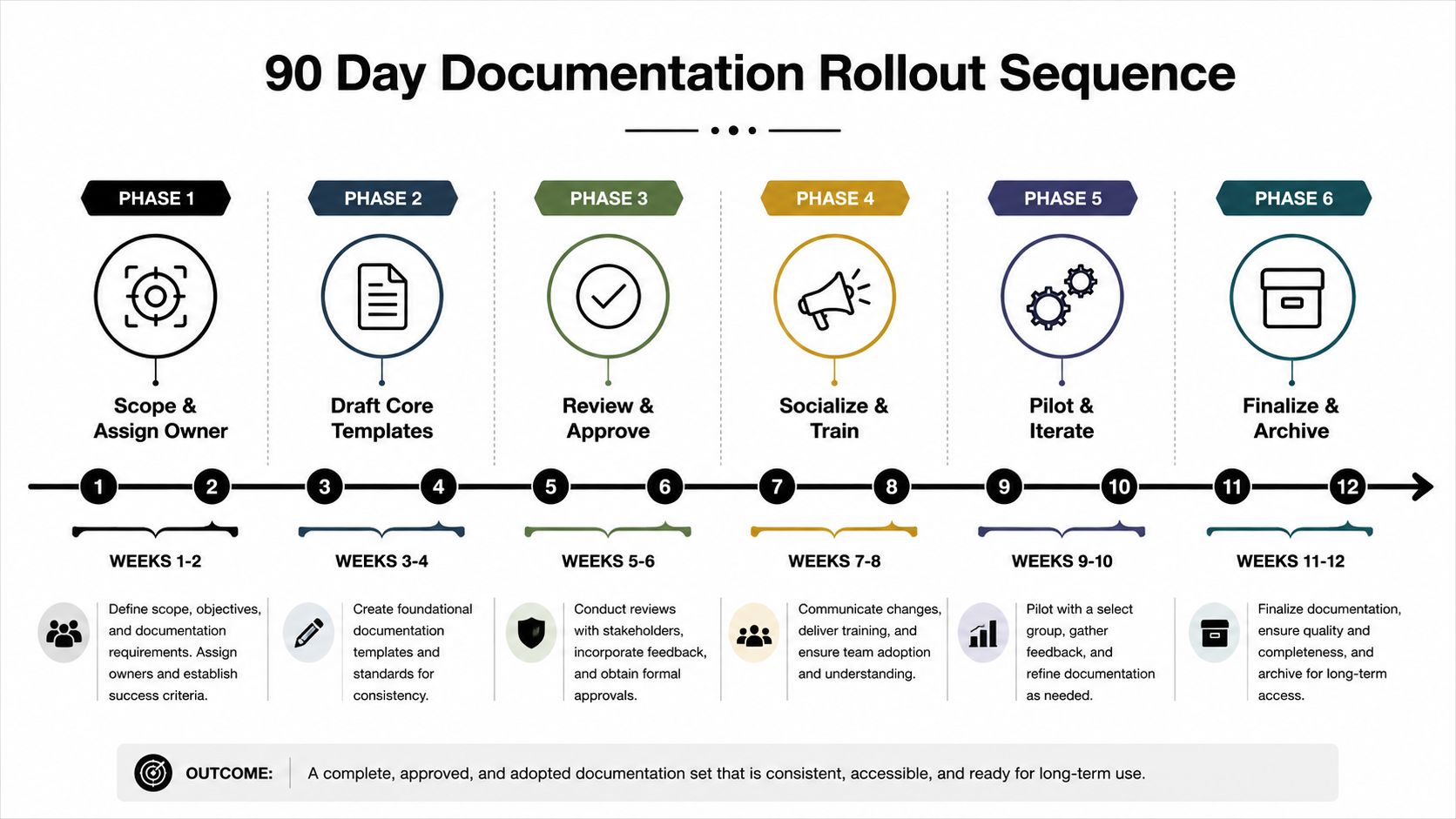
Ship the program in twelve weeks
Weeks 1 to 2: Define scope, inventory wallets and exposures, appoint a documentation owner, and name the approver. Verification means the scope document and responsibility record are committed.
Weeks 3 to 4: Draft the policy, risk criteria, roles, prohibited activities, and escalation rules. Verification means dated approval, not an unsigned draft.
Weeks 5 to 6: Build the register from real positions, wallets, protocols, bridges, oracles, and operating processes. Verification means every material row has an owner and treatment decision.
Weeks 7 to 8: Map controls to high-rated risks and collect existing evidence. Verification means each control has a type, owner, effectiveness state, and artefact.
Weeks 9 to 10: Write the incident runbook and conduct a tabletop exercise covering at least one off-chain failure. Verification means the exercise output records decisions, timestamps, gaps, and owners.
Weeks 11 to 12: Integrate governance minutes, role assignments, sign-off logs, version control, and archive rules. Verification means an internal reviewer can reconstruct how decisions were made without asking the original author.
The final deliverable is a linked set of records, not a policy sitting alone in a drive. Schedule the next review before the rollout closes.
Audit Readiness FAQ for Stablecoin Yield Operations
How can a three-person team evidence segregation of duties?
Assign distinct roles for preparation, approval, and review, even when one person holds more than one role in different workflows. Keep the RACI matrix, conflict assessment, compensating-control approval, and dated transaction records.
What if a control exists but was never documented?
Document the current procedure, label the historical period as an evidence gap, and create a remediation ticket. Don't backdate a policy or imply that missing records were created at the time.
How can we show key-management controls without exposing signer material?
Provide the signer roster, wallet addresses where appropriate, hardware-wallet attestations, approval records, transaction hashes, allowlist settings, and access-review evidence. Never provide seed phrases, private keys, or sensitive recovery material.
What should happen if a depeg occurs during an audit?
Open an incident record, preserve the alert and monitoring exports, record every decision and timestamp, update exposure and residual-risk assessments, and link the event to the remediation review. A live event should produce stronger evidence, not a pause in documentation.
How do we prove monitoring is ongoing?
Export dated alerts, reconciliation reports, dashboard snapshots, exception tickets, and review minutes across the operating period. One screenshot proves only that a dashboard existed at one moment.
What are reviewers likely to challenge first?
Expect questions about missing incident templates, incomplete registers, undocumented criticality assessments, absent board approval evidence, stale ownership, and controls that lack completion tracking. Independent commentary and DORA-focused guidance identify these as recurring documentation weaknesses. (Risk-management documentation workflow guidance)
What makes a register audit-ready?
Each row needs a specific risk statement, scoring rationale, residual decision, named owner, linked controls, review date, status, and change history. If the record can't show what changed and who approved it, it's not finished.
Yield Seeker helps stablecoin users and treasury teams evaluate protocol risk and liquidity depth while an AI agent reallocates capital according to documented risk preferences. Review your wallet inventory, register your real exposures, and then visit Yield Seeker to explore a more structured way to monitor and manage stablecoin yield.