

Passive income is earnings generated with limited ongoing labor after an initial setup. In crypto, it can mean earning yield on digital assets through strategies such as DeFi lending and AI-managed protocols.
You might hold USDC in a wallet, check your balance between meetings, and notice that it has earned a little yield without any trade from you. You didn't open a chart, move funds between pools, or manually approve a new strategy. The experience feels effortless, especially compared with active trading.
But the result still comes from somewhere. A protocol may lend your assets to borrowers, route liquidity into a market, or use capital as collateral. An automated system may monitor those opportunities and move funds according to its rules. Your labor has decreased, but the financial system still carries costs, dependencies, and risks.
That distinction answers the deeper question behind what is passive income. Passive doesn't mean guaranteed, risk-free, or completely work-free. It describes how much ongoing labor you contribute after building or funding an income-producing arrangement.
Earning Without Clicking - The Passive Income Reality
You deposit stablecoins, close your laptop, and return later to find that your balance has changed. No trade notifications appeared. No chart demanded your attention. For a busy professional, that can look like money earned while doing nothing.

The more accurate explanation is less magical and more useful. Your capital entered a system that allocates it across lending markets, liquidity pools, or other yield-producing strategies. Borrowers may pay for access to liquidity, while the protocol and its participants handle the transactions that generate the return.
Less labor is still labor
Traditional examples make the same point. A landlord may receive rent without working a shift for every payment, but the property still needs maintenance, insurance, financing, and vacancy management. Someone who earns dividends doesn't manually operate every company in which they invest, but they still supplied capital and accepted market risk.
Crypto automation changes who performs the routine actions. Software can monitor rates, compare opportunities, rebalance positions, and reinvest earnings. It can't make the underlying risks disappear, and it can't guarantee that a strategy will remain profitable.
Practical rule: Treat automation as a reduction in repetitive work, not as a replacement for judgment.
This framing helps you avoid two opposite mistakes. One is dismissing every automated strategy as fake passive income because it requires setup and oversight. The other is assuming that a hands-off dashboard means your funds are safe.
What the holder still does
A passive-income participant usually chooses the asset, evaluates the arrangement, supplies capital, and decides how much risk to accept. They may also review performance, update settings, record taxable activity, and withdraw funds when the strategy no longer fits.
That is a different workload from active trading, where the investor makes frequent decisions and executes transactions directly. The income may be less dependent on daily clicking, but it still depends on an operating system that someone must understand and monitor.
What Is Passive Income and What It Means
A rental property can send money to its owner while the owner is elsewhere. A dividend can arrive without the investor running the company. In both cases, passive income describes the limited labor required after the asset, business, or financial arrangement is established. Rent, dividends, interest, royalties, and profits from a business the owner does not materially participate in fit this broad definition, as explained in this definition of passive income.
“Passive” describes labor input, not safety. It does not promise stable prices, easy withdrawals, protection from defaults, or predictable returns. A yield strategy can run with little daily work while still exposing capital to market, credit, liquidity, smart-contract, or operational risk.

Three useful income categories
Tax terminology separates several ideas that everyday speech often combines. U.S. rules generally distinguish income from direct work, passive activity, and investments. A passive activity generally involves a rental activity or a trade or business in which the taxpayer does not materially participate during the year.
That distinction matters for DeFi users comparing a tax label with a product label. The IRS treats portfolio income, including interest, dividends, annuities, and certain royalties, separately from passive-activity income. Passive-activity losses may also face limits, so the tax result can differ from how an app or investor describes the earnings. IRS Publication 925 explains the framework, while the taxpayer's circumstances determine how it applies.
Category | What usually drives the income | Typical involvement |
|---|---|---|
Active income | Direct labor or material participation | Frequent work or operational decisions |
Passive-activity income | Qualifying rental activity or a business the taxpayer does not materially operate | Limited ongoing participation |
Portfolio income | Investments such as securities, interest, dividends, annuities, or certain royalties | Capital allocation and monitoring |
Stablecoin yield adds a useful test for the label. A holder might supply capital to a lending market, liquidity pool, margin arrangement, or collateral system. The protocol handles transactions, yet the holder still accepts risks tied to borrowers, collateral, the contract code, and redemption. The work may be light; the exposure is not.
For a practical comparison of labor-heavy earnings and system-generated returns, see passive income vs active income. The useful mental model is simple: passive income is repeatable earnings from an asset or system you fund, not free money that requires no capital or supervision.
Common Types of Passive Income Across Traditional and Crypto Markets
The easiest way to understand crypto yield is to compare its economic patterns with familiar forms of income. The technology differs, but the basic question remains the same: what does your capital, property, intellectual property, or infrastructure provide to someone else?
Rent and liquidity
A rental property gives another person access to useful space. In return, the owner may receive recurring rent, although repairs, vacancies, insurance, taxes, and financing affect the net result.
In DeFi, supplied liquidity gives borrowers or traders access to capital. A stablecoin holder may deposit assets into a lending market, where the protocol makes those assets available to borrowers. The yield is not rent in a legal sense, but the economic pattern is similar: capital remains productive because another participant uses it.
The BIS analysis of stablecoin-related yields describes mechanisms that commonly include re-lending, liquidity or margin pools, collateral arrangements, arbitrage, derivatives, and DeFi lending protocols. Each mechanism creates a different risk profile, so “stablecoin yield” isn't one uniform product.
Dividends and participation rewards
A dividend gives shareholders a distribution from a company's activity. The investor supplies capital and receives a portion of value without running the company.
Digital protocols can use incentives or rewards to attract liquidity and participation. That may resemble a dividend from the user's perspective, but the source matters. A return funded by recurring borrowing demand has a different foundation from one funded mainly by temporary token incentives. The first depends on market usage. The second may change when the incentive program changes.
Interest and lending
Interest is the clearest bridge between traditional finance and DeFi. A lender provides capital for a period or under specified conditions, and the borrower pays for access to it.
A DeFi lending market automates much of the process through smart contracts. The contract can track deposits, collateral, borrowing, repayments, and distributions. Automation improves execution, but it doesn't remove the possibility of faulty code, weak collateral, or stressed liquidity.
Royalties and digital products
Royalties can turn intellectual property into recurring revenue. A creator might build a digital product, license an asset, or establish a system that continues to produce income after the original work is complete. The initial effort may be substantial, and ongoing marketing or maintenance can still matter.
The common thread across all these examples is setup followed by reduced day-to-day labor. A stablecoin strategy fits the pattern only if the holder understands what produces the yield, who controls the funds, and what happens when conditions change.
The Hidden Risks Behind Stablecoin Yield Strategies
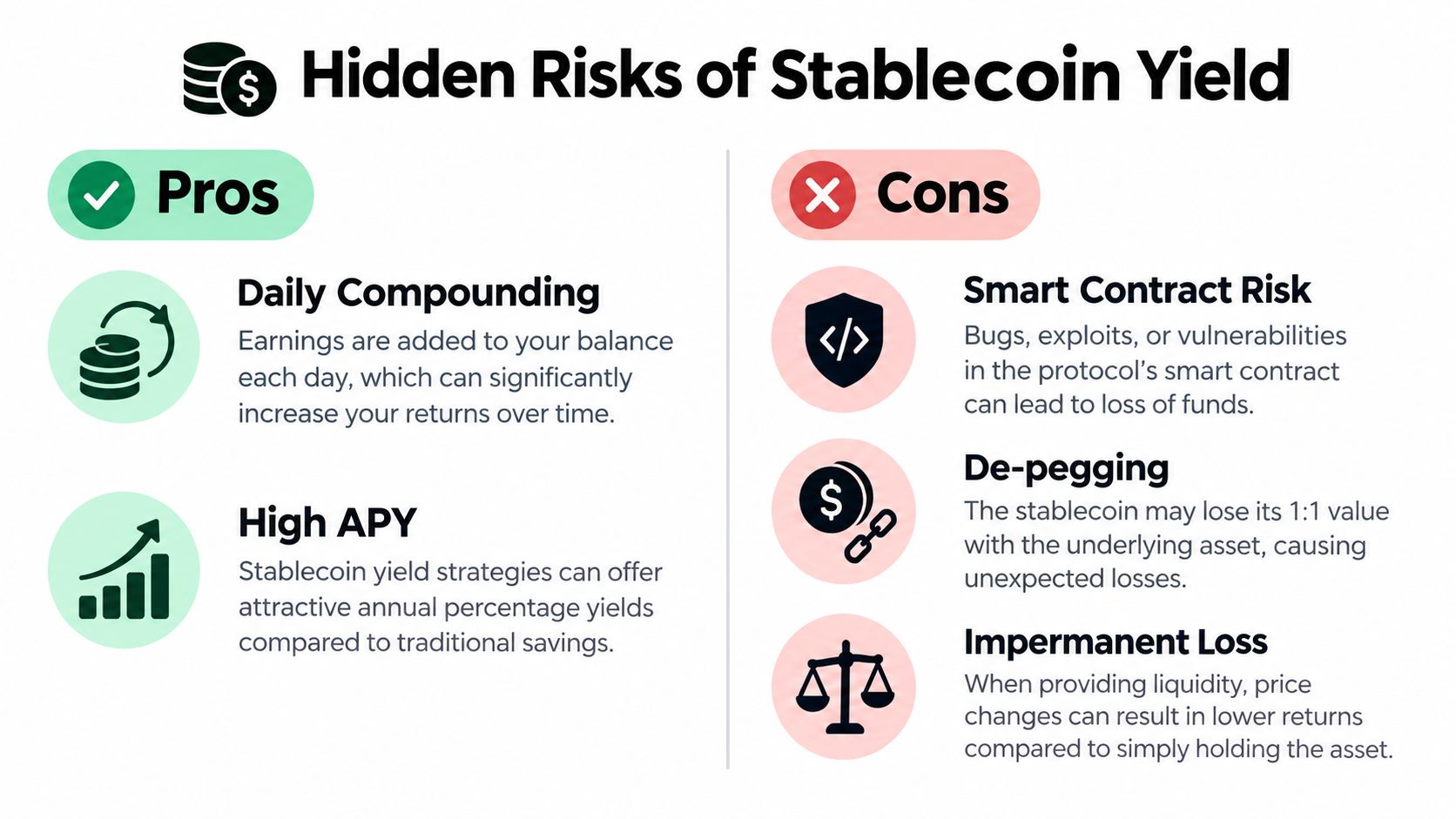
Stablecoin yield is not the same as risk-free interest. A bank deposit, rental property, dividend portfolio, and DeFi position each have different protections and failure modes. The word “stablecoin” describes an intended price relationship, not a promise that the token, reserves, protocol, or withdrawal process will remain stable in every market.
A yield strategy can expose you to several independent risks at once:
Smart-contract risk: A coding error, exploit, or flawed update can affect deposited funds.
Borrower and counterparty risk: The parties using liquidity may fail to repay, or an intermediary may fail while owing users money.
Depeg risk: A stablecoin can trade away from its intended reference value, reducing the value of the position when measured in another currency.
Liquidity risk: Withdrawals may face delays, utilization limits, slippage, or stressed markets.
Collateral risk: Falling collateral values can trigger margin calls, liquidations, and further selling.
Incentive risk: A headline APY may rely heavily on token rewards or temporary demand rather than durable cash flow.
What the evidence changes
A 2025 study of 121 stablecoins found that 21% had been abandoned at least once. Of those abandoned stablecoins, 36% were later resurrected, and only 11% maintained that recovered status, according to the study summarized in this 2025 stablecoin research listing. The same source reports an average interval of approximately 10 days between a statistically significant depeg and subsequent collapse or stabilization.
That evidence doesn't predict the outcome of every stablecoin. It does show why a passive-income explanation should discuss the asset itself, not just the yield displayed beside it. A separate 2025 academic estimate placed average annual stablecoin devaluation probability at 60 basis points under full default assumptions, rising above 200 basis points during the Terra-Luna crisis, as reported in the same research source.
Passive describes the investor's labor. It doesn't describe the asset's reliability.
Read APY as a starting point
A quoted APY is a gross figure, not necessarily the money you keep. A more useful calculation starts with gross yield and subtracts management or protocol fees, expected losses from smart-contract or counterparty failure, and the opportunity cost of holding a reserve that doesn't generate yield. That risk-adjusted approach is also emphasized in coverage of the BIS warning on digital-asset yield.
Compare the strategy with a lower-risk benchmark, inspect its collateral and oracle design, and ask how quickly you could exit during stress. A high number on a dashboard can be attractive, but realized return depends on what happens before, during, and after a withdrawal.
How AI Agents Automate Stablecoin Yield Generation
An AI agent can reduce the research and execution burden across fragmented DeFi markets. Instead of manually checking lending rates, comparing pools, approving transactions, and rebalancing positions, the user defines a strategy and lets software monitor available opportunities.
The workflow generally has four parts:
Observe: The agent gathers information about available lending markets, pools, liquidity, collateral, and strategy conditions.
Evaluate: It compares opportunities against the user's risk preferences and the rules governing the strategy.
Allocate: It directs capital into selected opportunities and handles the required on-chain actions.
Review: It tracks balances and performance, then considers whether rebalancing is appropriate.
Automation can make passive income more practical for a non-technical holder. You don't need to become a full-time protocol researcher to understand the basic result. You still need to know what the agent is allowed to do, which protocols it can access, and what safeguards limit concentration or rapid changes.
The same principle applies to data work outside DeFi. Teams often use a unified data provider when they need to bring scattered information into one workflow. In both cases, centralizing inputs can reduce repetitive research, but the quality of the decisions still depends on the rules, permissions, and data being used.
A visual walkthrough can make the first interaction less intimidating. Use the following guide to see how an automated yield workflow can fit into a broader DeFi routine.
Automation doesn't turn a volatile or experimental strategy into a guaranteed savings product. It can execute faster and more consistently than a person, but it may also execute an unsuitable decision if the configuration, data, or risk limits are wrong. Read how to use AI agents before depositing funds, and treat the agent as an operating tool rather than an independent financial adviser.
Practical Steps to Start Earning Crypto Yield
Start with the asset you already understand and a strategy you can explain in one sentence. If you can't describe where the yield comes from, pause before depositing.
A cautious setup sequence
Choose the platform: Review its supported networks, custody model, protocol access, withdrawal process, fees, and risk controls. Look for plain explanations rather than a dashboard that only emphasizes APY.
Connect a wallet: Use a wallet whose permissions you understand. Check every transaction request and avoid granting broader access than the strategy requires.
Select a stablecoin: Confirm what backs the token, how it maintains its intended value, and where you can redeem or exchange it.
Deposit a small test amount: Use an amount that lets you learn the workflow without making a temporary error financially painful. Verify the transaction and confirm that the balance appears correctly.
Activate the strategy: Review the agent's allocation rules, supported protocols, rebalancing behavior, and risk preferences before approving execution.
Monitor the position: Check earnings, allocation, liquidity, and any warnings. Passive doesn't mean abandoned.
The test deposit teaches you more than a headline yield. You learn how long transactions take, how the interface reports returns, whether withdrawals are understandable, and whether the strategy behaves as described.
Keep a reserve outside the strategy so a sudden need for cash doesn't force an exit during poor liquidity. Compare the expected return with a low-risk benchmark such as short-term government securities, and account for fees, taxes, potential depeg losses, and the value of your time.
The sustainable approach combines automation with limits. Diversification across independent protocols, position caps, and a clear withdrawal plan can reduce the damage from one failure, although no control eliminates risk.
Taxes, Management, and Long-Term Yield Strategy
Yield creates administration even when software executes each transaction. Save deposit and withdrawal records, rewards, swaps, fees, wallet movements, and the value assigned to taxable events. Rules differ by jurisdiction and may depend on whether the activity resembles an investment, business, lending arrangement, or another form of income.
Tax labels can change the result. Under the U.S. framework, Internal Revenue Code Section 469 limits how passive-activity losses offset other income. DeFi yield recorded as portfolio income may receive different treatment from a qualifying rental loss, so accurate categorization affects your net return. Confirm the rules that apply to your activity with a qualified tax professional.
“Passive” describes the labor you provide, not the risk you accept or the predictability of the return. A stablecoin strategy may require few manual actions while still facing smart-contract failure, depeg risk, changing incentives, and limited liquidity. Automation removes repetitive work. It does not turn uncertain yield into guaranteed income.
A maintenance checklist
Review the source of yield: Separate borrowing demand, trading fees, incentives, reserves, and derivatives.
Inspect the collateral: Check what borrowers pledge, how values reach the protocol, and what causes liquidation.
Set position limits: Keep one token, protocol, or intermediary from controlling the portfolio's outcome.
Keep liquid reserves: Hold funds outside pools that could face stress or delayed redemption.
Reassess incentives: Temporary rewards can fall, disappear, or mask weak underlying demand.
Track tax records: Export transaction history and investigate unclear classifications promptly.
Readers with online business income can use Suby's tax guide for digital sellers for general administrative context. For a focused discussion of treatment, review this guide to the passive income tax rate. Neither replaces advice about your jurisdiction or specific DeFi activity.
The long-term test is whether cash-flow sources, exposure, liquidity, and records remain understandable as conditions change. Passive income works best as a controlled system, not a set-and-forget promise.
Yield Seeker helps stablecoin holders automate yield allocation across DeFi opportunities through an AI-powered agent, reducing manual protocol tracking and rebalancing. Visit Yield Seeker to explore a guided approach while keeping strategy and risk decisions visible.