

You're probably in a familiar spot. You hold USDC or DAI, you open a dashboard, and one protocol flashes a yield that looks worth moving funds for. Another shows a lower number but feels safer. A third promises an even bigger APY if you stake, lock, or accept rewards in a token you don't really want.
The hard part isn't finding a number. DeFi is full of numbers. The hard part is knowing which number matters.
That's why yield vs rate matters. In traditional finance, the distinction is important. In DeFi, it's operational. If you confuse a quoted rate with the yield you'll realize after fees, timing, utilization changes, and execution friction, you can make a decision that looks smart on a dashboard and underperforms in your wallet.
Most stablecoin holders don't need more APY theater. They need a better way to judge real returns, compare protocols on equal terms, and avoid getting baited by stated yield that was never likely to survive contact with reality.
The Allure of DeFi Yield
You see it all the time. A stablecoin pool posts a high APY. It's attached to an asset you already trust. Withdrawals look easy. The interface is polished. For a minute, it feels irrational not to move capital.
Then the questions start.
Is that number fixed or floating? Is it coming from borrower demand, token incentives, or both? Will it still be there tomorrow? What happens when gas, slippage, or withdrawal conditions show up after the deposit?
That tension is healthy. It means you're asking the right question. In DeFi, the problem usually isn't that the published rate is fake. It's that the published rate is incomplete.
A quoted APY is often closer to a headline than a final return. It may assume ideal conditions, steady compounding, and no meaningful friction between entry and exit. Real life is messier. Utilization shifts. incentives change. Liquidity thins out when everyone tries to leave at once. A rate that looked attractive in the morning can become average by the evening.
Most yield mistakes start before the deposit. They start when someone treats a displayed APY as a promise instead of an estimate.
This is why smart stablecoin holders don't ask only, “What's the rate?” They ask, “What will I keep?”
That sounds subtle, but it changes behavior. You stop chasing the tallest number on the page. You start comparing how returns are produced, how quickly they can change, and how much work it takes to maintain them. Once you think that way, yield vs rate stops being a glossary term and becomes a filter for safer decisions.
Understanding the Foundational Terms
Before DeFi adds moving parts, it helps to get the base language clean. Most confusion comes from mixing up rate, APR, and yield as if they mean the same thing.
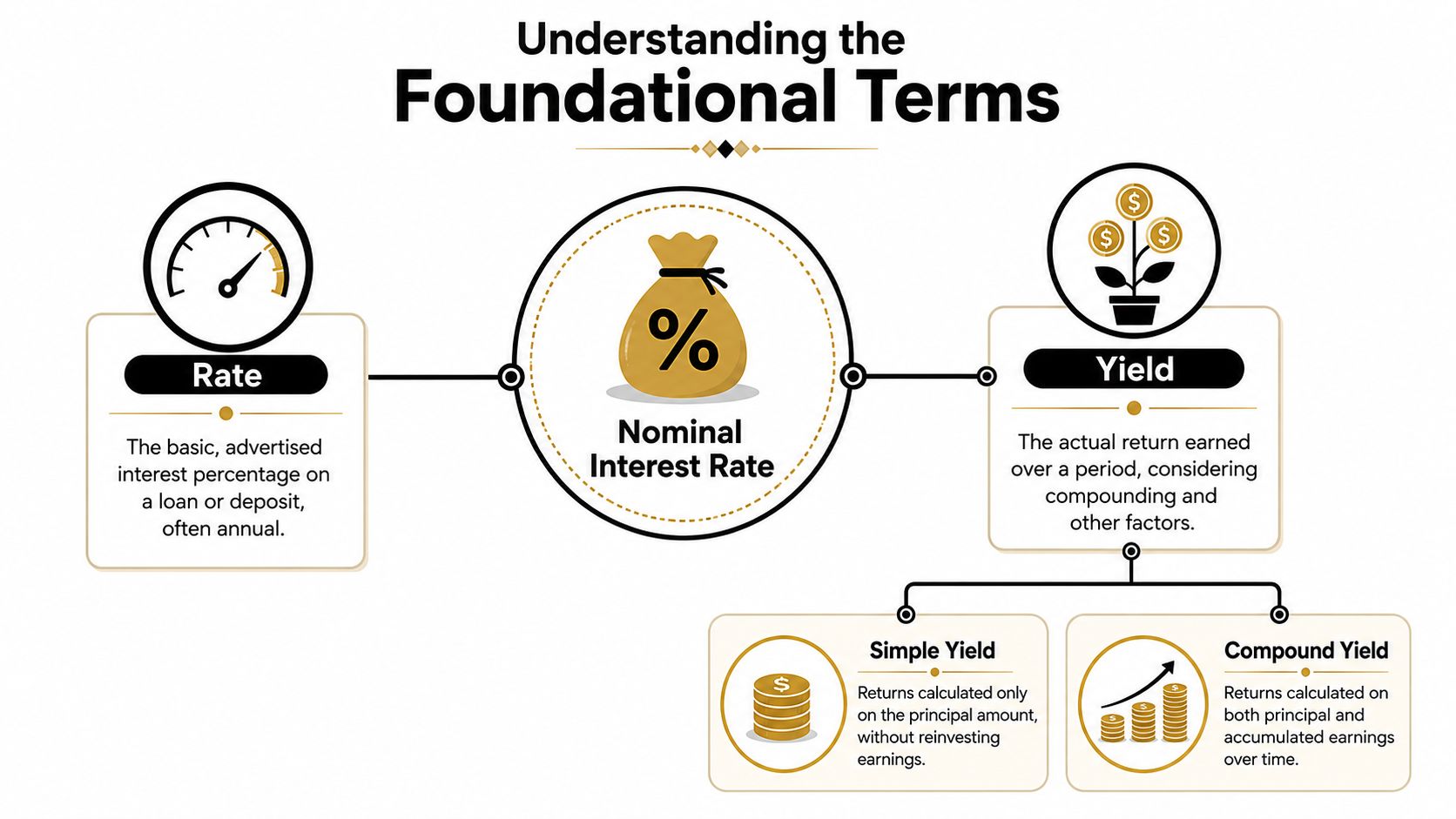
Rate is the quoted starting point
A rate is the basic percentage attached to an asset, loan, or deposit. In traditional fixed income, that's often the coupon or interest rate. It tells you what the instrument says it pays relative to its principal or face value.
The cleanest analogy is a bond. The key difference is that the interest rate is fixed against face value, while yield is calculated against current market price. If a bond has a $1,000 face value and a 5% coupon rate, it pays $50 annually. If you buy it for $900, the coupon rate stays 5%, but the current yield rises to about 5.56% because you're earning the same $50 on a lower purchase price, as explained in this bond yield breakdown from Bajaj Finserv.
That single example does most of the work. A rate tells you what the instrument says. Yield tells you what your capital is earning.
APR and APY aren't interchangeable
In crypto, interfaces often mix these terms casually. You shouldn't.
APR is the annualized return without compounding.
APY includes compounding, which means your earned return gets added back into the base that earns more return.
That sounds technical, but the practical point is simple. If a protocol shows APY, the number may assume rewards are harvested and redeployed. If that process requires extra transactions, manual claiming, or market swaps, your realized outcome can land below the displayed figure.
For a more direct crypto-specific breakdown, this guide on what APY means in crypto is worth reading before you compare platforms.
Yield is the real performance measure
Yield is broader than rate. It can include coupon payments, dividends, reinvestment effects, and gains or losses tied to price changes. Vanguard puts it plainly in its explanation of how bond yields work. Yield reflects the actual economic return on invested capital, while the interest rate is just the static contract term.
That's the frame to keep in your head:
Term | What it means | Why it matters |
|---|---|---|
Rate | The quoted percentage attached to the asset or loan | Useful as a starting signal |
APR | Annualized return without compounding | Better for plain comparisons |
APY | Annualized return with compounding | Useful only if compounding is realistic |
Yield | The return your capital actually generates | Best lens for decision-making |
If you only remember one thing, remember this. Rate is what's posted. Yield is what you experience.
How DeFi Recalibrates Yield and Rate
Traditional finance gives you stable reference points. DeFi doesn't. The definitions of rate, APR, and APY still apply, but the inputs are much more fluid.
A lending protocol can reprice your return as borrowing demand changes. A pool can look attractive because token incentives are temporarily boosting the headline number. A strategy can show a strong APY while hiding the fact that it requires active management to stay on target.
That's why the same stablecoin can earn very different returns across protocols at the same moment.
Why DeFi rates move so fast
The biggest shift is that many DeFi rates are market-driven in real time. Borrow demand, available lending supply, emissions, and utilization all feed into what depositors see.
Fixed yield and variable yield split the field in two:
Fixed yield gives you a return locked for a period. It trades flexibility and upside for predictability.
Variable yield changes with market conditions and protocol usage.
In DeFi, that difference is concrete. Plasma's overview of fixed vs variable DeFi yield notes that MakerDAO's Dai Savings Rate can offer a relatively stable 5–8% APY on DAI, while variable lending market rates adjust continuously based on supply and demand.
That means a quoted rate on a lending dashboard is less like a bond coupon and more like a live market quote. It's valid now. It may not be valid later.
DeFi return metrics compared
Metric | What It Includes | What It Misses | Usefulness |
|---|---|---|---|
Rate | The currently quoted return or base reward | Fees, changing utilization, execution costs | Good for a first scan |
APR | Annualized return without compounding | Whether compounding is practical, strategy friction | Good for cleaner comparisons |
APY | Compounding assumptions built into the annual figure | Whether you can actually compound at that cadence | Helpful, but easy to overread |
Realized yield | What lands after execution, timing, and costs | It's harder to estimate upfront | Best for real decisions |
What works and what doesn't
What works is separating return source from return display.
A protocol may show a strong APY for at least four different reasons:
Lending demand is high, so suppliers earn more.
Token incentives are temporarily boosting returns.
The pool is less liquid or carries extra risk.
The strategy assumes frequent compounding and smooth execution.
What doesn't work is treating all those APYs as comparable. They aren't. Two platforms can publish similar numbers while producing very different investor outcomes.
Practical rule: Before you compare APYs, ask what actually generates them. Borrow demand is different from token emissions. A fixed product is different from a floating one. A redeemable position is different from one that takes steps to unwind.
There's another wrinkle in DeFi that matters for more advanced users. Tokenized yield markets can split principal from future yield into separate claims. Plasma describes structures where smart contracts mint Principal Tokens and Yield Tokens, letting one user lock in cash today while another takes a directional view on future rates. That's powerful, but it also proves the point: in DeFi, yield is not just a rate. It's a tradable, changing economic output.
For busy stablecoin holders, the takeaway is simpler. The more dynamic the market, the less useful a single posted number becomes on its own.
A Practical Guide to Stablecoin Yield
Stablecoins are where this all becomes concrete. You're not comparing a bond to another bond. You're deciding where idle digital dollars should sit today.
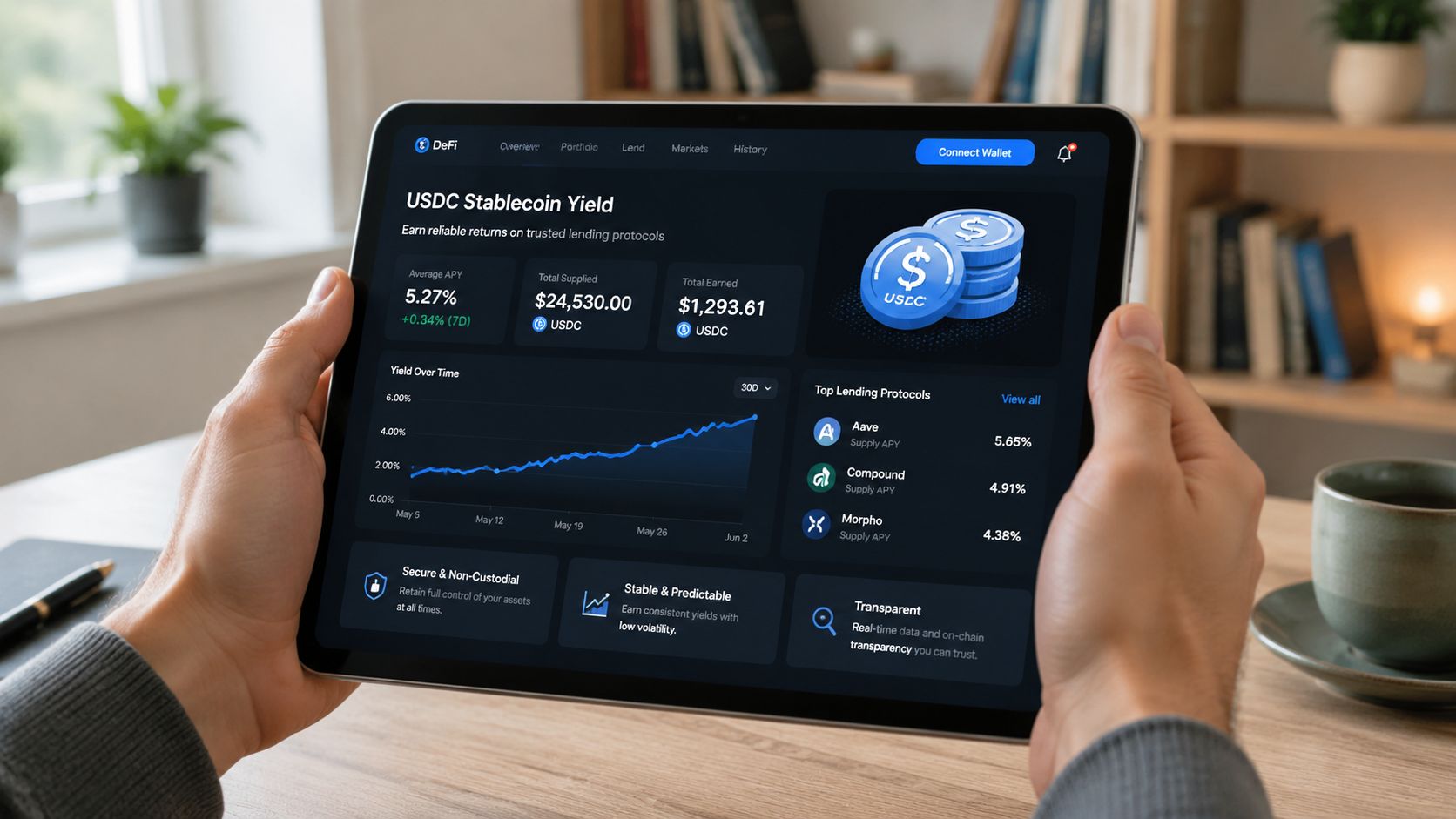
The attraction is obvious. According to Spark's stablecoin yield comparison, stablecoin yields in DeFi can range from 6–18% APY, while traditional bank yields sit around 0.4–5% APY. The same source notes that Aave provides 5–8% APY on USDC based on real-time supply and demand, and Compound offers 4–7% APY, both with near-instant withdrawals.
That spread is why stablecoin holders keep looking. Even if you ignore the top end, the difference between idle cash and productive cash can be material.
Reading a USDC opportunity correctly
Say you hold USDC and check Aave and Compound. One day, Aave may sit above Compound because more borrowers want USDC there. Another day, the gap narrows or flips. If you only scan the front-end number, you'll react to the display. If you understand yield vs rate, you'll ask better questions:
How stable is this return source?
Can I withdraw quickly if the opportunity changes?
Does this platform need extra actions to maintain the posted APY?
Am I being paid for efficiency or for taking on hidden risk?
That last question matters more than most users admit. Spark makes a useful point: if a yield offers a premium over U.S. Treasury bill levels, you should be able to explain where that extra return comes from and what additional risk you're accepting.
A practical comparison mindset
You don't need a huge spreadsheet to judge stablecoin strategies well. You need a repeatable filter.
Start with the asset. USDC on Aave is not the same operational experience as USDC in a more complex strategy, even if the APYs look close.
Check withdrawal behavior. Near-instant access is valuable, especially for treasury management or active reallocation.
Separate base yield from boosted yield. If extra return depends on governance tokens or side incentives, treat it as less durable.
Favor simple mechanics when returns are similar. Complexity should pay for itself.
A lot of users make the same mistake here. They compare a clean lending market to a layered strategy as if both are just “yield products.” They aren't. One may be easy to enter and exit. The other may need multiple transactions, reward claims, swaps, and periodic rebalancing.
This short walkthrough is a good companion if you want to see those moving pieces in action:
When a lower number can be better
A lower displayed APY can produce a better investor outcome if it's easier to maintain and cheaper to unwind.
That sounds less exciting than yield farming screenshots. It's still true.
A stablecoin position with clean mechanics often beats a “higher-yield” setup that leaks value through friction.
For busy holders, this is the practical edge. Don't just ask where USDC earns more. Ask where it earns cleanly, stays liquid, and doesn't force you into constant maintenance.
The Hidden Factors That Erode Your Yield
The gap between stated yield and realized yield is where most disappointment lives.
A protocol can advertise a compelling APY and still leave you with much less than expected. Not because the interface lied outright, but because the number never included the costs and assumptions attached to earning it.

The scale of that gap isn't trivial. The verified figure available here is stark: 68% of stablecoin yield farms lost 20%+ of their advertised returns due to hidden fees and slippage, and DeFi yield should be treated as a forward-looking, risk-adjusted estimate rather than a guaranteed outcome, as summarized in this Investopedia-linked reference on yields and interest rate differences.
Where the yield leaks out
Most yield erosion comes from a handful of sources.
Gas and transaction costs. Depositing, harvesting, swapping rewards, and withdrawing all cost money. A strategy that requires frequent intervention can eat into returns fast.
Slippage on entry or exit. If you need to swap into or out of a position, your execution price can move against you. This matters more in thinner markets and during volatile periods.
Protocol-level fees. Some strategies charge a management or performance layer that isn't obvious when you first scan the APY.
Compounding assumptions. APY often assumes rewards are reinvested. If you don't compound, or can't do it efficiently, your realized return falls short.
Operational restrictions. Withdrawal delays, extra unwinding steps, and liquidity constraints can turn a simple exit into a costly one.
If you want a clearer handle on one of the biggest hidden drags, this explainer on what slippage means in trading is a useful place to start.
Why busy users misread APY
Individuals don't lose money because they can't define APY. They lose money because they assume the dashboard number is already net of friction.
It usually isn't.
A front end may show an elegant annualized figure, but your path to earning that figure may involve claiming rewards, swapping them, taking additional smart contract exposure, and timing exits well enough to preserve value. If any of those steps break, the stated yield and realized yield separate.
Treat displayed APY as gross potential. Treat realized yield as the number that matters.
That mindset changes portfolio behavior. You become less impressed by inflated dashboards and more interested in net outcomes.
A better checklist before you deposit
Use a short pre-deposit review:
How is this yield generated? Lending demand, incentives, or both.
What transactions will I need after deposit? None, some, or many.
How easy is it to exit? Instant, delayed, or strategy-dependent.
What can reduce the outcome? Fees, slippage, lockups, poor liquidity.
Can I explain the risk premium? If not, skip it.
That list sounds plain. It saves a lot of avoidable mistakes.
How AI Navigates DeFi for Optimal Returns
Manual yield hunting breaks down for the same reason manual route planning breaks down in a busy city. There are too many variables changing at once.
A stablecoin holder can monitor a few protocols by hand. But doing it well means more than checking posted APYs. You need to judge whether the return is fixed or floating, whether the path to earning it is efficient, whether liquidity is deep enough, and whether moving funds again tomorrow would erase today's edge.
That's where automation becomes practical, not just convenient.
Why AI fits the problem
Yield is the better metric because it reflects actual economic return. Rate is only one input. Vanguard's explanation of bond yields makes the same core point in traditional markets: yield includes a broader set of return drivers, while interest rate is just the static contract term. In DeFi, that difference becomes even more important because market conditions change continuously.
An AI system is well suited to this kind of decision process because it can evaluate multiple live inputs at the same time:
Quoted returns across protocols
Execution friction such as trading costs and reallocation overhead
Liquidity depth that affects practical entry and exit
Risk signals that a rushed human review might miss
Opportunity cost of staying in a stale position
The goal isn't to chase the highest posted number. It's to optimize for the yield a user is most likely to realize.
Why realized yield needs system-level thinking
This is the same reason serious operators use automation in adjacent workflows. If you care about privacy and repeatability in research, tools focused on secure offline AI for Mac show the broader principle well. Sensitive decisions improve when the system can process complex inputs consistently without forcing the user to juggle everything manually.
That applies directly to DeFi. A person can compare dashboards. A good AI process can compare dashboards, account for friction, evaluate changing conditions, and keep doing it after you've logged off.
For users who want a closer look at that model, this overview of AI yield optimization is a useful reference.
The practical advantage of AI isn't that it invents better yields. It's that it helps users stop confusing posted rates with net outcomes.
That's the shift in yield vs rate for DeFi. Once the market is dynamic enough, the best system isn't the one that shows the loudest APY. It's the one that helps capital land where the likely realized return is strongest relative to the risk and effort involved.
If you want a simpler way to put this into practice, Yield Seeker helps stablecoin holders automate yield decisions with an AI-driven approach built around competitive, risk-aware returns. Instead of manually chasing dashboards and recalculating every trade-off yourself, you can use it to monitor opportunities, stay flexible, and focus on what matters most, the yield you keep.