You already know the feeling. You've got stablecoins sitting idle, treasury cash parked in a wallet, or a mandate to earn yield without handing full control to a centralized venue. You open a few dashboards, compare rates, and then hit a significant problem. The yield lives across protocols, chains, and liquidity pools, and every move has execution risk.
That's where the decentralized exchange stops being a crypto curiosity and becomes operating infrastructure. If you want to swap into a stable pair, move between assets without wiring funds into a custodian, or supply liquidity to earn fees, you'll touch a DEX sooner or later. The challenge isn't just understanding what a DEX is. It's knowing how to use one without leaking returns through bad execution, weak security habits, or shallow liquidity.
What Is a Decentralized Exchange and Why Does It Matter
A decentralized exchange is a place where you trade directly from your wallet instead of depositing funds into an exchange-controlled account. That single design choice changes a lot. You keep custody. You interact with on-chain contracts. You can often access assets and pools long before they appear on big centralized platforms.
For most professionals entering DeFi, the first real use case is practical, not ideological. You want to swap USDC into another token for a strategy, rotate back to a safer asset, or access a new market without waiting for a centralized listing. A DEX makes that possible because the market lives on-chain.
Why DEXs stopped being niche
This market structure became important fast. Decentralized exchanges first surpassed centralized exchanges in on-chain trading volume in September 2020. By June 2021, DEXs facilitated over 80% of all on-chain transaction volume, according to Chainalysis on DEX and CEX market share.
That matters for one reason above all. DEXs proved they could handle real trading activity at scale. They aren't just playgrounds for experimental tokens anymore. They became part of how crypto markets function.
Practical rule: If your stablecoin strategy depends on moving capital on-chain, you're already relying on DEX infrastructure whether you think of it that way or not.
What busy operators should care about
If you manage personal capital or treasury funds, a DEX gives you three things centralized venues often don't combine well:
Self-custody: Your assets stay in your wallet until you authorize an action.
Direct market access: You can reach pools, pairs, and strategies that don't exist in a brokerage-style environment.
Composable yield: Trading, rebalancing, and liquidity provision all connect to broader DeFi strategies.
That doesn't make DEXs automatically safer or cheaper. It just changes the surface area. Instead of worrying mostly about an exchange freezing withdrawals, you worry about contract quality, liquidity depth, and execution.
The right mental model
Think of a decentralized exchange less like a company and more like a market mechanism. You're not sending an order to a help desk. You're interacting with code that follows preset rules on a blockchain.
For stablecoin holders, that distinction is important. Most on-chain yield strategies start with the same basic moves. Swap into the right asset. Route to the right pool. Monitor whether the yield still justifies the execution and risk. DEXs sit at the center of all three.
How Decentralized Exchanges Actually Work
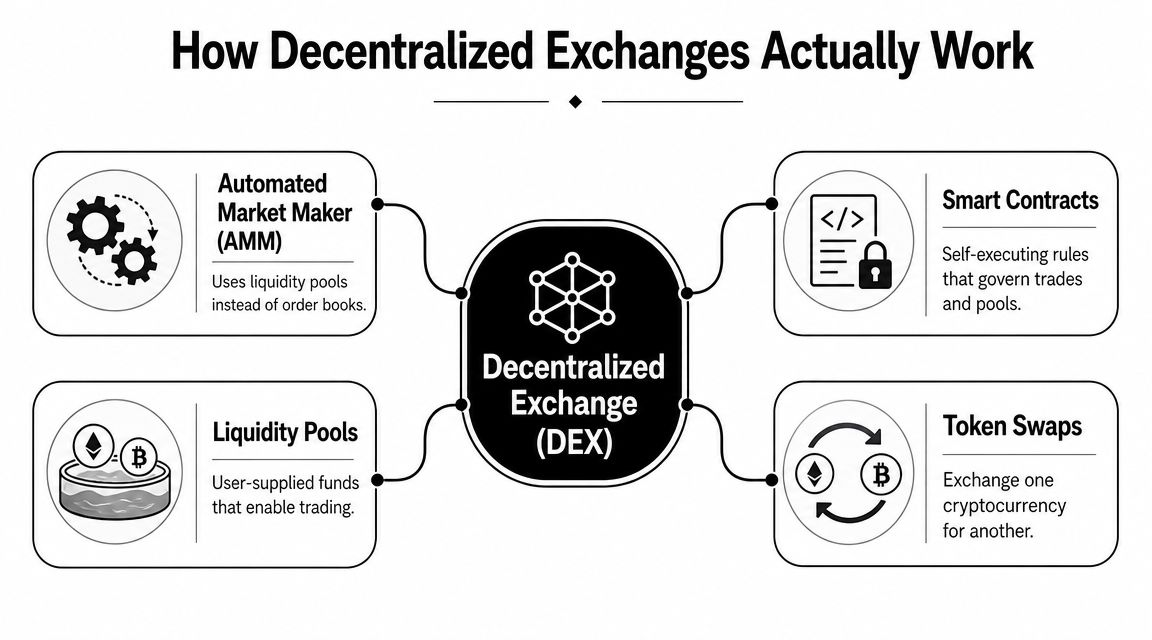
A DEX isn't just a website with a swap button. It's an on-chain application where trade execution is embedded in smart contracts, typically using an automated market maker formula. That design means execution, liquidity management, and fees are enforced by code, with pricing that is transparent and auditable, as described in the Wharton overview of decentralized exchange mechanics.
The simplest analogy
Think of a DEX like an automated currency booth with no clerk. There's no person deciding whether to take your trade. There's a pool of assets and a pricing rule. If you put one token in, the contract gives you another token out at whatever price the pool supports at that moment.
That's why many DEXs use liquidity pools instead of a traditional order book. Rather than matching a buyer and seller directly, the protocol lets traders interact with a shared pool funded by liquidity providers.
If you need a deeper primer on the pool side of the market, this guide on how liquidity pools work in DeFi is a useful companion.
What the AMM is actually doing
Most professionals don't need the math. They need the intuition.
An automated market maker, or AMM, prices assets based on the balance inside the pool. When you buy one asset from the pool, you remove some of it and add more of the other asset. The ratio changes. The quoted price changes with it.
That's the key mechanic behind why large swaps move the market more than small ones. You're not just paying a posted rate. You're changing the pool itself.
Here's the operational version:
Trader swaps: You send token A, receive token B.
Pool updates: Reserves shift immediately after your trade.
Price adjusts: The next trader sees a different rate.
Fees apply: A portion of the trade usually goes to liquidity providers.
Why this matters for yield
For stablecoin yield strategies, DEX mechanics aren't abstract. They affect whether a position is worth entering.
A pool can advertise an attractive return, but if routing into it requires poor execution, high gas, or repeated rebalancing, the net result may be worse than a simpler strategy. Teams that automate capital movement across chains like Base have to evaluate not just nominal yield, but also:
Consideration | Why it matters |
|---|---|
Pool depth | Thin liquidity can turn a routine rebalance into expensive slippage |
Fee tier | Lower headline fees don't always mean lower total cost |
Gas conditions | Small moves can become uneconomic during congestion |
Contract design | Auditable logic helps, but complexity increases failure modes |
A DEX gives you deterministic rules, not guaranteed outcomes. The contract can execute exactly as written and still produce a bad trade if you ignore liquidity and network conditions.
What works and what doesn't
What works is treating the DEX like infrastructure. Check the route, size the trade appropriately, and understand what pool you're touching.
What doesn't work is assuming the interface tells the whole story. The front-end is just the dashboard. The actual trade lives in the contract, and the contract only cares about current reserves, fee logic, and blockchain conditions.
Your First Steps Swapping and Providing Liquidity
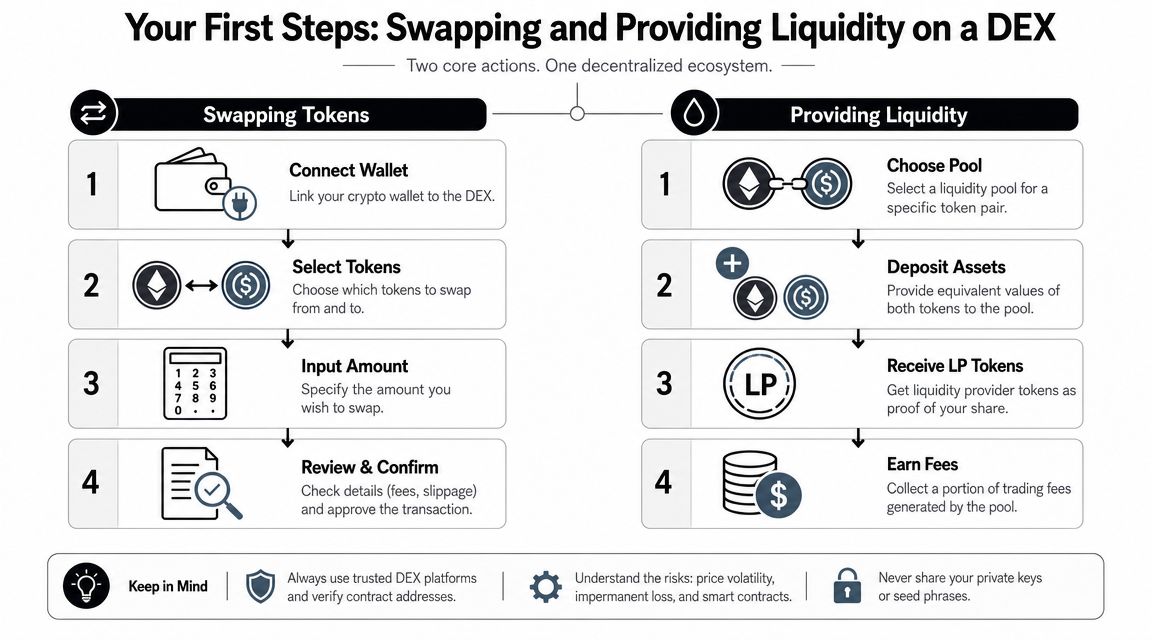
The first time new users use a decentralized exchange, they do one of two jobs. They either swap one asset for another, or they provide liquidity so other people can trade.
Those jobs look similar from the interface. They are not similar economically.
Swapping feels simple because it is
Say you hold USDC on Base and want exposure to another asset for a strategy. You connect a wallet, choose the token pair, enter the amount, review the route, and confirm.
That's the clean path. In practice, the review step matters most. Before signing, check the token you're receiving, the minimum received amount, and whether the route uses one pool or several. If a DEX aggregator is involved, the trade may split across venues to improve execution.
A simple swap usually means you're paying for convenience and access. You aren't trying to earn the fee flow. You're getting from one position to another.
Here's a useful walkthrough before you start clicking around:
Providing liquidity is a different role
Providing liquidity means depositing assets into a pool so traders can use them. In plain English, you become part of the inventory that powers the exchange.
If swapping is like paying the spread at a currency counter, liquidity provision is like owning a small piece of the counter itself. You supply the assets. The pool uses them. You earn a share of trading fees if activity flows through that pool.
The mistake beginners make is treating liquidity provision like passive savings. It's closer to market-making with simplified tooling.
How the two paths differ in practice
Swapper mindset: You care about execution right now. Your key questions are price, route quality, and network cost.
Liquidity provider mindset: You care about what happens after deposit. Your key questions are pool composition, volume quality, and whether the fee income compensates for the risks.
Yield seeker mindset: You usually end up doing both. You swap into a position, then provide liquidity, then later unwind and rebalance.
What usually works for new entrants
For stablecoin-focused users, the cleanest starting point is often a liquid, established stable pair on the chain you already use. That keeps the asset behavior easier to understand and reduces the chance that one side of the pool runs far away from the other.
What usually doesn't work is chasing the flashiest incentive program without understanding the pool. Extra token rewards can look attractive, but if the underlying pair is volatile or thinly traded, the economics can turn quickly.
A good first session on a DEX should feel almost boring. Connect wallet. Approve carefully. Swap modestly. Observe the settlement. If you provide liquidity, start with a pool whose assets and behavior you can explain in one sentence.
Calculating the True Cost of a DEX Trade
The stated fee on a decentralized exchange is rarely the full cost. What hits your return is the all-in execution cost, not the number shown in the headline.
That distinction matters more for stablecoin rotation and treasury management than many users expect. Frequent rebalancing can gradually turn a decent yield strategy into a mediocre one.
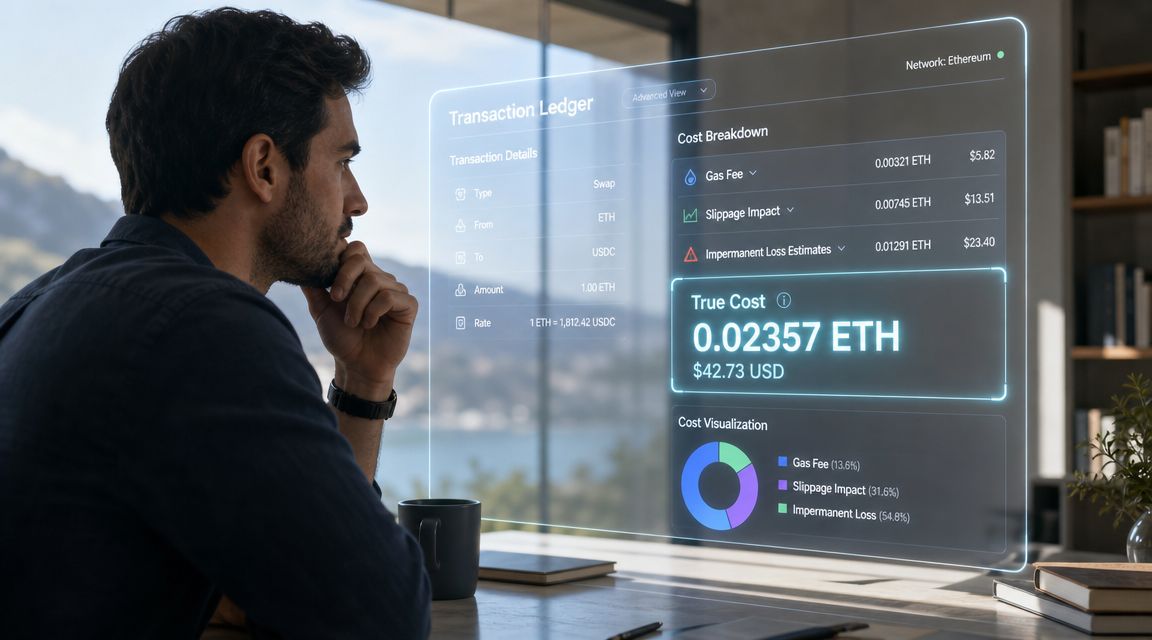
The three cost buckets
When you place a trade on a DEX, think in three layers:
Network fee
You pay the blockchain to process the transaction. On EVM chains, this is the gas cost.Protocol trading fee
The pool charges a fee that usually goes to liquidity providers, and sometimes partly to the protocol.Execution leakage
This is the expensive one people miss. It includes slippage and any adverse price movement caused by how your transaction gets processed on-chain.
If you want a clear breakdown of the most misunderstood part, this primer on what slippage means in trading is worth reading.
Why hidden cost expands in bad conditions
The most common bad habit is comparing venues only by visible fee tier. That's incomplete. A lower-fee pool with weak depth can cost more than a higher-fee pool with tighter execution.
Research from the BIS found that DEX liquidity is often concentrated among a few professional players, which helps explain why liquidity can thin during market stress and why retail users may get worse execution than expected, according to the BIS analysis of DEX liquidity and execution quality.
That has two practical consequences:
Volatile conditions can widen the gap between the quoted price and the executed price.
Smaller users can still get poor fills if the route passes through shallow liquidity or becomes visible to MEV searchers.
A better way to judge a trade
Use this checklist before you hit confirm:
Question | Why it matters |
|---|---|
How deep is the pool? | Depth affects price impact |
How large is my trade relative to that depth? | Even moderate orders can move a thin pool |
Am I trading during congestion? | Gas and timing risk rise together |
Is the route simple or fragmented? | More hops can mean more leakage |
On a DEX, the cheapest trade is often the one you don't split into too many small, reactive moves.
For treasury operators, discipline often beats activity. Fewer, better-timed reallocations often outperform constant optimization attempts that leak value on every hop.
Navigating the Top Risks of Decentralized Trading
The main risk shift in a decentralized exchange is simple. You remove a custodian, but you don't remove risk. You replace counterparty risk with smart contract risk and liquidity risk.
That's the right trade for many users, but only if they understand what changed. As Chainlink's explanation of DEX structure and risk notes, users retain self-custody while taking on exposure to code vulnerabilities and price impact from thin pools.
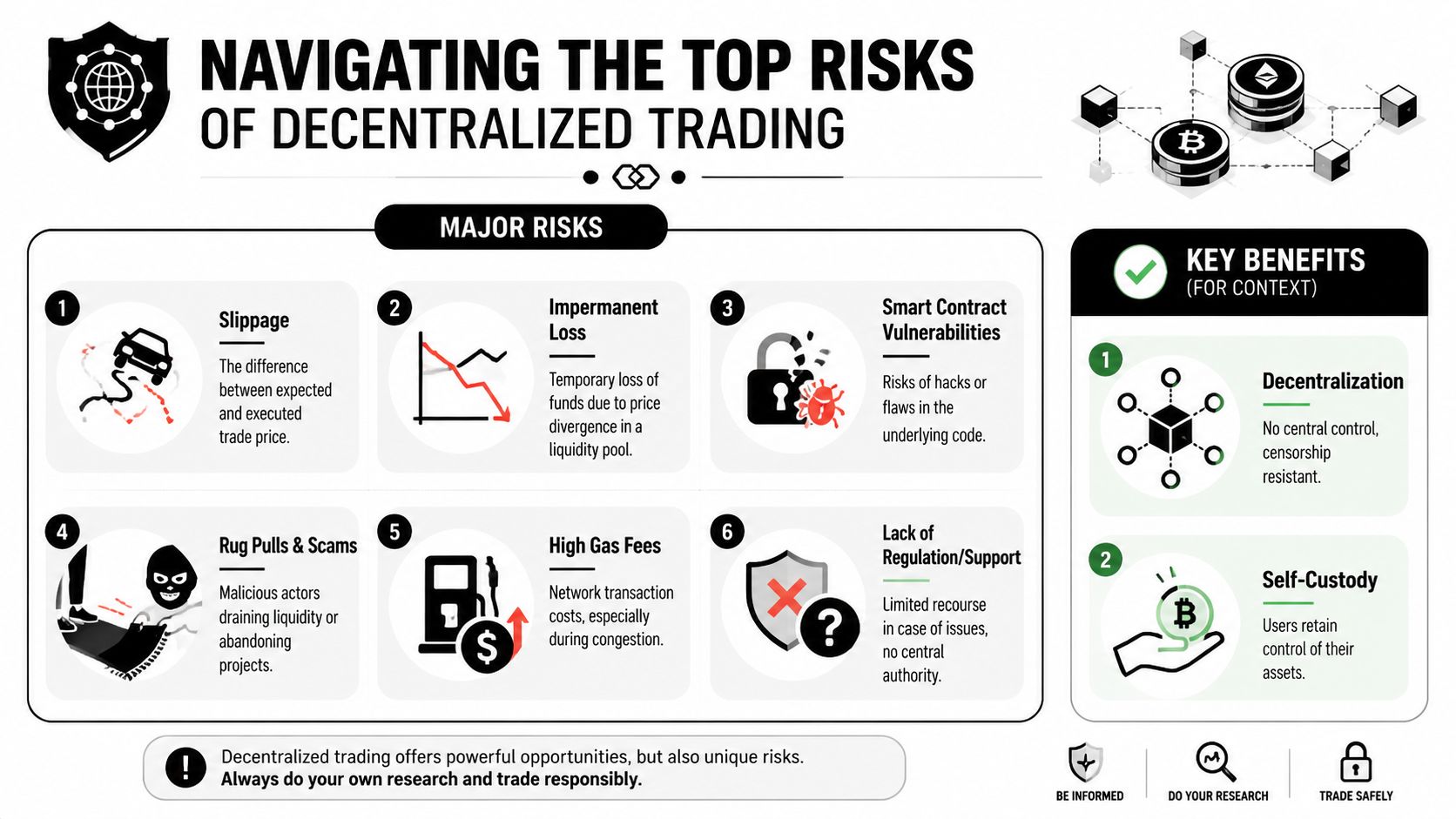
The risks that actually matter day to day
Some risks are dramatic and rare. Others are boring and frequent. In practice, the boring ones often do more damage.
Smart contract failure
If the contract has a flaw, self-custody won't save funds locked in that system. Audits help, but they don't erase implementation risk.Thin liquidity
A pool can look fine in quiet conditions and then become expensive to exit when activity spikes.MEV and transaction ordering
Public mempools create opportunities for bots to exploit visible trades, especially when users set loose slippage tolerances.Bad asset selection
A DEX lets almost anyone launch a token or pool. Permissionless access is useful, but it also lowers the barrier for junk and outright scams.
Impermanent loss is not a footnote
If you provide liquidity, you need to understand impermanent loss before you deposit. It's the economic drag that appears when the assets in a pool move relative to each other and the AMM keeps rebalancing your position.
For a focused explanation, read this guide to impermanent loss in DeFi. The short version is that fee income can offset it, but you should never assume it will.
Self-custody gives you control over the keys. It doesn't give you control over pool math, token behavior, or execution conditions.
Risk is also legal and operational
A lot of DEX users think only in technical terms. Treasury teams can't afford that. They also need to think about jurisdiction, internal controls, and who is accountable for approvals and wallet policy.
If you operate internationally or manage funds on behalf of others, it helps to review how digital asset rules differ across regions. This overview of fintech and crypto regulation in Israel is a good example of the kind of jurisdiction-specific context operators should understand before adopting on-chain workflows.
What works in the real world
The safest habit isn't avoiding all DEX risk. That's impossible if you want on-chain yield. The safer approach is selecting simpler exposures, using deeper pools, and avoiding strategies you can't monitor.
What doesn't work is assuming the interface filtered out the danger for you. On-chain markets reward users who verify, compare, and size positions conservatively.
Essential Security for Interacting with DEXs
Most DEX losses don't come from misunderstanding the slogan. They come from sloppy operational habits. The protocol may be decentralized, but your laptop, wallet approvals, and browser behavior are not.
There's another layer people miss. The protocol can be decentralized while the website you use to access it remains a centralized point of failure or censorship, including geographic filtering at the front-end level, as discussed in the Cato analysis of DEX decentralization and interface risk.
Security habits that actually reduce risk
Start with the basics that move the needle:
Use a hardware wallet for meaningful balances
A hardware signer won't fix a bad investment decision, but it does reduce the chance that a compromised browser session empties your wallet.Verify contract addresses and token contracts
Don't trust search results, random social posts, or lookalike front-ends. Bookmark the protocols you use regularly.Be careful with token approvals
Unlimited approvals are convenient and dangerous. Review them periodically and revoke stale permissions with tools such as Revoke.cash.Separate wallets by function
Many experienced users keep one wallet for long-term holdings and another for active DeFi interaction. That limits blast radius.
Front-end trust still matters
A polished site can create false confidence. If the front-end is filtered, compromised, or spoofed, you can still get hurt while interacting with an otherwise open protocol.
That's why serious operators keep a few habits:
Practice | Why it helps |
|---|---|
Bookmark official apps | Reduces phishing risk |
Check transaction details before signing | Wallet prompts often reveal what the UI hides |
Use small test transactions | Confirms route and recipient behavior before larger size |
Keep gas on-hand | Avoids rushed wallet actions when rebalancing is time-sensitive |
Treat every wallet signature like a bank wire. If you don't fully understand what it authorizes, don't sign it.
A practical checklist for Base and similar EVM chains
If you're using Base for stablecoin strategies, the operating pattern should be straightforward:
Keep enough native gas token available for approvals and exits.
Favor established pools over obscure incentives.
Test deposits and withdrawals with small size first.
Review approvals after trying a new protocol.
Assume convenience features increase trust assumptions until proven otherwise.
That last point matters. A decentralized exchange can be excellent infrastructure and still require disciplined human behavior around it.
Using DEXs for Stablecoin Yield and Treasury Management
A treasury wallet on Base rarely sits still for long. Stablecoins move through DEXs to enter a vault, rotate into a better pool, cut exposure to a weakening venue, or return to idle cash when the extra yield no longer pays for the risk.
That operating reality matters more than headline APY. A pool can advertise attractive yield and still be a poor treasury decision once you account for swap costs, liquidity depth, smart contract exposure, and the time required to monitor it. For a team managing working capital, the goal is not to chase every basis point. The goal is to keep capital productive without making exits hard or introducing avoidable failure points.
DEXs are the routing layer for that job. They let you move between stablecoins, rebalance positions, and source liquidity without waiting on a centralized counterparty. In practice, that makes them useful for treasury management. It also means every yield decision depends on execution quality.
Automation helps when it reduces monitoring burden and keeps the operator focused on risk. Yield Seeker is one example of that approach for stablecoin deployment on Base, tracking opportunities and helping allocate capital across DeFi venues as conditions change. Used well, software handles repetitive scanning and routing. The human still sets the constraints, decides acceptable protocol risk, and defines when yield is worth the operational complexity.
Teams that manage stablecoin yield well treat DEXs like market infrastructure. The exchange is not the strategy. It is the rail that lets a strategy enter, exit, and rebalance with discipline.