
You're probably looking at a vault, pool, or lending market right now with a very large tvl number next to it. That number creates two reactions at once. One part of you thinks, “a lot of capital is here, so this must be real.” The other part thinks, “or maybe everyone just rushed in for the incentive and will leave next week.”
Both instincts are right.
For stablecoin holders, tvl is useful because it tells you where capital is sitting, how much liquidity a strategy may have, and whether exits are likely to be smooth. But tvl can also flatter weak protocols, hide short-term farming behavior, and overstate confidence. If you use it as a headline, it misleads. If you use it as a tool, it helps you earn better yield with fewer surprises.
Why TVL is DeFi's Most Famous and Flawed Metric
A protocol advertises high tvl. Users take it as a signal of trust. Teams put it on the homepage because it's the fastest way to communicate scale.
That instinct didn't come from nowhere. TVL is one of DeFi's foundational statistics because it captures both deposited capital and sensitivity to market conditions, and major market summaries track it over time rather than as a single snapshot. Historical market coverage also shows how violently it can move. Multi-chain DeFi TVL fell below USD 50 billion in April 2023 after earlier growth phases, which is a useful reminder that capital in DeFi can expand and contract quickly with the cycle, as reflected in historical TVL tracking and market context.
For a stablecoin earner, that matters in a practical way. If you're choosing between two places to park USDC, tvl gives you a first read on depth. A deeper venue often handles deposits and withdrawals more gracefully than a thin one. It can also suggest that more users, market makers, or allocators trust the setup enough to keep capital there.
What tvl gets right
TVL is good at answering a simple question. How much value is currently committed to this protocol?
That helps with:
Liquidity context: Bigger pools usually make it easier to enter and exit.
Relative comparison: You can compare protocols within the same category.
Trend reading: A steady climb often looks different from a one-day spike.
Where people get burned
The trouble starts when users treat tvl as a verdict instead of a clue.
A high number doesn't tell you who deposited the capital, why they deposited it, how concentrated it is, or how quickly it can leave. For stablecoin strategies, those details matter more than the headline. A pool full of patient lenders is different from a pool full of incentive farmers rotating through whatever pays most this week.
High tvl can mean trust. It can also mean rented attention.
That's why the best way to think about tvl is this. It's the starting point for due diligence, not the end of it.
Breaking Down Total Value Locked
Total Value Locked is the fiat value of the crypto assets deposited into a protocol's smart contracts. In plain English, it's the dollar value of the assets currently sitting inside the system.
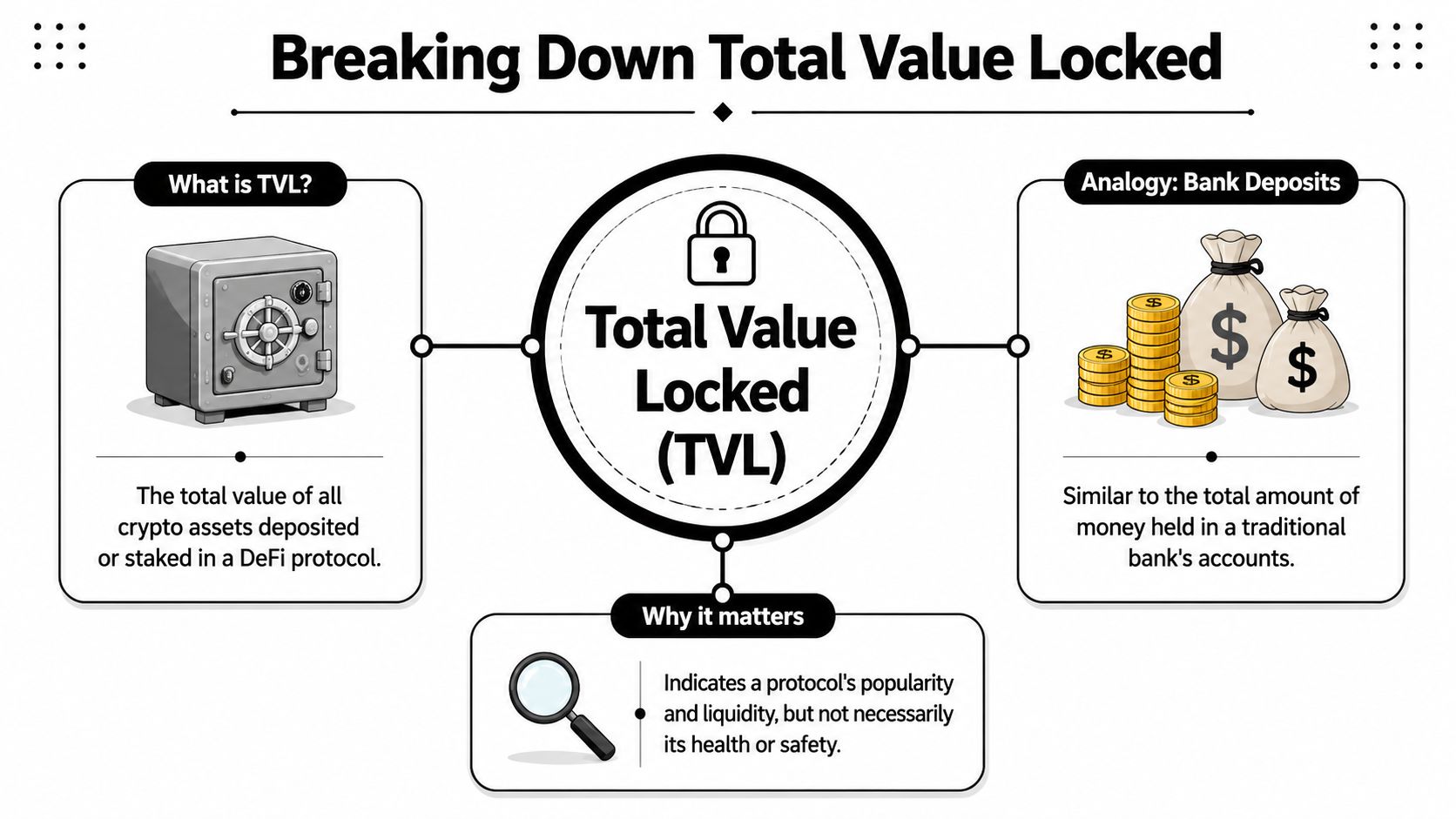
A simple analogy helps. Think of a local bank. If you want to know how much money customers have deposited there, you total the balances in all the accounts. TVL does something similar for DeFi, except the “accounts” are smart contracts and the “deposits” are tokens.
According to Chainlink's explanation of tvl, the calculation is straightforward: take each deposited asset balance, multiply it by the asset's current market price, then sum the values. That also explains why tvl moves for two reasons. Capital enters or leaves, and asset prices change.
How the calculation works
Here's the mechanics without the noise:
Identify the assets held in the protocol's contracts.
Find the current market price for each asset in fiat terms.
Multiply balance by price for each asset.
Add everything together to get tvl.
If a stablecoin vault holds only USDC and USDT, the calculation is usually easier to interpret because the assets are intended to stay near a fiat reference. If the protocol holds ETH, governance tokens, LP tokens, or yield-bearing wrappers, the number gets harder to read because price moves and layered exposure can distort the headline.
Why stablecoin users should care
For stablecoin strategies, tvl tells you more than popularity. It helps answer practical questions:
Can this strategy absorb my deposit cleanly?
Will exits be crowded if sentiment turns?
Is the liquidity base mostly stable assets, or is it propped up by volatile collateral?
A stablecoin lender usually wants predictable behavior. TVL can help, but only if you look at what's inside it.
A simple mental model
Use this quick frame when you evaluate tvl:
Question | Why it matters for stablecoin yield |
|---|---|
What assets make up the tvl? | Stable-heavy tvl is easier to interpret than volatile-token tvl |
Has tvl changed suddenly? | Sharp jumps can come from incentives, not durable demand |
Is the protocol simple or layered? | More wrappers and rehypothecation usually mean noisier tvl |
Practical rule: TVL is more useful when the underlying assets are simple, liquid, and easy to redeem.
The Hidden Dangers of Chasing High TVL
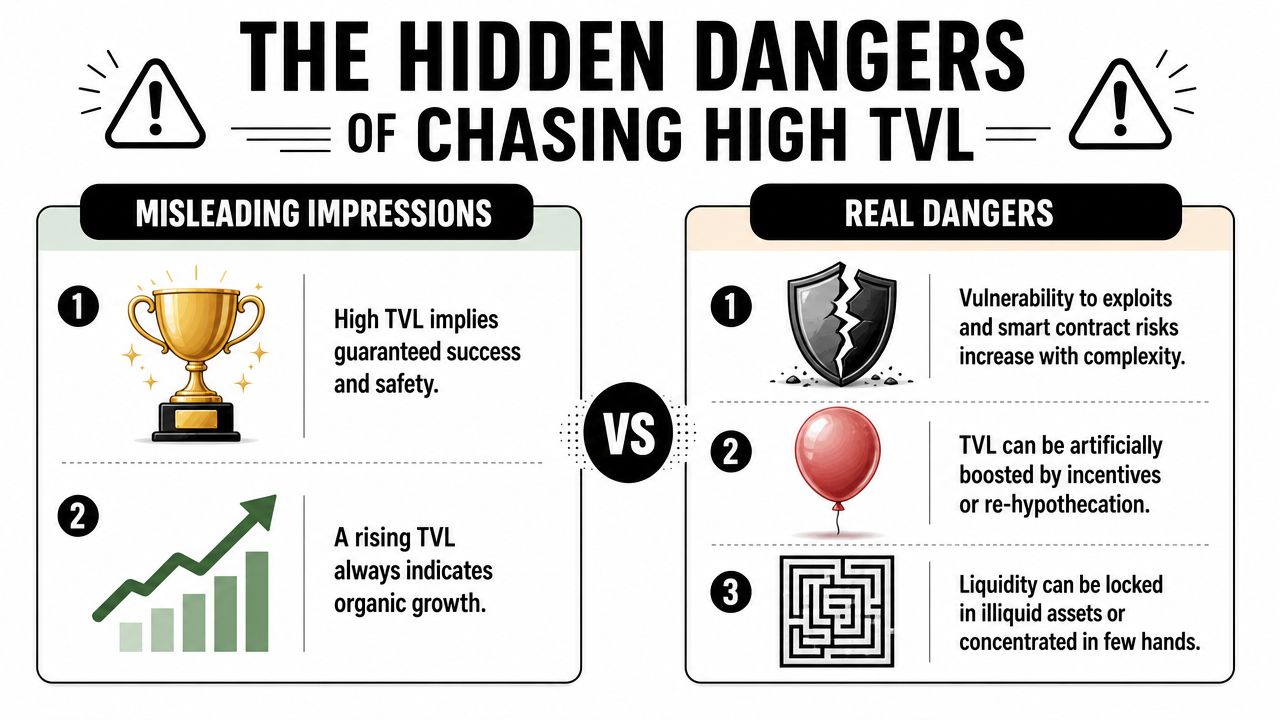
A large tvl number can make a protocol look safer than it is. Consequently, many stablecoin users make the wrong move. They chase the deepest-looking venue without asking what the number represents.
The biggest warning sign is that tvl isn't standardized as tightly as many people assume. A Bank for International Settlements paper noted that at the end of 2024, Ethereum TVL estimates from different aggregators ranged from roughly USD 80 billion to USD 190 billion, which means methodology alone can change the headline by more than 100%, as documented in the BIS working paper on verifiable TVL.
If that spread exists at the ecosystem level, you should expect noise at the protocol level too.
Three ways tvl fools people
Double counting
Capital can be represented more than once across DeFi. A user deposits one asset, receives a receipt or LP token, then stakes that receipt elsewhere. Depending on methodology, dashboards can count value at more than one layer.
That's dangerous for stablecoin yield hunters because it makes a system look deeper than the redeemable base really is.
Volatile collateral hiding under a stablecoin strategy
A vault might market itself to stablecoin depositors while routing capital through volatile collateral or wrapper layers behind the scenes. The top-line tvl looks healthy, but the quality of liquidity is weaker than the label suggests.
If the supporting assets swing hard, the strategy can face stress even if your deposit started in a stablecoin.
Mercenary capital
Some tvl shows up because incentives are rich. Then it leaves as soon as the yield compresses or a new venue pays more. That capital was never loyal to the protocol. It was loyal to the spread.
For stablecoin users, this is one of the most important distinctions in DeFi. A vault full of short-term farmers can unwind fast.
What to ask before trusting the number
Use this checklist:
Who is likely providing the capital? Whale allocators, treasury capital, LP farmers, and ordinary users behave differently.
What attracted the inflow? Organic demand is very different from temporary emissions.
How easy is it to leave? Fast exits are good for you as a user, but they also mean everyone else can leave quickly.
What sits underneath the strategy? If you can't map the exposure, the tvl figure won't save you.
If you want a wider lens on smart contract and pool-level hazards, this guide to navigating liquidity pool risks is a useful companion to tvl analysis.
The best defense against bad tvl is simple skepticism. Don't ask how big it is first. Ask what it's made of.
Using TVL to Evaluate Protocols and Stablecoin Yields
You are choosing where to park a six-figure stablecoin balance for the next quarter. Two vaults both advertise attractive yield. One has far more TVL. That matters, but only if that capital is the kind that stays put when rates compress, markets get noisy, or a large user exits.

For stablecoin yield, TVL works best as a screening tool for durability. The job is to answer three practical questions. Is there enough depth for your size? Is the capital base likely to remain during ordinary market stress? Can the protocol keep producing yield without depending on short-lived incentives?
A working framework for real decisions
I use four checks before allocating.
Start with deposit depth relative to your size
A vault does not need the highest TVL in its category. It needs enough liquidity for your entry and exit. If your position would represent a meaningful share of the pool, your risk changes. Withdrawals get harder to predict, strategy rebalancing has more impact, and any rush for the door hits you faster.
For a smaller allocator, a mid-sized pool can be perfectly usable. For a treasury or larger account, the same pool may be too thin.
Check whether the asset base fits the yield source
A stablecoin strategy should let you trace the path from deposit to yield. If the TVL is mostly stable assets and the return comes from borrowing demand, DEX fees, or basis-style opportunities, the pool is easier to underwrite. If the route passes through volatile collateral, thin wrappers, or governance-token emissions, the headline TVL matters less.
The key question is simple. Does the capital structure match the promise being made to stablecoin depositors?
Read the TVL chart like a behavior signal
The chart matters less for size than for character. A slow build over time often points to users who found the product useful enough to stay. A sharp one-week jump can mean a campaign, an integration, or one large allocator. None of those are automatically bad. They just deserve a different assumption set.
At this juncture, sticky and mercenary capital start to separate in practice.
Sticky capital usually has a reason to remain beyond this week's APY. Treasury deposits, users parking operational cash, and integrators routing flow through a venue tend to behave differently from wallets chasing emissions. Mercenary capital can still help a strategy scale, but it should not be mistaken for a stable foundation.
Pair TVL with operating evidence
A pool with high TVL and weak usage can still disappoint stablecoin depositors. Look for proof that the strategy is being used. On a lending market, that means borrow demand and utilization. On a DEX vault, it means fee generation and repeat volume. On a yield aggregator, it means the underlying venues still make economic sense after incentives fade.
TVL can point you toward a protocol. It cannot replace actual protocol review. A proper protocol safety analysis for DeFi yield strategies belongs beside your TVL check.
A practical comparison mindset
Here is a cleaner way to compare two stablecoin vaults:
What you see | What it usually means for a stablecoin allocator |
|---|---|
Vault A has higher TVL | Good starting sign, but confirm whether the deposits are broad-based or concentrated in a few wallets |
Vault B has lower TVL | Fine if it still offers enough depth for your size and does not force slow or costly exits |
TVL spiked recently | Treat current yield as less durable until you know what caused the inflow |
TVL grew steadily while yield stayed competitive | Better sign that the protocol is attracting repeat users rather than temporary farmers |
The vault holds mostly stable assets | Easier to model downside and easier to understand where your yield actually comes from |
Here's a short explainer worth watching before you allocate:
Where automation fits
If you manage stablecoin yield across several chains, TVL becomes one line in a larger operating dashboard. You still need it. You just should not let it drive the whole decision.
Good tools help sort venues by depth, monitor changes in capital stability, and flag cases where a pool looks large but the liquidity is likely to leave quickly. Yield Seeker, for example, automates stablecoin allocation across DeFi venues and can use TVL trends as one input alongside risk and yield data. That is the right role for TVL. A useful filter for better stablecoin deployment decisions.
Advanced TVL Analysis Beyond the Basics
Once you're comfortable with the headline number, the next step is separating sticky capital from mercenary liquidity. That distinction matters more than ever for stablecoin earners because modern DeFi moves fast. Capital rotates across chains, wrappers, and vaults with very little friction.
Recent guidance on interpreting tvl recommends pairing it with other signals like utilization and transaction volume, especially because incentive-driven capital can make a protocol look healthier than it is. That's the core point in CoinTracker's discussion of tvl interpretation. High tvl alone doesn't prove durable demand.
How to judge sticky versus mercenary capital
Sticky capital tends to have a reason to stay. It may come from users who need the protocol's utility, treasury managers who value consistent access, or allocators who care about long-term routing and execution quality.
Mercenary liquidity behaves differently:
It follows incentives first
It leaves quickly when spreads compress
It often clusters in whatever strategy is currently fashionable
You can't identify every wallet's intent, but you can infer the character of the tvl by watching behavior. If yield drops slightly and capital immediately disappears, that wasn't a loyal deposit base. If the protocol keeps activity and retains liquidity through changing conditions, the capital is usually more durable.
Useful advanced lenses
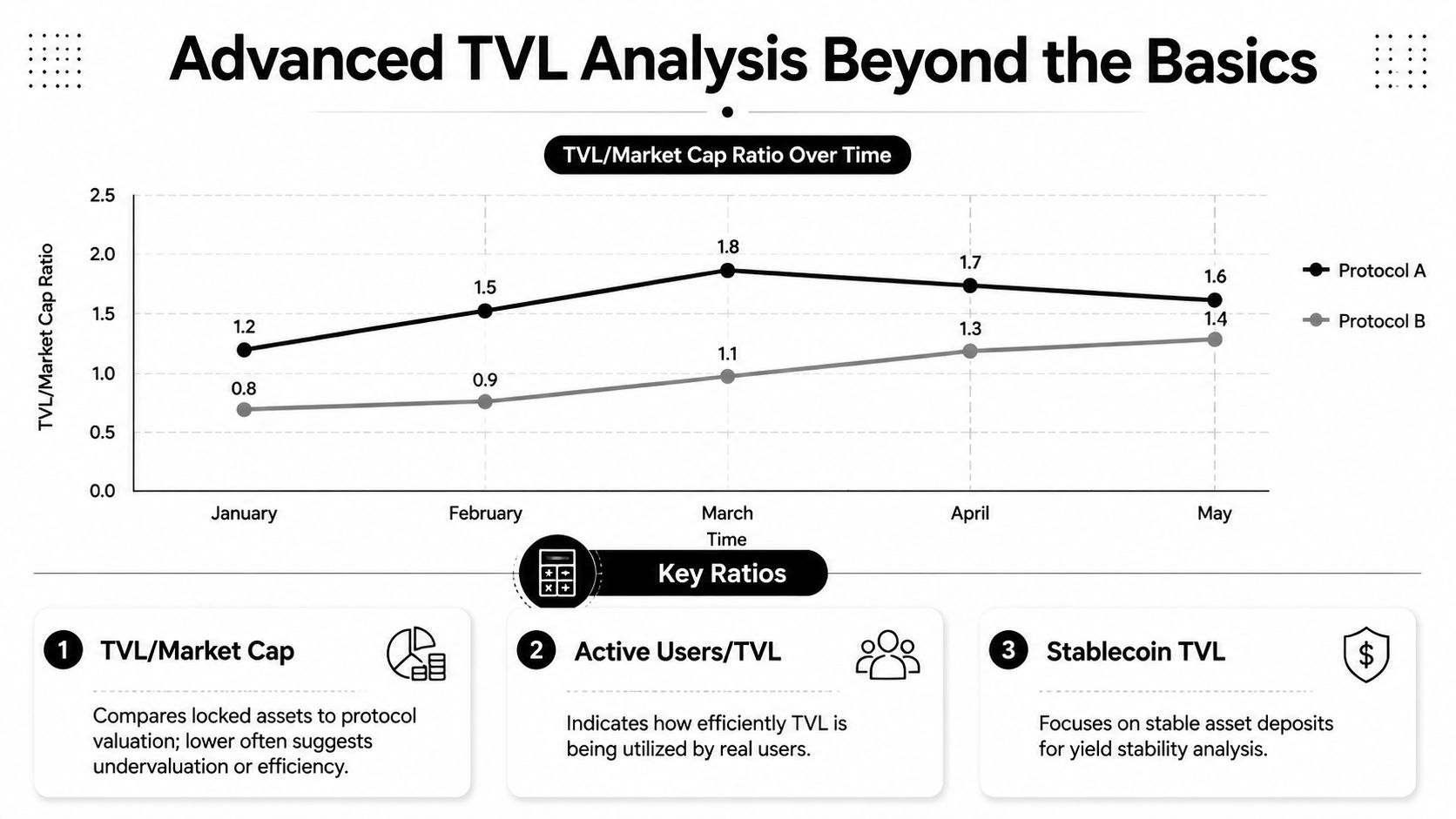
TVL versus market value
Many analysts compare a protocol's locked assets with its token valuation through the TVL/market cap ratio. That ratio isn't a magic signal, but it helps frame whether a token's market value looks rich or restrained relative to actual capital committed to the protocol.
For stablecoin users, it's less about token investing and more about avoiding platforms where narrative outruns usage.
Cross-chain tvl behavior
Capital on Ethereum, Base, Solana, and other chains doesn't sit still. Watching where stablecoin liquidity gathers can help you spot where execution is improving, where incentives are pulling demand, and where exits may become crowded.
Cross-chain analysis is especially helpful when two protocols offer similar headline yield. If one chain's liquidity looks more stable and less fragmented, that often matters more than a temporary rate advantage.
Watch where capital stays after incentives cool off. That's usually where the real product-market fit is.
The professional view
Advanced tvl work is less about predicting the perfect entry and more about avoiding bad liquidity. A disciplined allocator asks whether capital is productive, observable, and likely to remain through normal market stress.
That's the difference between using tvl as a marketing metric and using it as a risk tool.
Top Tools for Tracking TVL in 2026
If you want tvl to improve your stablecoin decisions, use more than one dashboard. Different tools answer different questions. One is good for chain and protocol breadth. Another is better for fundamentals. Another helps when you want raw data or custom views.
The core stack
DeFiLlama is still the first stop for most users. It's the fastest way to compare protocols, chains, categories, and historical tvl trends in one place. For broad scanning, it's hard to beat.
Token Terminal is useful when you want context beyond locked capital. If you're trying to connect tvl to economic activity, revenue-style metrics, and protocol fundamentals, it gives a more valuation-oriented lens.
Artemis is valuable when your question is chain-level behavior rather than one protocol's number. It helps compare ecosystems and can be especially helpful when you're deciding where stablecoin liquidity actually looks active.
For builders and power users
If you want historical series or warehouse-style access, API and data platforms matter.
EigenExplorer API: Useful if you want access to historical tvl data across timestamps in a more programmatic workflow.
Allium: Helpful when you want structured DeFiLlama-derived warehouse data and chain or protocol slicing.
Dune: Better for custom dashboards when off-the-shelf views don't answer your exact question.
A smart workflow usually starts broad, then gets narrower. Scan with dashboards. Verify with custom analysis. Only then allocate.
If you want a practical framework for reading metric changes instead of chasing them, this piece on tvl tracking signals is a good next step.
Common TVL Questions Answered
Does tvl include staked governance tokens
Sometimes. TVL tracks the dollar value of assets sitting in a protocol's contracts, and some methodologies count staked governance tokens, LP tokens, or receipt tokens in that total.
For stablecoin yield, that distinction matters more than the headline number. A pool funded mostly by stable assets behaves very differently from one padded by volatile governance tokens that can leave fast when incentives fade. If you want to judge whether liquidity is sticky, start by checking what is locked.
How is tvl different from market cap
TVL measures deposited capital. Market cap measures the value of a token's circulating supply.
Those metrics can move in completely different directions. A protocol can have deep stablecoin liquidity and a weak token price, or a hot token and very little usable depth for depositors. For anyone allocating USDC, USDT, or DAI, TVL is usually the more practical signal because it affects execution, withdrawal capacity, and how likely a yield opportunity is to hold up under real size.
What is a good tvl
A good TVL is enough TVL for your size and strategy.
If you are deploying a small stablecoin balance, a niche market may be fine. If you are moving serious size, you need depth that can absorb deposits and exits without distorting yield or forcing you to wait behind a crowded withdrawal queue. The better question is not whether TVL looks big on a dashboard. It is whether the capital base is stable enough to support your entry, your exit, and the yield in between.
Is rising tvl always bullish
No. Rising TVL can reflect real user demand, but it can also come from token price appreciation or short-term incentive farming.
The useful question is what kind of capital arrived. Sticky capital tends to stay after rewards normalize because the product still works for depositors. Mercenary liquidity shows up for emissions, pushes TVL higher, then disappears as soon as another pool offers a better rate. For stablecoin strategies, that difference often matters more than the growth chart itself.
Should stablecoin users care more about absolute tvl or trend
Use both, but weight them differently.
Absolute TVL tells you whether a venue is large enough to matter for your position size. The trend tells you whether liquidity is settling in or rotating through. If I am choosing between two stablecoin vaults with similar yields, I care more about the one with steadier deposits, calmer outflows, and less dependence on incentive spikes. Size gets attention. Behavior gets capital.
Yield Seeker helps stablecoin holders turn TVL from a vanity metric into an allocation filter by monitoring opportunities across DeFi while keeping funds accessible and reducing the manual work of tracking fragmented venues.