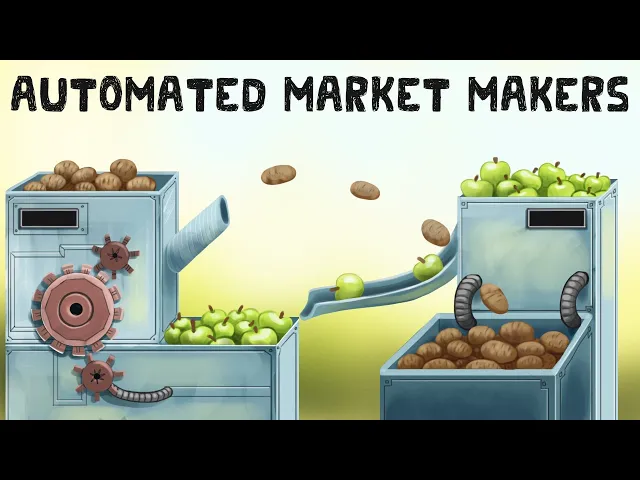
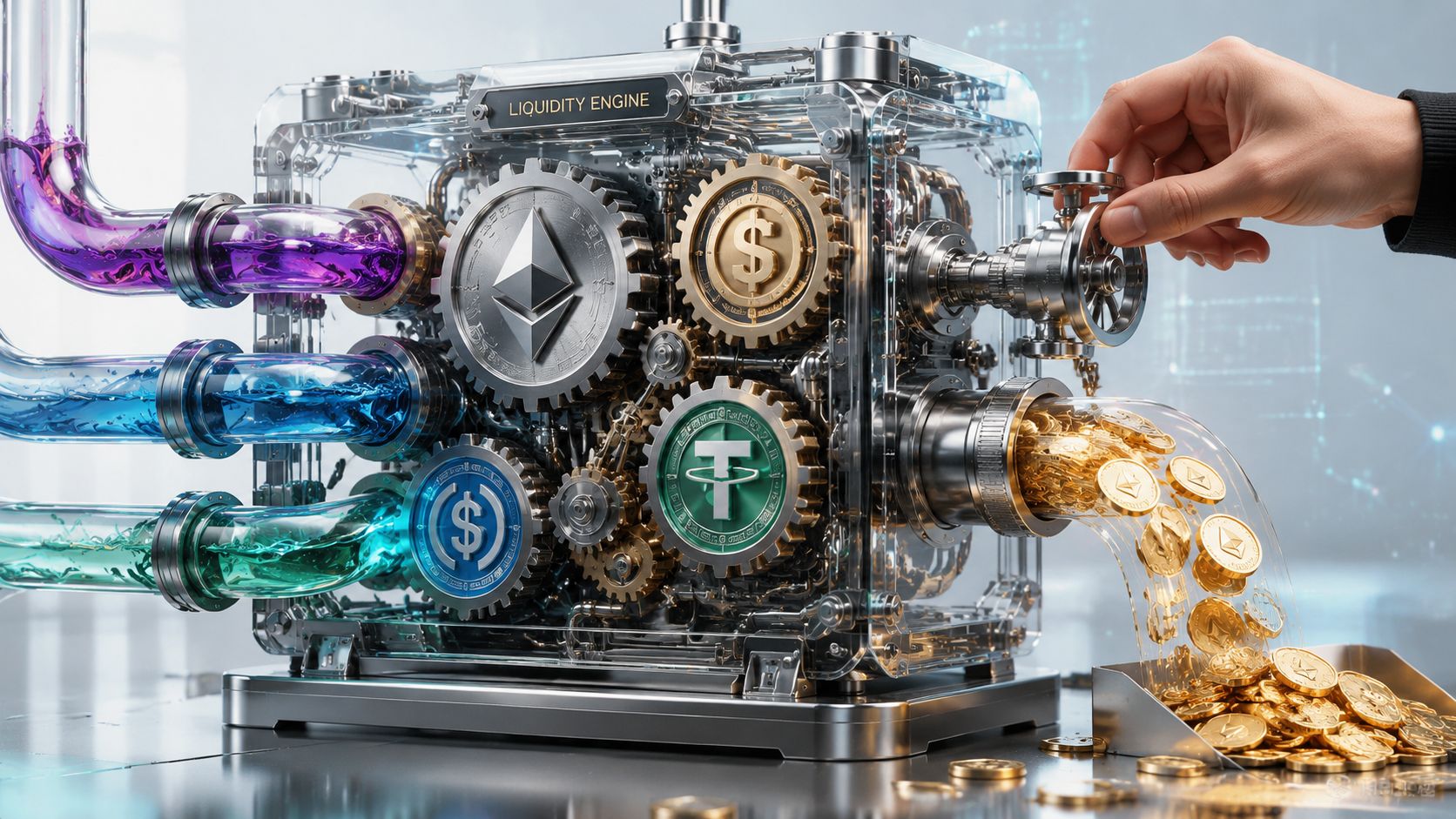
You're probably in one of two camps right now.
Either you hold stablecoins and you're tired of letting them sit idle, or you've looked at DeFi yield and run into a wall of jargon. AMMs, LPs, slippage, impermanent loss, sandwich attacks. The vocabulary makes dex sound more complicated than it is.
A DEX is just crypto's trading engine without a central operator holding your funds. That design matters because the same machinery that lets traders swap tokens also creates yield for people who supply liquidity, especially in stablecoin pools. If you want to understand where on-chain yield comes from, dex mechanics are one of the first places to look.
What Is a Decentralized Exchange (DEX)
You want to buy a token that just launched. It isn't listed on Coinbase or Binance yet. A centralized exchange can't help you, at least not today.
A decentralized exchange, or DEX, is where that trade often happens. Instead of sending money to a company account and asking that company to execute trades on your behalf, you connect your own wallet and trade directly on-chain. The key difference is simple. You keep custody of your assets until the trade executes.
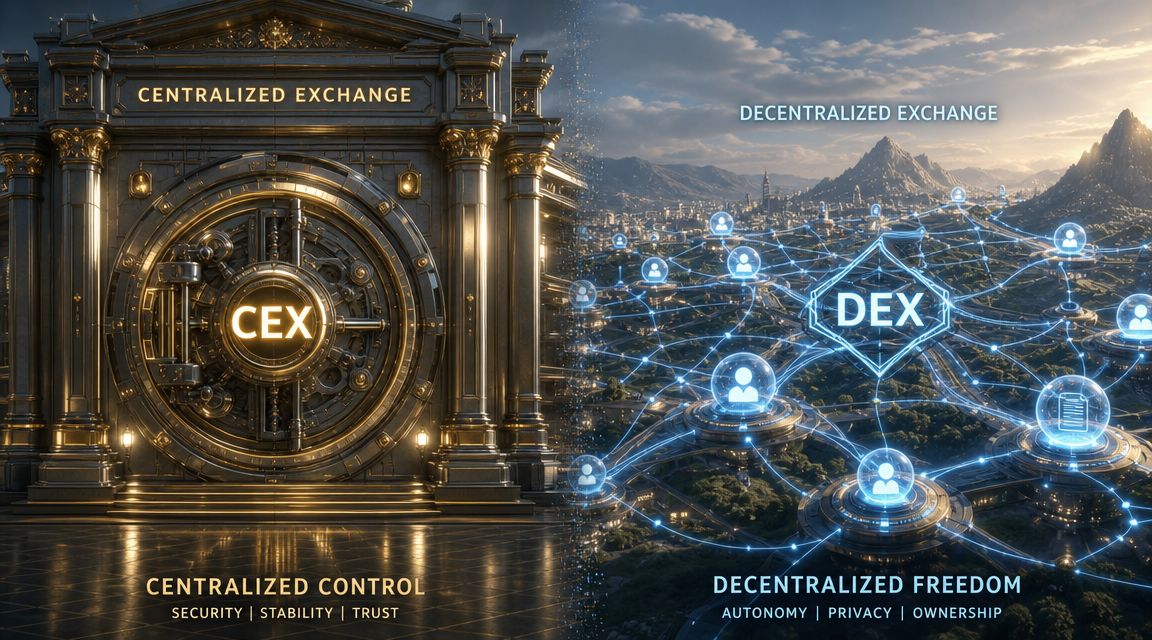
With a centralized exchange, think of a broker who takes your cash, keeps the inventory, and updates a database when you trade. With a DEX, think of a vending machine built on a blockchain. You bring your own wallet, press the button, and the machine dispenses according to code.
Why people use dexs
The first draw is access. DEXs often list assets far earlier than large centralized venues because anyone can create a pool and allow swapping. The second draw is control. You don't need to hand your coins to an exchange and trust that it will manage them well.
That's one reason DEXs aren't a fringe corner of crypto anymore. DEXs accounted for roughly 10% to 15% of total crypto spot trading volume in 2024, with recent data showing about $11.8 billion in 24-hour volume according to DEX market statistics.
Practical rule: Use a DEX when access and self-custody matter more than convenience.
The real point for stablecoin holders
If you only see dex as a place to speculate on new tokens, you'll miss the bigger opportunity. A DEX is also where traders pay fees to access liquidity. Those fees don't disappear. In many pool designs, they flow to the people who supplied the capital.
That's the bridge to yield. Traders want fast swaps. Liquidity providers make those swaps possible. Fees become income.
If you like sharp DeFi explainers that stay grounded in actual mechanics, the Lirefin blog is worth browsing alongside your own research.
How DEXs Actually Work
Most busy professionals hear “exchange” and picture buyers and sellers posting bids and asks. Some DEXs do work that way. But most of the dex activity you'll run into in DeFi uses a different model.
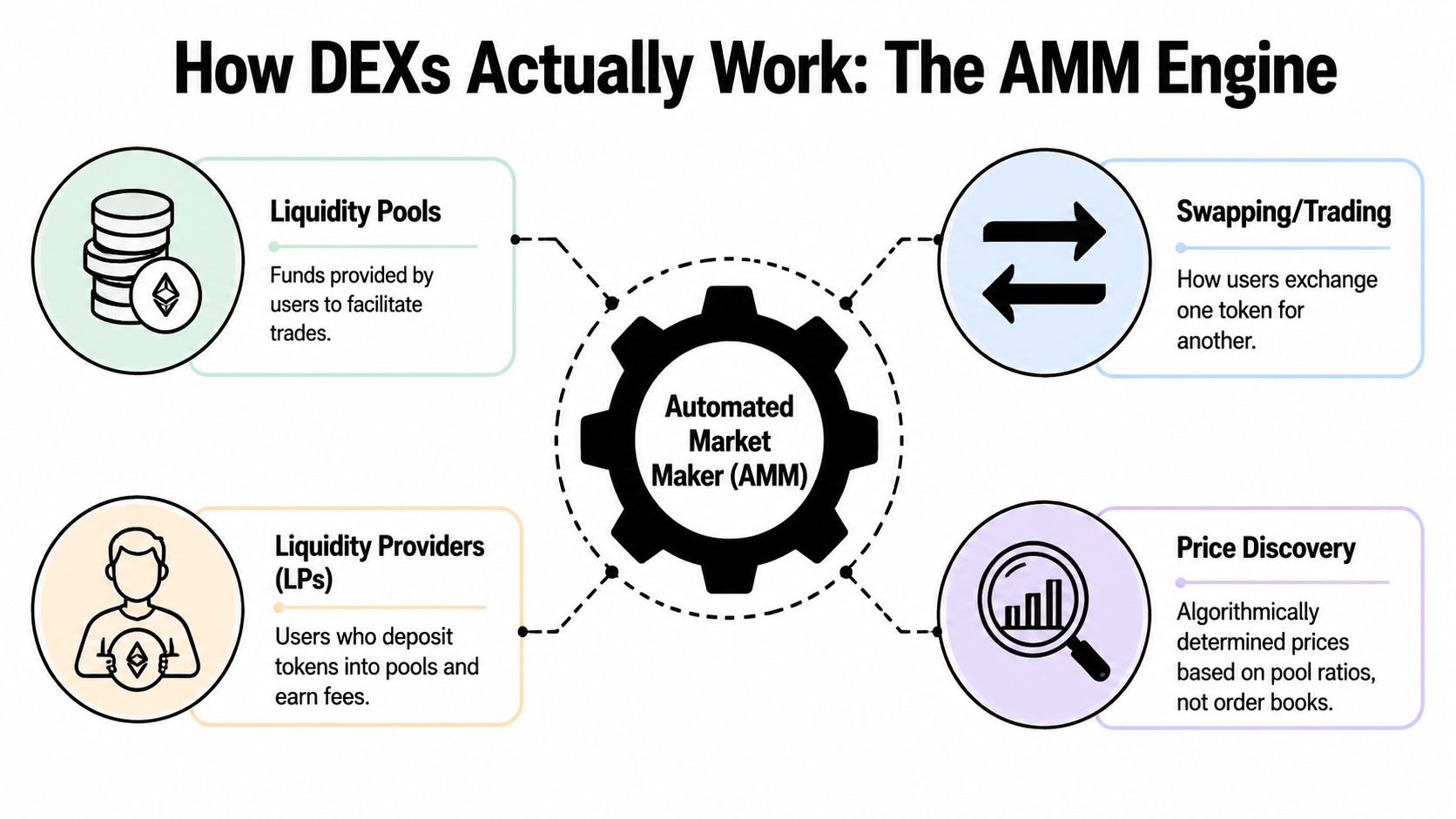
It uses an automated market maker, usually shortened to AMM.
The village well analogy
Think of a liquidity pool like a village well with two buckets hanging over it. One bucket holds USDC. The other holds ETH.
People walk up to the well and make swaps. If someone puts USDC in and takes ETH out, the ETH bucket gets lighter and the USDC bucket gets heavier. The exchange rate changes automatically because the balance between the two buckets changed.
That's the heart of an AMM. You're usually trading against a pool of assets, not directly against another trader on the other side of the screen.
What liquidity providers actually do
The pool needs inventory. That inventory comes from liquidity providers, often called LPs. They deposit token pairs into the pool so traders can swap.
In return, LPs may receive a share of the trading fees generated by that pool.
Here's the simple flow:
Trader arrives: They want to swap one token for another.
Pool serves the trade: The smart contract pulls from the available assets in the pool.
Price updates: The pool ratio changes, so the next trader gets a slightly different rate.
Fees accrue: Part of the swap fee goes to liquidity providers, depending on the design of that dex and pool.
If you want a focused primer on the pool side of this, this guide on what liquidity pools are gives a useful companion explanation.
A short visual can help if you prefer to see the moving parts.
Where prices come from
In a centralized order book, price comes from matched orders. In an AMM, price comes from the ratio of assets in the pool and the pool's pricing formula.
You'll often hear people mention the formula x*y=k. You don't need to memorize the algebra to understand the practical effect. The practical effect is that as one asset gets bought from the pool, it becomes scarcer in that pool, so its quoted price moves.
That automatic repricing is what lets the system function without a traditional market maker standing there all day.
A good mental model is a currency booth that changes its posted rate every time its inventory gets out of balance.
Why this matters for yield
AMMs solved a coordination problem. They made it possible for anyone to contribute capital to a trading venue and earn from activity, rather than leaving market-making to a handful of specialized firms.
For stablecoin holders, that changes the question from “Where can I trade?” to “Where is trading volume creating fee income, and what risks come with providing that liquidity?”
That's where dex stops being a crypto curiosity and starts becoming part of a yield strategy.
Your First Trade on a DEX
The first time you use a dex, the interface feels unfamiliar for one reason. No one opens an account for you. You bring your own wallet.
A typical first trade looks like this. You hold USDC in a wallet, you connect that wallet to a DEX such as Uniswap or Aerodrome, and you choose the token you want to receive. The DEX reads your wallet balance, builds a transaction, and asks you to approve it.
What “connect wallet” really means
Connecting a wallet doesn't send your funds anywhere by itself. It usually means the app can read your public address and ask your wallet to sign actions. Your wallet remains the control center.
If you're still getting comfortable with that piece, this primer on what a DeFi wallet is helps make the wallet side less abstract.
Why dex asks for approval first
Many tokens require an approval transaction before the swap itself. Approval is you telling the token contract, “This application may spend up to this amount from my wallet.”
Then comes the actual swap transaction.
That two-step flow confuses a lot of newcomers because it feels redundant. It isn't. One action grants permission. The next action uses that permission.
The settings that matter
When you submit a trade, you'll usually see a few knobs:
Slippage tolerance tells the DEX how much price movement you'll accept before the transaction should fail.
Network fee is what you pay to the blockchain for processing your transaction.
Route shows whether the DEX is swapping directly through one pool or hopping through several pools.
A simple example helps. Say you want to swap USDC for ETH. The screen quotes one rate, but between the moment you sign and the moment the blockchain confirms, the pool can move. Slippage tolerance gives the trade room to complete without exposing you to an unlimited surprise.
If you don't understand a DEX setting, don't increase it just to make the transaction go through. That's how small mistakes become expensive ones.
The user experience in plain English
So the front-end sequence is usually:
Connect wallet.
Select the token pair.
Approve the token if needed.
Review slippage and fees.
Confirm the swap in your wallet.
Wait for on-chain confirmation.
That's it. Underneath, smart contracts and liquidity pools are doing the heavy lifting. On your screen, it's mostly a permission flow and a transaction review.
The Hidden Costs of DEX Trading
A dex trade can look cheap until you separate the costs properly. Most users focus on the visible swap fee and ignore the less visible cost that often matters more.
That hidden cost is slippage.
Two costs, not one
The cleanest way to think about it is this:
Cost type | What it is | Who it usually goes to |
|---|---|---|
Trading fee | A fee charged by the pool or protocol for executing the swap | Often liquidity providers |
Slippage | The gap between the quoted price and the final execution price | It isn't paid to one party in the same direct way. It comes from price movement and pool depth |
Trading fees are straightforward. The pool takes its cut.
Slippage is trickier because it's not a line item in the same way. It's the cost of moving through available liquidity. If the pool is shallow and your order is large, your own trade pushes the price against you.
A practical example
Suppose there's a deep stablecoin pool with lots of inventory on both sides. Your swap will likely execute close to the quoted price because the pool can absorb it.
Now compare that with a tiny pool for a new token. You arrive with a larger order. As the swap consumes available liquidity, the price shifts quickly. You end up buying progressively worse prices within the same transaction.
That's why the same trade size can feel cheap in one pool and painful in another.
What busy users should actually check
Before you hit confirm, scan for three things:
Pool depth: Deeper pools usually mean less slippage.
Trade size relative to the pool: A modest swap in a small pool can still move price a lot.
Price impact warning: If the interface flags high impact, pause and reconsider.
For a more focused explanation of this one concept, this guide on what slippage in trading means is a useful reference.
Lower fees don't automatically mean a better trade. A low-fee pool with poor liquidity can still give you a worse final outcome.
Why this matters for yield hunters too
If you provide liquidity, these costs shape the attractiveness of your pool. Traders prefer venues where execution feels predictable. LPs, meanwhile, earn from fee flow but also need enough real usage to justify the position.
So even if your end goal is passive stablecoin yield, it helps to think like a trader for a minute. Fees create the revenue. Liquidity quality determines whether traders show up.
Key Risks of Using a DEX
DEXs give you control, but they also remove the safety rails that many users take for granted on centralized platforms. The main risks aren't mysterious once you translate them into plain language.
Some are economic. Some are technical. Some are just human error.
Impermanent loss
If you provide liquidity to a pool with two assets that move apart in price, your mix of assets changes as traders rebalance against the pool. When you withdraw, you may end up with a lower value than if you had held the assets separately.
A plain analogy helps. Think of lending apples and oranges to a shop that promises to keep them balanced by value. If oranges suddenly become much more valuable, customers will pull oranges out and leave more apples behind. You still own inventory, but not the same inventory mix you started with.
That effect is called impermanent loss. It becomes “real” when you withdraw.
MEV and front-running
Public blockchains are transparent. Pending transactions are often visible before they're finalized. That creates room for skilled actors to react.
One common risk is a trader seeing your order and placing theirs first to profit from the price movement your swap is likely to cause. Another is the sandwich attack, where someone trades before and after your transaction so your execution worsens and they capture the difference.
You can think of a sandwich attack like someone seeing you walk toward a currency booth with a big order, jumping in line ahead of you to move the rate, then trading back after your order clears.
These risks matter most when you trade large size into thin liquidity or use loose settings.
Smart contract and token risk
DEXs run on smart contracts. If the contract has a bug, is exploited, or behaves in an unexpected way, users can lose funds. The same applies to the tokens themselves. A pool can exist for a token that later turns out to be broken, deceptive, or malicious.
That means due diligence matters on two layers:
Protocol layer: Is the DEX and pool design something you trust?
Asset layer: Are the tokens in the pool credible and well understood?
The practical defense
You can't remove risk. You can reduce avoidable risk.
Risk | A practical response |
|---|---|
Impermanent loss | Favor pairs whose prices are less likely to diverge sharply if your goal is steadier yield |
MEV | Avoid oversized trades in thin pools and be conservative with settings |
Smart contract risk | Stick to protocols and assets you understand |
Scams and rug pulls | Treat unknown tokens and brand-new pools with skepticism |
Operational mistakes | Double-check wallet prompts, approvals, and token addresses |
The sharpest DeFi users aren't fearless. They're selective.
Finding Stablecoin Yield on a DEX
At this stage, the abstract parts click into place.
A trader swaps through a pool. The pool charges a fee. The fee goes to the liquidity side of the system. That's the basic engine behind a lot of stablecoin yield on dexs.
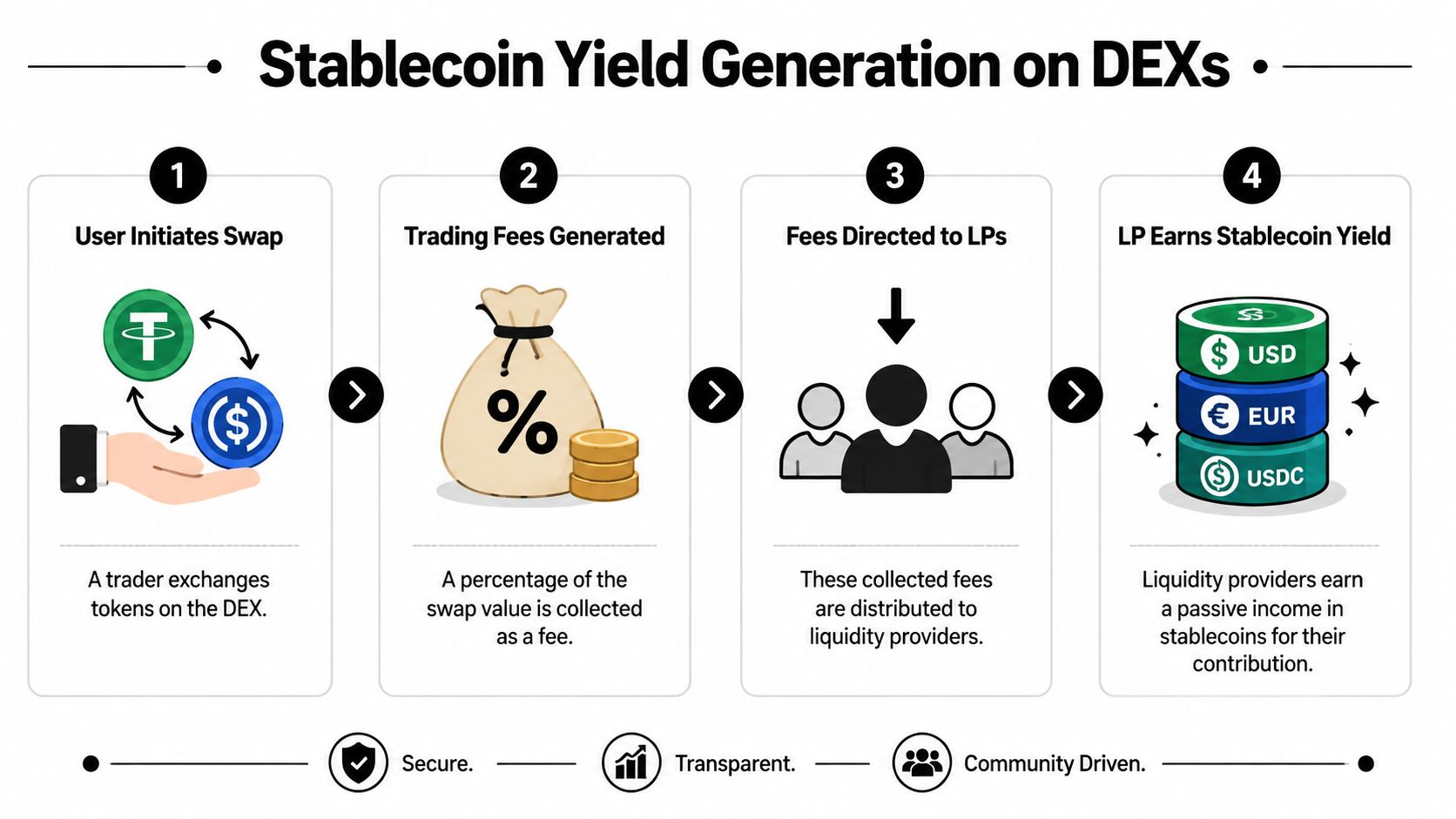
Why stablecoin pools stand out
A pool with two volatile assets can generate fees, but it also exposes LPs to sharper price divergence. Stablecoin-to-stablecoin pools are different because the assets are designed to stay near the same reference value.
That doesn't erase risk. It does change the shape of it.
If you deposit USDC and USDT into a stablecoin pool, you're still taking protocol risk, smart contract risk, and stablecoin-specific risk. But you usually reduce the type of divergence that makes impermanent loss more punishing in volatile pairs.
The income source in plain language
Think of stablecoin LPing like owning part of a toll road. Traders use the road because they want quick passage between assets. Every time they pass through, they pay a toll. If traffic is steady and the road is structurally sound, the owner earns.
That's why volume matters more than marketing language. A yield opportunity on a dex is strongest when there is real usage, durable liquidity, and a risk profile you can tolerate.
What to look for in practice
When evaluating stablecoin yield from dex liquidity, focus on decision criteria, not hype:
Pool composition: Stablecoin pairs usually behave differently from volatile pairs.
Trading activity: Fee income depends on people using the pool.
Liquidity quality: Deep pools tend to offer smoother execution and can attract more consistent flow.
Protocol design: Different dexs distribute fees and incentives differently.
Exit conditions: You should know how easy it is to unwind the position if market conditions change.
Stablecoin yield on a dex isn't magic. It's payment for providing useful market infrastructure.
The part many people miss
The best-looking opportunity on paper can still be a poor fit if it demands constant monitoring. Yields move. Pools change. Incentives rotate. Risk can shift faster than a part-time investor can keep up with.
That's why understanding the source of yield matters so much. If you know the yield comes from fees created by actual trading activity, you can ask a better question: is this pool producing income because it's useful, or because temporary incentives are masking weak fundamentals?
A Smarter Way to Capture DEX Yield
Manual dex yield farming sounds simple until you do it for real.
You need to compare pools across protocols, watch how liquidity changes, track whether fee generation is still healthy, and decide when the risk of staying put is higher than the cost of moving. Then you need to repeat that process without letting gas costs and operational mistakes eat the edge.
That's manageable for full-time DeFi users. It's harder for someone who has a job, a portfolio, and limited attention.
A more practical approach is to use software that monitors opportunities continuously and helps allocate capital with clear risk constraints. Some users build their own workflow with dashboards, wallets, analytics tools, and manual rebalancing rules. Others prefer a managed interface that reduces the amount of protocol hopping they need to do themselves.
One example is Yield Seeker, which lets users deposit USDC on Base and use an AI agent to monitor and allocate capital across DeFi yield opportunities while keeping funds accessible without lockups. That kind of setup fits people who want exposure to on-chain stablecoin yield but don't want dex research to become a second job.
The important point isn't that automation removes risk. It doesn't. The point is that automation can make a dex-based strategy more disciplined, more repeatable, and easier to manage when markets move faster than your calendar does.
If you want a lower-friction way to put stablecoins to work without manually scanning every new pool and protocol, Yield Seeker offers an AI-guided approach to finding and managing on-chain yield while keeping your funds accessible.