
When you put your investments on autopilot, you're essentially using digital platforms and rule-based systems to invest for you, no manual clicks required. This could be as simple as setting up recurring buys on an exchange, or as advanced as deploying AI agents in DeFi to hunt for yield.
The whole point is to take your own emotions out of the equation and enforce some discipline. You let the strategy do the work.
Why Automation Is the Smarter Way to Invest

Think about it: what if your portfolio could grow without you constantly second-guessing it? That’s the real promise here. Setting up these systems is a total game-changer for building wealth because it cuts right through the most common mistakes investors make.
By stepping back from the day-to-day tinkering, you sidestep the biggest behavioral traps. Panic-selling during a market dip or chasing the latest "hot" token are classic ways to lose money. Automation locks in a consistent approach, which is what you need to win in the long run.
Before we dive deeper, let's look at a quick comparison. It really highlights the shift in mindset and effort when you move from a manual to an automated approach.
Manual vs Automated Investing at a Glance
Aspect | Manual Investing | Automated Investing |
|---|---|---|
Effort | High; requires constant research and execution. | Low; set it up once and it runs on its own. |
Emotion | Prone to fear, greed, and impulsive decisions. | Removes emotion; trades are based on rules. |
Consistency | Relies on personal discipline and memory. | Guaranteed consistency through scheduled actions. |
Cost Averaging | Difficult to execute perfectly. | Naturally implements dollar-cost averaging. |
Tax Optimization | Manual and complex to manage. | Can be done automatically (e.g., tax-loss harvesting). |
Time | Demands significant time for monitoring. | Frees up your time for other things. |
As you can see, the benefits of automation aren't just about convenience; they're about building a more robust and disciplined investment framework.
Consistency Powers Compounding
The real magic is how automation feeds the power of compounding. When you automate contributions, your money gets put to work on a schedule, no matter what the market is doing.
This method, dollar-cost averaging, means you buy more when prices are low and less when they are high, smoothing out your average cost over time.
Instead of relying on willpower, your money moves into investments right on schedule. Think of it like a streaming subscription; you don't decide each month whether to pay. The charge just happens, but the payoff is the wealth you're steadily building.
Modern platforms have made this so easy. You have everything from traditional robo-advisors to incredible DeFi tools that put AI to work for you. For instance, a platform like Yield Seeker lets you deploy an AI agent to generate yield on stablecoins—all with minimal effort on efficient networks like Base.
Sidestep Emotional Investing Pitfalls
The rise of automation shows just how much we've learned about investor psychology. The robo-advisory market has been on a tear, with assets under management projected to blow past $3 trillion by the end of 2026.
This isn't just hype. The growth is fueled by data showing that automated strategies simply work. Research has shown that trying to time the market can cost investors up to 1.5% in annual returns compared to just buying and holding. That's a huge drag on performance, all because of selling at the worst possible times.
Unlock Tax Efficiencies
Beyond discipline, automation brings some powerful financial perks. A huge one is the opportunity for proactive investment planning with optimal tax implications.
Some of the more advanced automated services can perform tasks like tax-loss harvesting—selling assets at a loss to offset gains—without you lifting a finger. This feature alone can add a meaningful boost to your after-tax returns each year. Trying to do that manually is a nightmare for most people.
Alright, let's get into the nitty-gritty. Before you dive headfirst into automated investing, you need a game plan. Just jumping in without a clear strategy is like trying to build a house without a blueprint—it’s a recipe for disaster. This initial planning is what makes the difference between a smooth, stress-free automated portfolio and one that just gives you a massive headache.
It really all boils down to your financial goals. Figuring out your "why" is the most critical piece of the puzzle because it shapes every single decision you'll make from here on out. What are you actually trying to achieve with automation?
What’s Your Financial Mission?
Knowing what you’re working towards gives your entire automated strategy a clear direction. Different goals mean different timelines and risk appetites, which completely changes the kind of automation you should be using.
Think about where you might fit:
Retirement: This is the long game, usually 15+ years out. That long timeline gives you room to be more aggressive and growth-focused since you have plenty of time to ride out any market bumps.
Home Down Payment: A classic medium-term goal, maybe 3-7 years away. You’ll want a more balanced approach here, making sure you protect your capital as you get closer to needing it.
General Wealth Building: This is more flexible, without a hard deadline. Your strategy can shift and adapt based on market opportunities and how comfortable you are with risk at any given moment.
Passive Income Generation: Here, the focus is all on creating consistent cash flow. This might steer you toward dividend stocks or, in the world of DeFi, high-yield stablecoin strategies on platforms like Yield Seeker.
Once you know where you're headed, you can start drawing the map. And that brings us to the next crucial step: figuring out just how much risk you can stomach along the way.
Figuring Out Your Personal Risk Tolerance
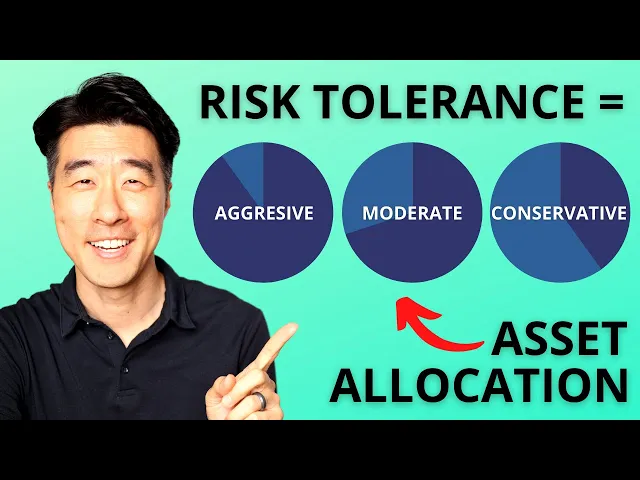
Risk tolerance isn't just some buzzword financial advisors throw around. It's about your gut feeling. How would you really react if your portfolio suddenly tanked by 20% in a single month? Would you hit the panic button and sell everything, or would you see it as a chance to buy the dip?
Your risk tolerance is the emotional anchor of your investment strategy. If your automated setup is too aggressive for your comfort level, you'll constantly be tempted to meddle with it—which defeats the whole purpose of automating in the first place.
Most of us land in one of three buckets. See which one sounds like you.
Risk Profiles Explained
Profile | Description | Typical Automated Strategy |
|---|---|---|
Conservative | You’re all about protecting your capital. High returns are nice, but the thought of losing money keeps you up at night. | Strategies built around high-quality bonds, blue-chip dividend stocks, or audited, low-volatility stablecoin yield farming in DeFi. |
Moderate | You’re cool with some risk to chase better returns, but you want a balanced portfolio to shield you from major drops. | A classic 60/40 mix of stocks and bonds, or a DeFi strategy that blends stable yields with a small slice of more speculative assets. |
Aggressive | You’re focused on maximizing long-term growth and are totally comfortable with big market swings to get there. | A portfolio heavy on growth stocks, emerging markets, or higher-risk, higher-reward DeFi protocols. |
Getting this right is absolutely key. A conservative investor using a tool built for an aggressive one is going to be a nervous wreck.
Matching Your Risk to a Real-World Strategy
This is where it all comes together. You take your goals and your risk profile and connect them to a concrete, automated strategy.
For instance, a young professional with an aggressive risk profile saving for retirement might set up automatic monthly buys into a growth-heavy stock ETF. On the other hand, someone saving for a house down payment in five years might opt for a moderate-risk robo-advisor.
Or, to bring it back to DeFi, if your goal is to earn passive income on the Base network, you could use a platform like Yield Seeker. You can deposit USDC and let its AI agent handle the diversification and risk management across different vetted protocols for you. It perfectly aligns a specific goal (passive income) with a tailored, automated solution, giving you a solid foundation to build on.
Alright, let's talk about picking the right automation platform. This is a big decision. Think of it as choosing a partner for your investing journey. Now that you've got your goals and risk tolerance mapped out, it’s time to find the tool that actually fits your strategy.
The market is flooded with options, from old-school robo-advisors handling stocks and bonds to specialized DeFi platforms built to squeeze yield out of your stablecoins.
Finding the right fit really comes down to a few key things. You’ll need to look at fee structures, how much you need to get started, what assets they even offer, and frankly, how much control you want to have. What's perfect for one person might be a total disaster for another.
Traditional Robos vs. Modern DeFi Platforms
Traditional robo-advisors, like Wealthfront or Fidelity Go, are a solid choice for a hands-off approach to the stock market. They build you a diversified portfolio of low-cost ETFs based on a questionnaire, and they handle all the rebalancing. Some even do tax-loss harvesting. They are a proven, reliable way to automate your long-term wealth building in traditional markets.
Then you have the new kids on the block, born out of decentralized finance (DeFi). These tools are designed to plug directly into blockchain protocols, usually with a laser focus on generating passive income from digital assets like stablecoins.
The real difference is what’s under the hood. Robo-advisors play in the traditional sandbox of stocks and bonds. DeFi platforms tap directly into an open, code-based financial system, which opens up totally different opportunities—and risks.
For a lot of people, getting started is surprisingly simple. Platforms like Yield Seeker let you jump in with as little as $10 in stablecoins on the Base chain. From there, an AI agent takes over, dynamically allocating your funds across various DeFi protocols to chase risk-adjusted yields that often hit 5-15% APY on USDC. Compare that to a traditional savings account, which is probably stuck under 1% in 2026. It’s a different world.
What to Actually Look For
When you're digging into your options, researching the best investment management software is a good place to start, but you need to focus on what matters for you.
Fees: Robos typically charge an annual management fee, maybe 0.25% of your assets. DeFi platforms might take a small performance fee on the yield they generate for you or have tiny transaction fees.
Minimums: Some traditional platforms won't talk to you unless you have thousands to invest. Many of the newer DeFi tools have practically no minimums. This makes them incredibly accessible if you're just starting out.
Asset Types: What are you trying to do? Are you investing for the long haul in the stock market with ETFs? Or are you trying to make your cash work harder by earning yield on stablecoins like USDC? Your goal points you to the right asset.
Automation Smarts: A basic robo-advisor uses a pretty fixed allocation model. A more advanced, AI-driven platform like Yield Seeker is constantly scanning the market, reallocating your capital in real-time to jump on the best opportunities for you.
For a more detailed look, you can explore our complete guide for a deeper breakdown of how to select from various https://yieldseeker.xyz/blog/automated-investment-platforms.
Real-World Example: A Platform for Stablecoin Yield
Let's make this less abstract.
Imagine your main goal is to generate 5-10% in annual passive income on your cash reserves. You want to start with a small amount of capital and put in minimal effort. You're cool with the crypto space but have zero time to become a DeFi protocol expert.
This specific set of needs immediately rules out a traditional, stock-focused robo-advisor. It points you directly toward a platform like Yield Seeker. It runs on the Base network, which means low fees, and it uses an AI agent to manage your USDC deposit.
Here’s what you’d actually see inside the app:
The dashboard is clean. It shows your total balance and what you’re earning in real-time, hiding all the crazy complexity of DeFi. The AI does all the heavy lifting—it finds the best risk-adjusted yields across audited protocols, moves your funds to chase better returns, and diversifies to keep your risk in check. This is how you hit that goal of high-yield passive income without needing to become a full-time DeFi degen.
Activating Your First Automated Strategy Step-by-Step
Alright, enough with the theory. It's time to get our hands dirty and see how this actually works. Let's walk through setting up your first automated investment strategy, moving from the drawing board to a real, working system.
We'll use the DeFi platform Yield Seeker as our example to make everything concrete. By the time we're done, you'll have connected your wallet, funded your account, and kicked off an AI-driven strategy. You’ll see just how straightforward it is to get started.
Connecting Your Digital Wallet
Your gateway to the world of DeFi is your Web3 wallet. This is what’s known as a self-custody wallet, which is just a fancy way of saying you—and only you—are in control of your funds. It’s your digital passport and bank account all in one.
If you're just starting out, popular and trusted options like MetaMask or Coinbase Wallet are fantastic choices. They work as simple browser extensions or mobile apps.
Connecting to a platform like Yield Seeker is a breeze. You’ll just navigate to their site, find the "Connect Wallet" or "Launch App" button, and click it. Your wallet will then pop up asking for permission to connect. Once you approve, you’re in. This is just a digital handshake; it doesn’t send any funds but simply creates a secure link so the platform can see your public address.
You'll use this wallet to sign and approve every transaction, keeping you firmly in the driver's seat.
Funding Your Account on the Base Network
With your wallet connected, you need some capital for your AI agent to put to work. For this walkthrough, we’re going to deposit USDC, a well-known stablecoin pegged 1:1 to the US dollar. We'll be doing this on the Base network.
Why Base? It’s a strategic choice. While Ethereum is the OG, its transaction fees (known as "gas") can get pricey, especially for smaller investment amounts. Base is an Ethereum Layer 2, meaning it offers similar security but with much lower fees and faster speeds. This makes it perfect for automated strategies where frequent, small transactions might occur.
You'll initiate a deposit directly from your wallet to the platform. This moves your USDC into the platform's smart contracts, giving your AI agent the funds it needs to start hunting for yield. If you want a bit more background on the mechanics, our guide on automated crypto investing strategies dives deeper.
This flowchart below lays out the two main paths for automating your investments: the traditional robo-advisor route and the more nimble DeFi approach we're taking today.
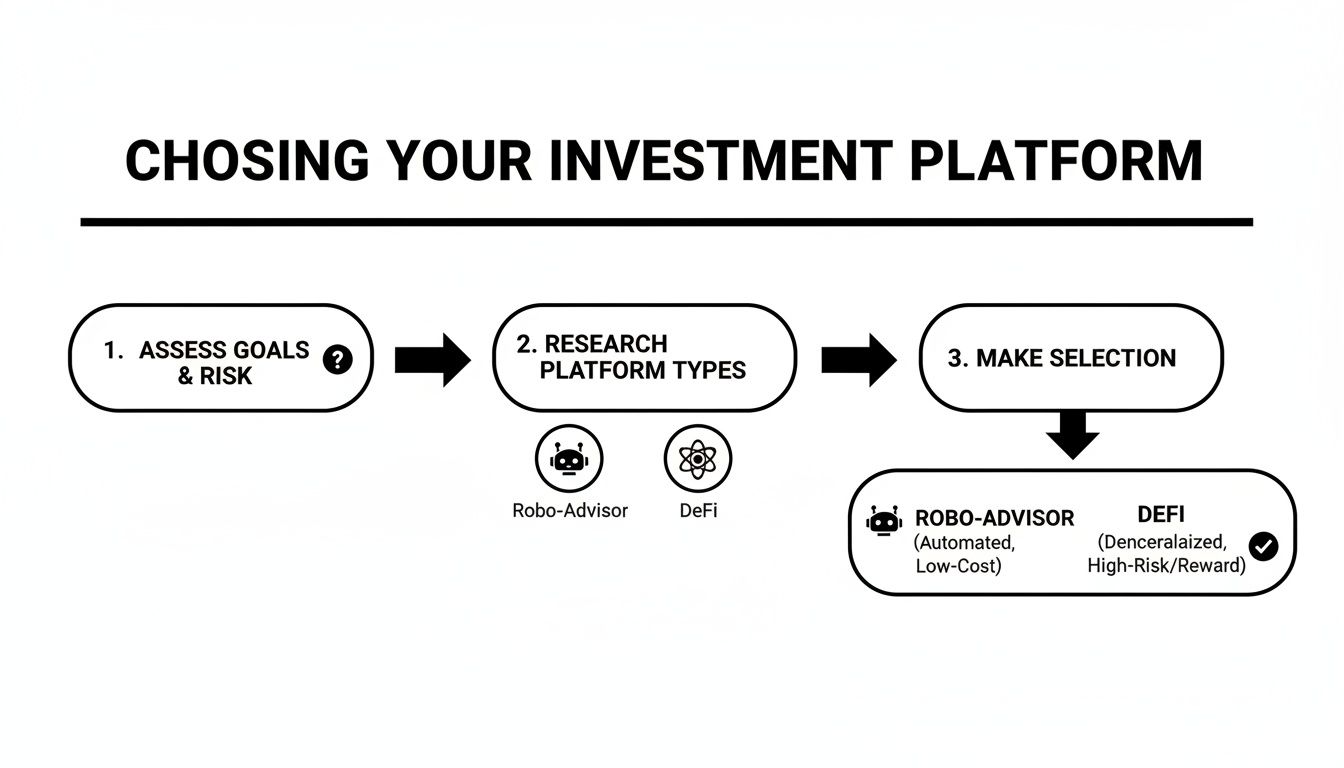
As you can see, one path sticks to the familiar world of stocks and bonds, while the other—our path—taps into the agile, code-driven world of decentralized finance.
Engaging with the AI Agent
This is where the magic happens. Once your USDC is deposited, it's time to unleash your personalized AI agent. Platforms like Yield Seeker give you two ways to get going:
Go with the Default: This is usually the best option for beginners. The default settings are typically balanced for a good risk-to-reward profile. The AI will automatically start diversifying your funds across a list of pre-vetted, audited DeFi protocols to find solid, risk-adjusted returns.
Fine-Tune Your Settings: If you're a bit more experienced, you can tweak the parameters yourself. For instance, you could tell the agent to avoid certain types of protocols or crank up the risk tolerance to chase higher yields.
For most people, sticking with the default is the way to go. It lets you get started safely without needing a PhD in DeFi.
The beauty of this model is its "set and forget" nature. You aren't hunting for protocols or manually moving funds around. You’re giving high-level commands to an AI agent that handles all the heavy lifting for you, 24/7.
This kind of automation is a huge leap forward. On Yield Seeker, you can deposit as little as $10 USDC on Base and the AI agent gets to work, scanning protocols in real-time. It might shift funds to capture 12% on Morpho one day or 8% on Aave the next, all while managing risk for you.
Tracking Your Automated Earnings
Once your agent is live, your job is pretty much done. You can switch from being an active manager to a passive monitor. The platform's dashboard is your command center for tracking performance.
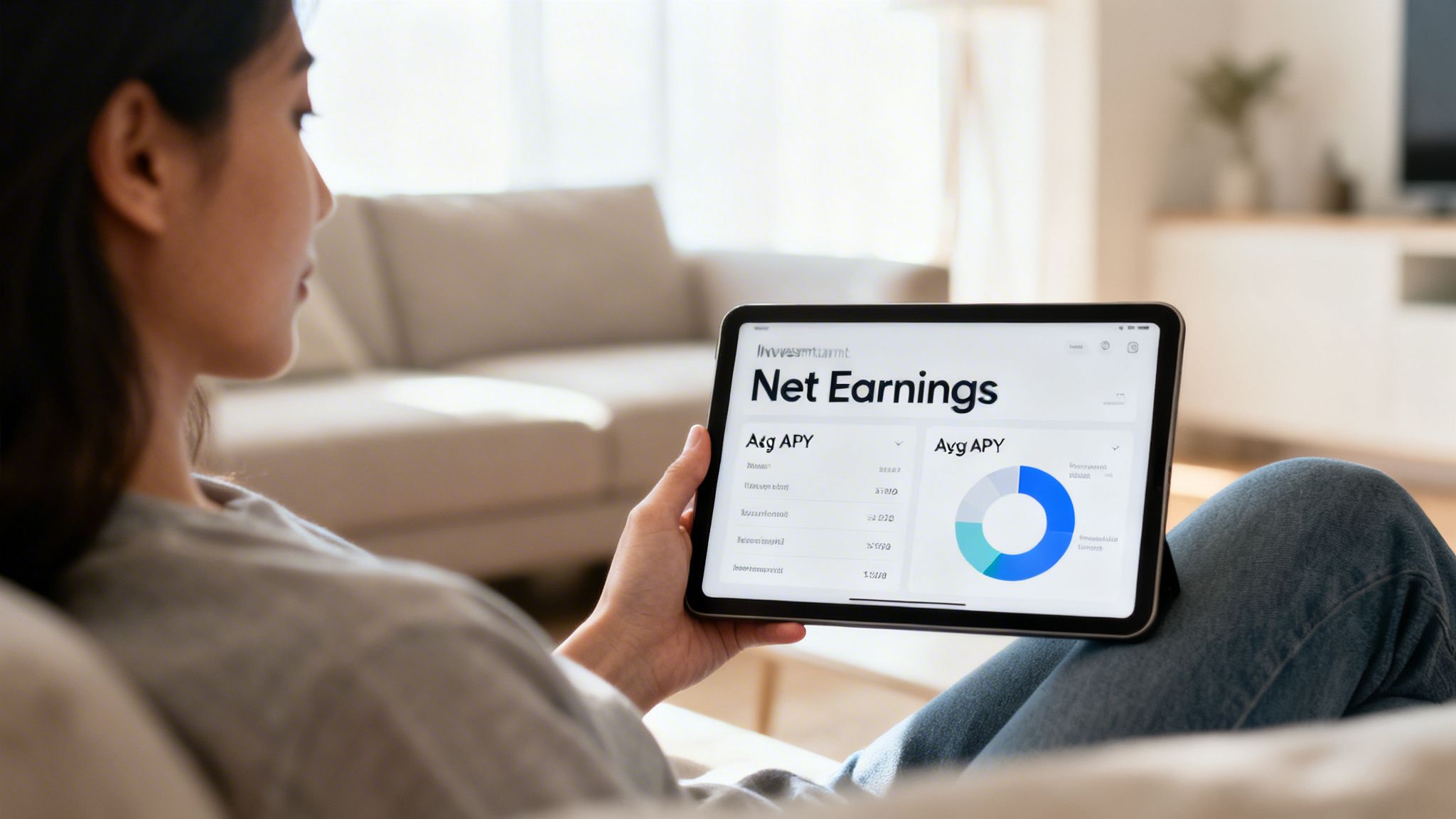
Here, you'll see your earnings accumulate, often ticking up in real-time. The dashboard will display your total balance, your net profit, and the average Annual Percentage Yield (APY) you're earning. Most importantly, it gives you full transparency, showing you exactly where your funds are allocated at any moment. This lets you keep an eye on things without ever getting lost in the weeds.
Monitoring Performance Without Micromanaging
Getting your automated strategy up and running is a great feeling, but your job isn’t over. The real magic of learning how to automate your investments is freeing up your time, not walking away from your portfolio entirely. This is where you learn to be a smart observer—keeping an eye on things without getting sucked into obsessive micromanagement that actually hurts your returns.
You want to stay informed and feel in control, while letting the automation do the heavy lifting. It's about knowing which numbers matter and when to trust the system versus when a strategic tweak is genuinely needed. Think of yourself as the captain of the ship, letting the autopilot handle the moment-to-moment steering.
What to Track on Your Dashboard
Your platform's dashboard is your mission control, but it's easy to get lost in the noise. Staring at hourly price swings will just drive you nuts and tempt you into making emotional, knee-jerk decisions. Instead, zoom out and focus on the big-picture metrics that tell you if your strategy is actually working.
These are the key performance indicators that give you a clean, simple snapshot of how things are going:
Net Earnings: This is your bottom line—the total profit or loss after fees. It’s the most direct way to measure your strategy's success.
Average APY (Annual Percentage Yield): This metric shows your rate of return over time. Watching its trend tells you if the AI is successfully sniffing out and capturing good yield opportunities.
Current Protocol Allocations: If you're using a DeFi platform like Yield Seeker, this shows you where your capital is spread out. A quick look confirms your funds aren't all piled into one protocol, which is crucial for managing risk.
By focusing on these high-level numbers, you can get a meaningful update in just a few minutes a week. If you ever feel the need to go deeper, our guide on real-time yield monitoring can show you how to dig into the details.
Trusting the Automated Process
One of the most powerful things about automating your investments is that it takes your own emotional biases out of the picture. An algorithm doesn't panic-sell when the market dips, and it doesn't get greedy when things are flying high. It just sticks to the plan with cold, hard discipline.
This discipline is a powerful wealth-building tool. One undeniable edge of automating investments is dodging the emotional rollercoaster that tanks returns—algorithms don't panic-sell like humans do. Behavioral finance pioneer Daniel Kahneman's research, echoed in Fidelity's data, reveals that individual investors underperform market indices by 3-5% yearly due to fear-driven decisions during dips, but automated strategies enforce discipline, capturing full rebounds. You can find more on how AI is changing financial services with insights from industry analysis on Arria.com.
When you see a dip, your first instinct should be to trust the system you've set up. The AI is built to see these moments not as a crisis, but as part of a bigger cycle. It will often rebalance to optimize your position for the recovery that follows.
Pro Tips for Secure and Smart Automation
While "set and forget" is the general idea, a few smart habits will add another layer of security and boost your results over the long run.
Lock Down Your Access with a Hardware Wallet. This is non-negotiable. Connecting to platforms like Yield Seeker with a hardware wallet (think Ledger or Trezor) keeps your private keys offline, safe from hackers and digital threats.
Dollar-Cost Average into Your Position. Instead of throwing in a huge lump sum all at once, think about adding funds on a regular schedule. This smooths out your average entry price and lowers the risk of buying in right at a market peak.
Know When to Make a Strategic Shift. Automation is smart, but it can't read your mind. If your personal financial goals change—maybe you now need money for a down payment sooner than you thought—it’s time to step in. Manually adjust your strategy’s risk level or pull out some capital. Trust the system for the day-to-day, but take the wheel for major life changes.
Answering Your Top Questions About Automated Investing
Jumping into a new way of managing your money, especially with something as new as AI in DeFi, naturally brings up a few questions. It's smart to get these answered upfront. Let's walk through some of the most common ones I hear so you can get started with confidence.
Is It Actually Safe to Automate Investments in DeFi?
This is a big one, and the real answer isn't a simple yes or no. Safety in DeFi is a mix of a few things: the platform's security, how your strategy is set up, and your own security habits.
Any decent platform will put a huge emphasis on security, which means getting their smart contracts audited by well-known third-party firms. They'll also be transparent about who their developers are and how they manage risk. These audits are your first line of defense.
The AI automation part actually adds its own layer of safety. Instead of you manually throwing all your money into a single, high-yield protocol you just saw on X, the AI spreads your funds across several different, pre-vetted DeFi protocols. This cuts down your risk of a single point of failure. If one protocol has a problem, your entire stack isn't on the line.
While no investment is ever 100% risk-free, this automated, diversified approach is almost always safer for newcomers than manually chasing the highest APY on some unaudited platform you've never heard of.
At the end of the day, the platform's job is to handle the tech and protocol risks. Your job is to secure your end by using best practices, like connecting with a hardware wallet.
How Do I Handle Taxes on Automated DeFi Earnings?
This is a critical point that trips a lot of people up: yes, the yield you earn from these automated strategies is usually taxable income. And it's on you to report it.
The good news is that solid platforms are built to make this less of a headache. While they can't give you tax advice, they provide a complete, exportable transaction history. You can see every deposit, withdrawal, and every penny of yield earned.
The best way to handle this is to connect your wallet to a dedicated crypto tax tool.
These tools pull in your transaction data automatically, sort everything into the right categories (like income or trades), and can even generate the tax forms you need, like Form 8949. This turns what could be a nightmare into a much simpler process.
Can I Really Start with a Small Amount and See Results?
Absolutely. In fact, starting small is one of the best things about modern DeFi automation. Being able to get going with just $10 or $20 is a massive change from traditional finance, where high minimums often lock people out.
When you start small, the goal isn't to get rich quick. It's about learning the ropes with almost no risk. You get to see the whole process firsthand: depositing funds, watching the AI put them to work, seeing the yield pop up on your dashboard, and then making a withdrawal.
This hands-on experience is what builds real confidence. Once you see compounding do its thing—even with a small amount—you'll feel a lot more comfortable when you decide it's time to scale up your passive income strategy.
Are My Funds Locked Up or Can I Access Them Quickly?
Liquidity—being able to get your money when you need it—is a huge deal. One of the major perks of many automated DeFi platforms is that they don't have lock-up periods. Your funds stay liquid.
This works because the AI usually places capital into highly liquid spots like DeFi money markets and lending protocols, not into fixed-term staking contracts. This means you’re always in control and can pull your capital out whenever you want, typically with just a couple of clicks. With platforms like Yield Seeker, a busy professional can deposit once and let the AI take over, knowing their funds aren't locked away. As you'll see when you explore tools for automating investments on Mexem.com, this approach makes it simple to earn passive income without having to manage a dozen different DeFi apps.
This flexibility is a major advantage over things like old-school bank CDs or even some crypto staking options that hit you with big penalties for withdrawing early. Having the freedom to move your funds without penalty is huge for peace of mind.
Ready to stop juggling platforms and let AI handle the heavy lifting? With Yield Seeker, you can start earning smarter, automated yield on your stablecoins in minutes. Launch your first AI Agent today