
You've probably seen the phrase “not your keys, not your coins” after an exchange freeze, bankruptcy, or withdrawal pause. You also may have seen wallet apps, DeFi dashboards, and yield tools describe themselves as non-custodial. Many users nod along, then keep going without a clear mental model of what the term means.
That's a problem, because non-custodial isn't just crypto jargon. It changes who controls your assets, who can move them, who can block access, and who has to clean up if something goes wrong. If you're holding stablecoins and thinking about yield farming, those aren't abstract questions. They directly affect your money and your time.
A lot of articles stop at the definition. That's not enough. What matters is the user trade-off: convenience versus control, easy recovery versus irreversible mistakes, curated yield options versus direct access to DeFi. If you've ever wondered whether self-custody is worth the hassle, or whether a managed product is “good enough,” this is the decision you're making.
The True Meaning of Digital Ownership
A good way to understand non-custodial is to start with a familiar mistake. Someone buys USDC on a centralized exchange, leaves it there, and assumes they “own” it in the same way they own cash in a wallet. Then a platform limits withdrawals, adds delays, or changes account access rules. Suddenly, ownership feels a lot less direct.
In crypto, non-custodial means you control the credentials that authorize transactions. In plain English, you hold the thing that can move the assets. No company, exchange, or app needs to approve you first.
That's why people keep repeating “not your keys, not your coins.” It's shorthand for a simple point: if another party controls the keys, your access depends on their systems, policies, and solvency. If you control the keys, the asset is much closer to cash in your own safe than money in someone else's account.
Practical rule: If a service can freeze, delay, or deny your withdrawal because it holds the signing authority, you're using a custodial model, even if the app feels modern and crypto-native.
That doesn't make custodial products useless. For some people, they're the right tool. But if you're exploring DeFi, yield farming, or onchain treasury management, the difference becomes impossible to ignore. The wallet is no longer just a login. It's the control layer.
If you want a quick primer on the wallet side before going deeper, this guide to what a crypto wallet is is a useful starting point.
How Non-Custodial Systems Actually Work
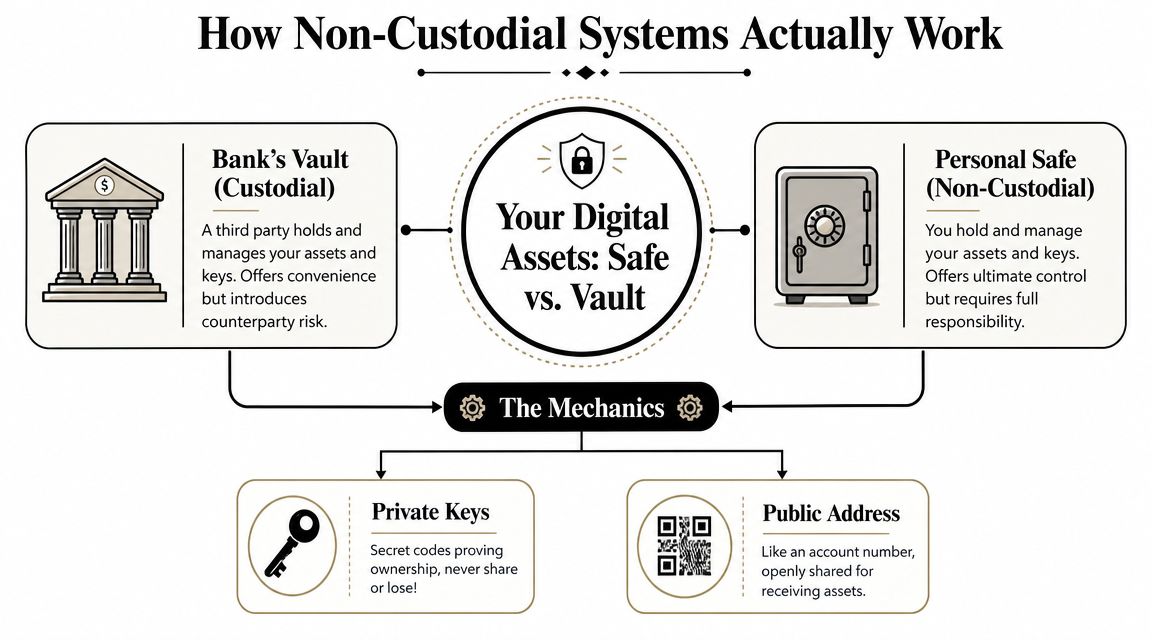
The easiest mental model is bank vault versus personal safe.
With a bank vault, the institution manages the building, the locks, the staff, the access process, and the records. You have a claim on assets, but you don't personally open the vault and move the contents whenever you want. With a personal safe at home, you control access directly. That gives you autonomy, but it also means there's nobody to call if you lose the key.
The two parts people confuse
Most wallet confusion comes from mixing up public addresses and private keys.
A public address is like an account number. You can share it so other people can send you assets. A private key is the secret credential that proves you can authorize movement from that address. If the public address is your inbox, the private key is the only valid signature the blockchain accepts.
Your wallet app doesn't “hold” coins in the way a leather wallet holds cash. The assets live on the blockchain. The wallet manages the credentials used to interact with them.
Here's the cleanest way to think about it:
Public address: Where assets can be sent.
Private key: What authorizes spending or moving them.
Seed phrase: A backup that can recreate the wallet's keys if your device is lost or replaced.
What non-custodial changes in practice
In a non-custodial setup, the wallet generates and stores your credentials on your behalf, but the service provider doesn't take control of them. You approve transactions yourself. When you connect to a DeFi app, your wallet signs a request. The blockchain recognizes that signature as valid proof of authority.
That's why non-custodial systems can feel both liberating and unforgiving. There's no support agent with the power to reverse an onchain action. There's also no intermediary who needs to approve your participation in a protocol.
Your wallet is less like an online brokerage account and more like a cryptographic control panel.
This model also explains why non-custodial tools are the default gateway to DeFi. Lending protocols, DEXs, stablecoin vaults, and onchain yield strategies typically interact with your wallet directly. They don't need to open an account for you in the old financial sense. They need a valid onchain signature.
Why this matters for your money and your time
For your money, the answer is straightforward. Control lives with whoever controls the keys.
For your time, the trade-off is subtler. Custodial systems offload operational work. Non-custodial systems remove permission barriers but ask you to learn wallet security, transaction approvals, and protocol risk. That sounds like a burden until you compare it with the time cost of limited platform options, withdrawal friction, or having to move funds every time a centralized provider changes its terms.
If you're farming stablecoin yield, non-custodial access usually means broader choice and faster execution. It also means your workflow has to be tighter. The freedom is real. So is the responsibility.
Custodial vs Non-Custodial Models Compared
People often talk about custody as if one model is obviously superior. It isn't. Each model solves a different problem.
A custodial exchange is built for convenience, support, and familiar account-based access. A non-custodial wallet is built for direct control, portable identity, and permissionless use across DeFi. The right choice depends on what failure mode bothers you more: relying on someone else, or relying on yourself.
The head-to-head trade-off
Feature | Custodial Model (e.g., Centralized Exchange) | Non-Custodial Model (e.g., MetaMask, Yield Seeker) |
|---|---|---|
Key control | Provider controls the keys | You control the keys or direct signing authority |
Account recovery | Usually easier, often through password reset or support | Recovery depends on your backup method |
Access to DeFi | Often limited to platform-supported products | Broad direct access to onchain apps and protocols |
Withdrawal control | Provider can delay, review, or restrict access | You can move assets when you sign a valid transaction |
Operational burden | Lower day to day for the user | Higher, because you manage wallet security |
Error handling | Some actions may be reversible within the platform | Onchain mistakes are often irreversible |
Privacy and permissions | Access is mediated by the provider | Access is typically wallet-based and direct |
Yield discovery | Curated menu, simpler but narrower | Wider set of options, more research required |
Best fit | New users, active exchange traders, users who want support | DeFi users, long-term holders, treasury operators, yield seekers |
Security risk isn't one thing
Custodial and non-custodial setups fail in different ways.
With custody, the central risk is counterparty dependence. You trust the provider's solvency, controls, internal processes, and access rules. If they pause withdrawals, your technical skill doesn't help much.
With non-custody, the central risk is operator error. You click the wrong approval, expose your seed phrase, lose a device without a backup, or sign a malicious transaction. The blockchain won't ask whether you meant to do it.
That's why “more secure” is too vague to be useful. A hardware wallet may reduce one class of risk while increasing the importance of your backup process. A custodial account may reduce key-management mistakes while increasing exposure to centralized failure.
Convenience has a hidden price
Busy professionals often underestimate the time cost of fragmented access.
A custodial app feels easy because the interface is familiar. But if your goal is optimized stablecoin yield, convenience can become a funnel into a smaller menu of choices. You save time on setup, then spend time later working around product limits, transfer delays, or missing integrations.
The real question isn't “Which model is simpler?” It's “Which model creates less friction for the outcome I actually want?”
For someone who only buys and holds a small amount of crypto, custody might be enough. For someone deploying stablecoins across DeFi opportunities, non-custodial infrastructure usually maps better to the job.
Understanding Your Security Responsibilities
Non-custodial security sounds intimidating because people frame it like an all-or-nothing test. In reality, it's a set of habits. You don't need to become a cryptographer. You need a clean process.
Start with the seed phrase
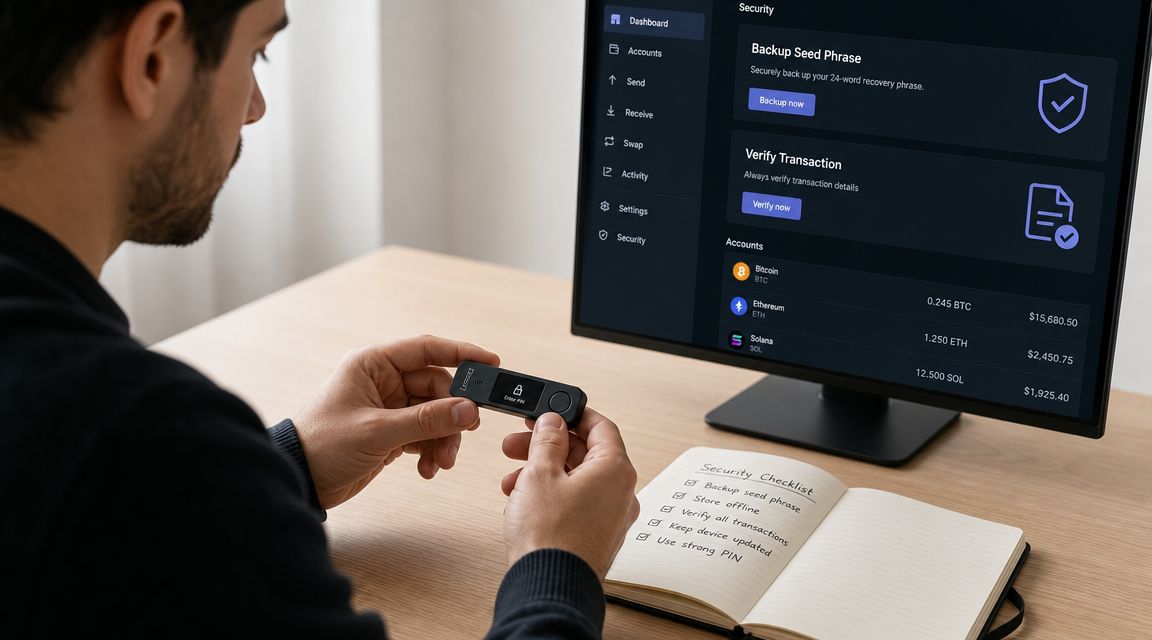
Your seed phrase is the master backup for many wallets. If someone gets it, they can usually recreate your wallet. If you lose it and lose access to your device, recovery may be impossible.
That leads to a few basic rules:
Store it offline: Don't leave it in cloud notes, email drafts, screenshots, or chat apps.
Keep it legible: A backup you can't read under stress is not a backup.
Separate copies carefully: Redundancy helps, but every extra copy is another exposure point.
Don't normalize sharing: No real support person, protocol, or wallet app should ask for it.
A lot of self-custody failures aren't technical. They're workflow failures. Someone moves too fast, stores a phrase where it's convenient, then forgets that convenience is exactly what attackers look for.
Hot wallets and hardware wallets
A hot wallet is connected to an internet-enabled device like a phone or laptop. It's practical for daily use, signing routine transactions, and exploring DeFi.
A hardware wallet keeps signing isolated on a dedicated device. That doesn't remove every risk, but it narrows the attack surface. For larger balances or treasury funds, that separation matters.
Here's a practical split many users adopt:
Daily activity wallet: Smaller balance, browser or mobile wallet, used for frequent DeFi interactions.
Vault wallet: Hardware-backed, used for larger holdings and less frequent moves.
Operational transfer path: Funds move from vault to activity wallet only as needed.
That structure keeps one mistake from exposing everything at once.
Working habit: Treat your hot wallet like the cash in your physical wallet, and your hardware wallet like the safe you don't open casually.
Smart contract risk is different from wallet risk
Even if your wallet setup is solid, DeFi adds another layer: smart contract risk. You can control your keys perfectly and still interact with a protocol that has design flaws, admin risk, liquidity issues, or poor security practices.
Effective due diligence is key. Look for established protocols, clear documentation, understandable strategy mechanics, and a transparent approach to risk. If a product automates execution, review how it frames permissions, vault access, and asset movement.
For teams evaluating automated systems or agent-based infrastructure, a focused AI agent security assessment can help translate “this looks smart” into a more disciplined review of controls, permissions, and failure modes.
A broader checklist for personal self-custody practices is in this guide on how to keep my crypto safe.
Slow down transaction approvals
Most real-world losses happen at approval time.
Users sign token approvals without reading the spender. They connect wallets to lookalike sites. They rush because the transaction “looks normal.” In a non-custodial system, your signature is the action. There's no separation between clicking and authorizing.
This video gives a helpful visual overview of that mindset shift:
Three questions catch a surprising amount of avoidable risk:
What app am I connected to?
What exactly am I approving?
Does this permission match the action I intended?
If you can't answer all three, don't sign yet.
How Non-Custodial Choices Affect Yield Strategies
If your goal is stablecoin yield, custody isn't just a storage decision. It shapes your opportunity set.
A custodial platform usually offers a menu. You pick from what the provider supports. That can be useful if you want simplicity and don't care much about strategy depth. The trade-off is that your access is constrained by the platform's listing choices, business incentives, and operational scope.
A non-custodial setup changes the model. Your wallet can connect directly to DeFi protocols, vaults, and aggregators. You aren't waiting for a centralized intermediary to add support for a strategy. You can move where liquidity and risk-adjusted opportunity make sense to you.
Why this matters in stablecoin farming
Stablecoin yield farming often isn't about finding one magical vault and forgetting it forever. Conditions change. Rates move. Incentives shift. Liquidity rotates. New pools appear while older ones become less attractive or less efficient.
In a custodial environment, you often react slowly because your path is indirect. In a non-custodial environment, you can act directly. That creates two benefits:
More choice: You can access a broader range of onchain opportunities.
Faster repositioning: You can adapt without waiting for a centralized platform to update its product shelf.
The catch is obvious. More choice creates more research work.
The real bottleneck is decision fatigue
For many users, the hardest part of non-custodial yield isn't the wallet. It's the constant monitoring.
You need to compare protocols, understand where yield comes from, watch for changing conditions, and decide when to move capital. That's manageable if DeFi is your full-time hobby. It's painful if you're a founder, operator, or investor with an actual job.
That's where a non-custodial tool can earn its keep. Some platforms help users automate discovery and allocation without taking custody of funds. One example is self-custody yield platforms, which combine wallet-based control with software that reduces the manual research burden.
Yield Seeker fits that model. It's an AI-powered platform for stablecoin yield that operates non-custodially, so users keep control while software monitors and allocates across DeFi opportunities. That matters if you want DeFi access without turning portfolio maintenance into a second job.
Non-custodial yield works best when your control layer stays yours and your research layer gets lighter.
What this means for your money and your time
For your money, non-custodial access can mean broader exposure to onchain yield options instead of being confined to a single provider's menu.
For your time, the answer depends on tooling. If you manage everything manually, non-custodial can become a spreadsheet-heavy burden. If you use software that helps with monitoring and execution while leaving custody with you, the balance improves sharply.
That's the unique appeal of modern DeFi infrastructure. You don't have to choose between total autonomy and total complexity in the same way you did a few years ago.
Which Path Is Right for You
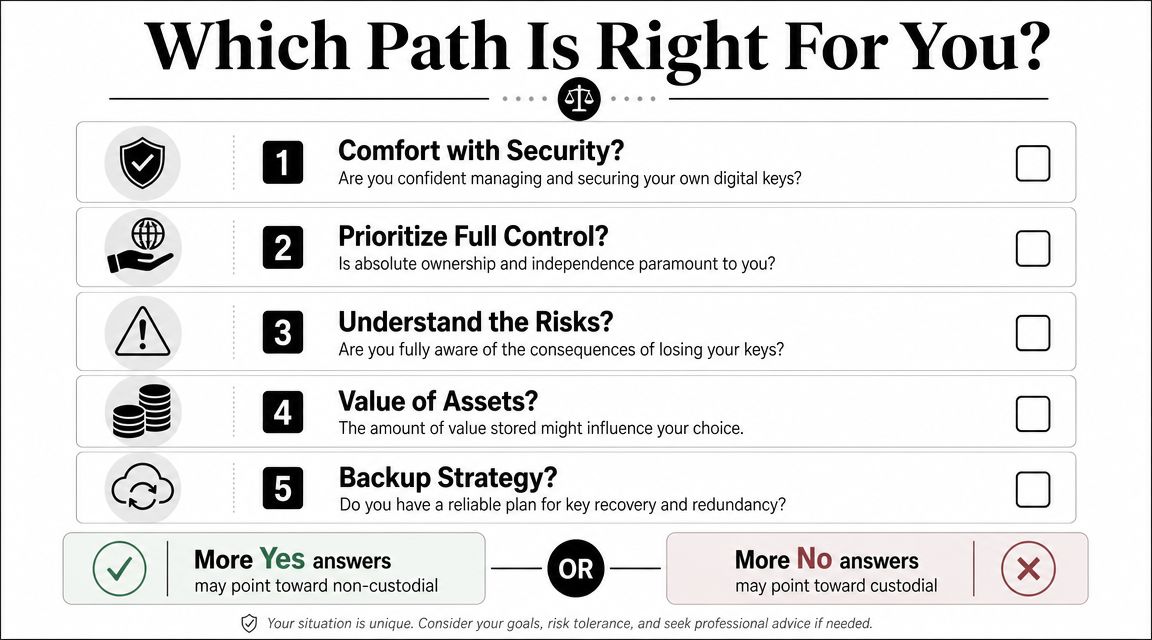
The cleanest decision framework is to stop asking what sounds more “crypto native” and ask what matches your actual operating style.
For the DeFi beginner
If you're early in your learning curve, non-custodial can still make sense, but only if you respect the security side from day one. The mistake beginners make is treating self-custody like a feature toggle instead of a responsibility shift.
A beginner-friendly path usually looks like this:
Start small: Use an amount that lets you learn without panic.
Use one wallet first: Don't create a maze of addresses before you understand approvals and backups.
Prefer simple strategies: Stablecoin lending or straightforward vaults beat complicated multi-step loops.
Write down your process: Backup, test deposit, confirm withdrawal, then scale.
If that sounds like too much friction right now, a custodial starting point may be reasonable. But if your goal is DeFi participation rather than exchange trading, you'll probably end up moving toward non-custodial anyway.
For the time-constrained investor
This group usually knows enough to understand the value of self-custody. The issue isn't knowledge. It's bandwidth.
If you're juggling work, family, and a portfolio, ask yourself:
Question | If your answer is yes | What it suggests |
|---|---|---|
Do you want access to onchain yield without monitoring rates daily? | You value automation | Non-custodial with software assistance fits well |
Do you hate operational friction more than market complexity? | You need a smoother workflow | Custodial may feel easier, but can cap flexibility |
Are you comfortable learning wallet basics once if it saves future time? | You can handle setup cost | Non-custodial may win over the long run |
For this persona, the best setup is often not pure DIY and not pure custody. It's non-custodial infrastructure with a simpler interface and automated assistance.
For the Web3 treasury manager
Treasuries care about a different stack of problems: control, auditability, policy, signer management, and concentration risk.
A custodial account can simplify some workflows, especially when internal teams want familiar approvals and external support. But it also introduces dependence on a third party at the exact moment when treasury resilience matters most.
Non-custodial treasury management usually makes more sense when your team needs:
Direct control over reserves
Clear signer policies and wallet separation
Transparency into where assets are deployed
Flexibility to move across protocols without account-level gatekeeping
This doesn't mean every treasury should go fully manual. It means the custody layer and the operations layer should be designed intentionally, not inherited by default from an exchange account.
A good treasury setup doesn't optimize only for convenience. It optimizes for control under stress.
A short decision checklist
Choose a custodial path if most of these are true:
You want password-based recovery more than direct control
You mainly trade on exchanges
You don't plan to use DeFi protocols directly
You prefer provider-managed operations
Choose a non-custodial path if most of these are true:
You want direct wallet-based ownership
You care about access to DeFi yield opportunities
You're willing to learn backup and signing hygiene
You don't want withdrawal access governed by a third party
For many stablecoin holders, the answer ends up being practical rather than ideological. They want the control and portability of non-custodial finance, but they don't want to spend evenings chasing yield changes across five dashboards. That's the gap modern tools are trying to close.
If you want a simpler way to put non-custodial stablecoin yield into practice, Yield Seeker is built for that middle ground. You keep control of your funds while the platform helps monitor and allocate across DeFi opportunities, which can make self-custody feel much more usable for beginners, busy professionals, and onchain treasuries alike.