
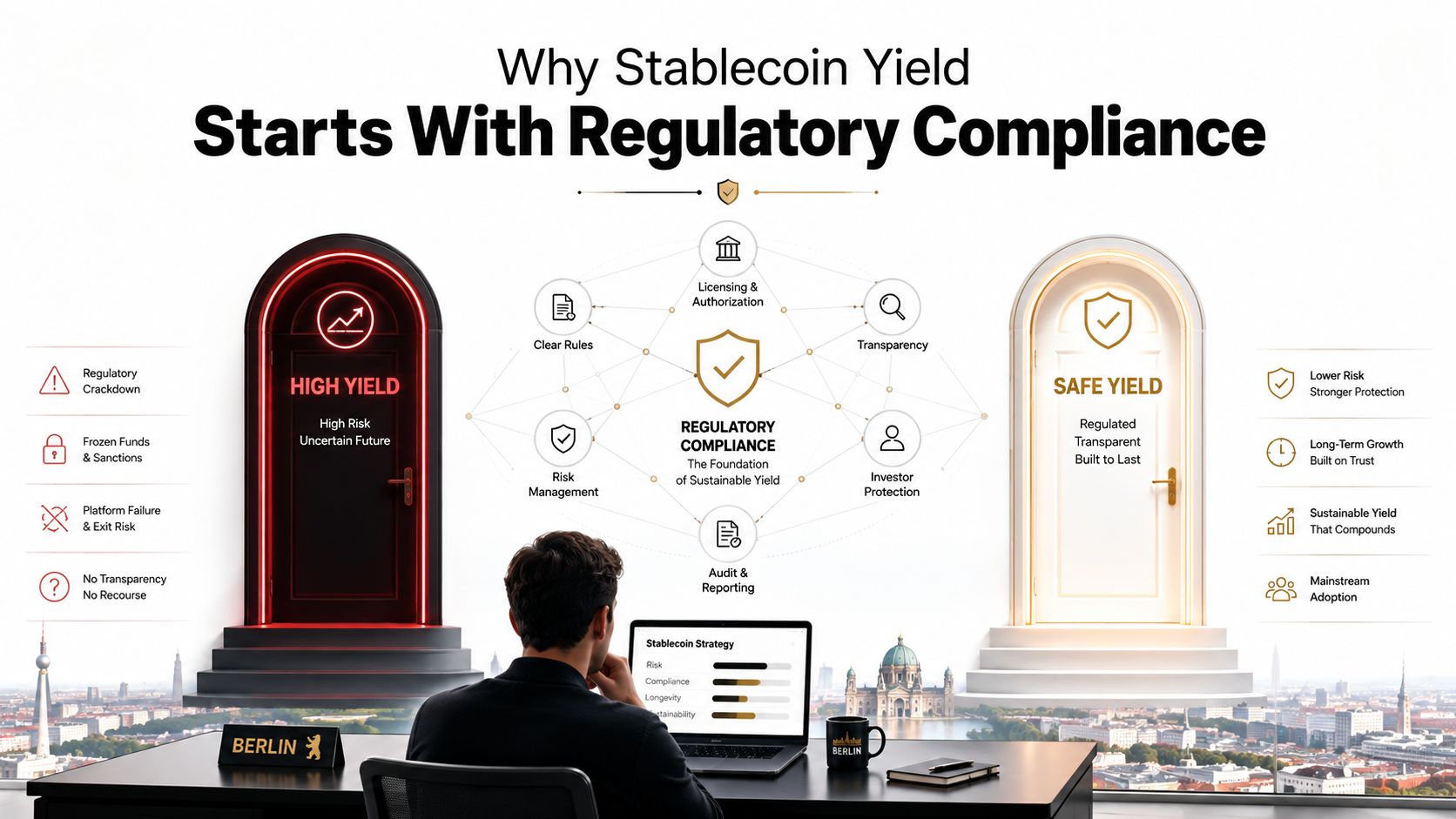
You're holding stablecoins, comparing yield dashboards, and wondering why one platform offers a modest return while another advertises a far higher rate. The instinct is to compare the percentages first. In practice, the more important question is whether the strategy is legally available to you, whether the platform can keep operating in your jurisdiction, and whether you'll have usable records if an auditor, bank, tax authority, or compliance team asks how the funds moved.
Understanding regulatory compliance means learning to read those constraints as part of the product itself. Regulation affects who may access a protocol, which assets can be offered, how wallets are screened, how reserves are documented, and what happens when a transaction triggers a risk alert. For DeFi users and founders, compliance isn't just a legal shield around a finished product. It's one of the inputs that determines which yield strategies can exist in the first place.
Why Stablecoin Yield Starts With Regulatory Compliance
Suppose you're in Berlin with USDC in a custodial wallet. One lending market displays a moderate yield and offers a familiar onboarding flow, while a permissionless aggregator advertises a much higher rate through several underlying protocols. The choice looks financial, but it's also regulatory. The first venue may have clearer disclosures, identifiable operators, documented reserves, and an onboarding process that fits the rules applied to your location. The second may be inaccessible through your custodial on-ramp, unavailable to residents of your country, or difficult to use if something goes wrong.
Regulatory compliance is the ruleset that decides which doors are open. It covers the laws, licenses, supervisory expectations, disclosures, controls, and records that shape how financial activity reaches a user. A stablecoin issuer applies those rules to reserves and redemptions. A lending protocol or front-end applies them to access, marketing, monitoring, and transaction flows. A custodian applies them to account ownership, withdrawals, and recovery procedures.
The rate is only the visible layer
A yield rate is the final output of many upstream decisions. The protocol may be taking smart-contract risk, liquidity risk, counterparty risk, market risk, or jurisdictional risk. A front-end may limit certain wallets. A stablecoin issuer may restrict minting or redemption routes. A bank or exchange may refuse to process funds connected to an address it considers high risk.
That means a high displayed rate doesn't automatically represent a better opportunity. It may reflect a strategy that has fewer access controls, less transparent counterparties, more volatile incentives, or a weaker recovery path. A lower rate may come with stronger operational controls and clearer user recourse, although compliance alone never guarantees that a product is safe or profitable.
Practical rule: Treat accessibility, transparency, monitoring, and recoverability as part of yield analysis, not as footnotes after the rate.
Before depositing, ask what happens if the platform changes its geographic policy, pauses withdrawals, or flags your wallet. Review the venue's legal entity, user restrictions, risk disclosures, and recordkeeping practices. For a plain-language introduction to identity checks, suspicious transaction controls, and financial crime prevention, the Smart Classic Business Hub AML guide can help establish the basic vocabulary.
What Compliance Actually Means in 2026
Regulatory compliance is more than “following the law.” It's the operating system that tells a financial business how to conduct activity, document decisions, protect customers, monitor risk, and demonstrate that its controls work. The OECD's 2014 Regulatory Compliance Cost Assessment Guidance formalized practical methods for measuring and reducing compliance costs across OECD countries. Its importance lies in treating compliance as an economic problem as well as a legal one, with governments and firms assessing complexity, burden, enforceability, and implementation cost.
That framework maps cleanly onto crypto. A stablecoin issuer has to decide how much infrastructure to build for reserves, reporting, customer screening, and redemption. A DeFi company has to decide whether to restrict a feature, add wallet intelligence, create an audit trail, or avoid a market entirely. These decisions affect product design, staffing, banking access, user experience, and the economics of each strategy.
The market is already large enough for compliance to appear as a material business category. One industry review estimated the global regulatory compliance market at $23.18 billion in 2025, compared with $21.16 billion in 2024, an increase of $2.02 billion and a 9.5% CAGR. The same review estimated average annual compliance spending per company reached about $4.7 million in 2024, after rising 12% between 2020 and 2024. These figures come from ScottMax's compliance industry trends review, and they illustrate why compliance decisions increasingly influence the cost structure of financial products.
Compliance as an economic discipline
Metric | Traditional Finance | DeFi / Crypto Firms |
|---|---|---|
Core obligation | Apply established controls to accounts, products, transactions, and reporting | Translate financial controls into wallets, smart contracts, front-ends, tokens, and on-chain activity |
Main cost question | How much staffing and infrastructure are needed to meet supervisory expectations? | Which controls are needed without making permissionless products unusable? |
Product effect | Licensing and controls shape distribution, pricing, and customer access | Geofencing, screening, disclosures, custody design, and contract permissions shape viable yield |
Evidence standard | Policies, approvals, logs, reports, and audit records | The same evidence needs, connected to wallet events, contract changes, treasury actions, and user activity |
A useful tax and reporting companion is this guide to crypto tax reporting requirements. The central lesson is simple: compliance is not an expense added after launch. It's an economic input that determines what can launch, where it can operate, and which users it can serve.
The Five Regimes That Shape Every DeFi Yield
A single deposit can touch several regulatory regimes at once. Think of them as different control layers around the same transaction. One layer asks who you are, another asks where funds came from, another classifies the product, another calculates what you owe, and another determines who controls the assets.
KYC is the bouncer at the door
Know Your Customer, or KYC, verifies identity and eligibility. If you deposit USDC into a hosted lending platform, the service may request identity documents, residency information, and source-of-funds details before allowing access. The practical question is not just whether you can connect a wallet. It's whether the business is permitted to serve someone with your location, profile, and intended activity.
KYC can also affect a founder designing a front-end. If the interface actively routes users into a yield product, the team may need to decide whether every user receives the same access or whether location, identity, and risk profile change the available options.
AML is the camera system
Anti-money laundering controls monitor suspicious movement. A platform may examine deposits, withdrawals, rapid transfers, links to sanctioned addresses, mixer exposure, or unusual changes in transaction behavior. If you bridge funds to a Layer-2 network, the bridge and receiving venue may evaluate the wallet history rather than treating the new chain address as a clean slate.
AML doesn't mean every flagged transaction proves wrongdoing. It means the platform has a process for generating alerts, reviewing context, requesting information, restricting activity, and reporting where required.
Securities law classifies the yield promise
Securities rules ask whether a token, contract, or managed arrangement resembles a regulated investment product. A governance token used in a protocol isn't automatically the same as a yield-bearing token marketed around the work of a centralized team. The facts matter, including how the product is structured, promoted, managed, and sold.
For a user, the action point is to read the offering terms and disclosures before claiming rewards or buying a token whose value depends on another party's managerial efforts. For a US-based team, the same design may require a very different distribution model than a purely automated interface.
Tax rules follow realization and records
Tax treatment depends on your residency and the facts of the activity. Claiming staking rewards, receiving lending income, swapping reward tokens, or bridging assets can create records that you'll need to reconcile. Self-custody changes who controls the wallet, but it doesn't erase the need to track transactions.
Keep transaction IDs, timestamps, asset quantities, wallet addresses, protocol names, and the value used for your own tax analysis. A clean export is more useful than a screenshot of a dashboard because it preserves the underlying activity.
Custody decides who holds the keys
Custody is about control and responsibility. If a platform holds the keys, it may control withdrawals, freeze activity, or impose recovery procedures. If you use self-custody, you control the signing key, but you also carry the consequences of phishing, contract approvals, lost credentials, and irreversible transfers.
These regimes overlap. A withdrawal can trigger AML monitoring, custody controls, tax records, and a product eligibility review at the same time.

How Jurisdictions Treat Stablecoin Yield Differently
A user deposits a stablecoin expecting yield, but the available strategy changes after the interface checks their residence. The difference may come from the user's jurisdiction, the operator's entity, the marketing language, the custody model, or where the activity takes place. Stablecoin yield has no single global legal category. Regulation therefore works as a product-design input, shaping which strategies a team can offer and how users assess risk before depositing.
Jurisdiction | Key Regime | Stablecoin Yield Stance | Practical Limit |
|---|---|---|---|
United States | Securities regulation and FinCEN money services business rules may apply depending on the activity | Yield-bearing tokens and managed yield arrangements can receive securities scrutiny, while AML obligations may apply to relevant service providers | A US retail user may be blocked from products that lack a suitable registration, exemption, or distribution structure |
European Union | MiCA, including e-money token and crypto-asset service provider frameworks | Reserve, disclosure, authorization, and conduct requirements shape stablecoin distribution and service access | A protocol or front-end may need eligibility controls, including restrictions or allowlists, before serving EU residents |
United Kingdom | FCA crypto-promotion rules and the developing framework for stablecoin activity | Promotions and issuance arrangements face close scrutiny, with compliant communication central to distribution | A product can be technically reachable yet unlawfully promoted or unavailable through a compliant channel |
Singapore | Payment Services Act licensing and Monetary Authority of Singapore supervision | Compliant payment and stablecoin activities can operate within licensing boundaries, while retail access to unregulated borrowing is restricted | A Singapore platform shouldn't assume it can offer perpetual or yield products using borrowed capital to retail users |
Offshore hubs | Local frameworks such as BVI, Cayman, and Dubai's VARA regimes | Some operators may launch products more quickly, but retail protections and access rules vary by entity and activity | Offshore incorporation doesn't make a product available or compliant in the user's home jurisdiction |
Read the jurisdiction before the strategy
For a US retail user, the starting question is whether the issuer, venue, and distribution model can lawfully serve that user. A high-yield token marketed with promises of managerial performance calls for careful securities analysis before a deposit. The interface and its claims may matter as much as the underlying smart contract.
For an EU resident, MiCA-related status, reserve disclosures, and the operator's service permissions affect the choice between lending, staking, and custodial products. A permissionless smart contract may remain visible on-chain while its front-end restricts access through geographic controls. Technical availability is not the same as permitted distribution.
In the UK, promotional language can determine whether a product may be presented to consumers. A strategy accessible through a wallet may still be unsuitable for a UK promotion if the communication fails applicable requirements. Teams should review the audience, claims, approval route, and channel before treating wallet access as market access.
Singapore-based users should distinguish a licensed payment or stablecoin activity from products involving borrowed capital, derivatives, or managed returns. A platform's ability to process a stablecoin does not automatically authorize every form of yield. That distinction can change both the product design and the user group allowed to access it.
Offshore structures can support specialized products, yet the user must examine the actual entity, governing documents, customer restrictions, and dispute process. The jurisdiction of incorporation is only one part of the decision. Legal protections, withdrawal terms, and the party responsible for the service may point elsewhere.
A practical mapping helps connect the strategy to its compliance questions:
Lending strategies depend on borrower activity, collateral controls, disclosures, and access rules. Review how losses, liquidations, and user eligibility are handled.
Staking strategies require clarity about the underlying network, reward mechanics, custody, and tax treatment. The advertised return should be separated from the network's actual reward process.
Delta-neutral strategies add execution, derivatives, counterparty, and borrowing questions. A stable asset does not remove those operational and legal dependencies.
Custodial yield places more weight on licensing, insolvency treatment, withdrawal controls, and customer asset segregation. Users should identify who holds the assets and what happens if withdrawals stop.
How Modern Compliance Systems Actually Work
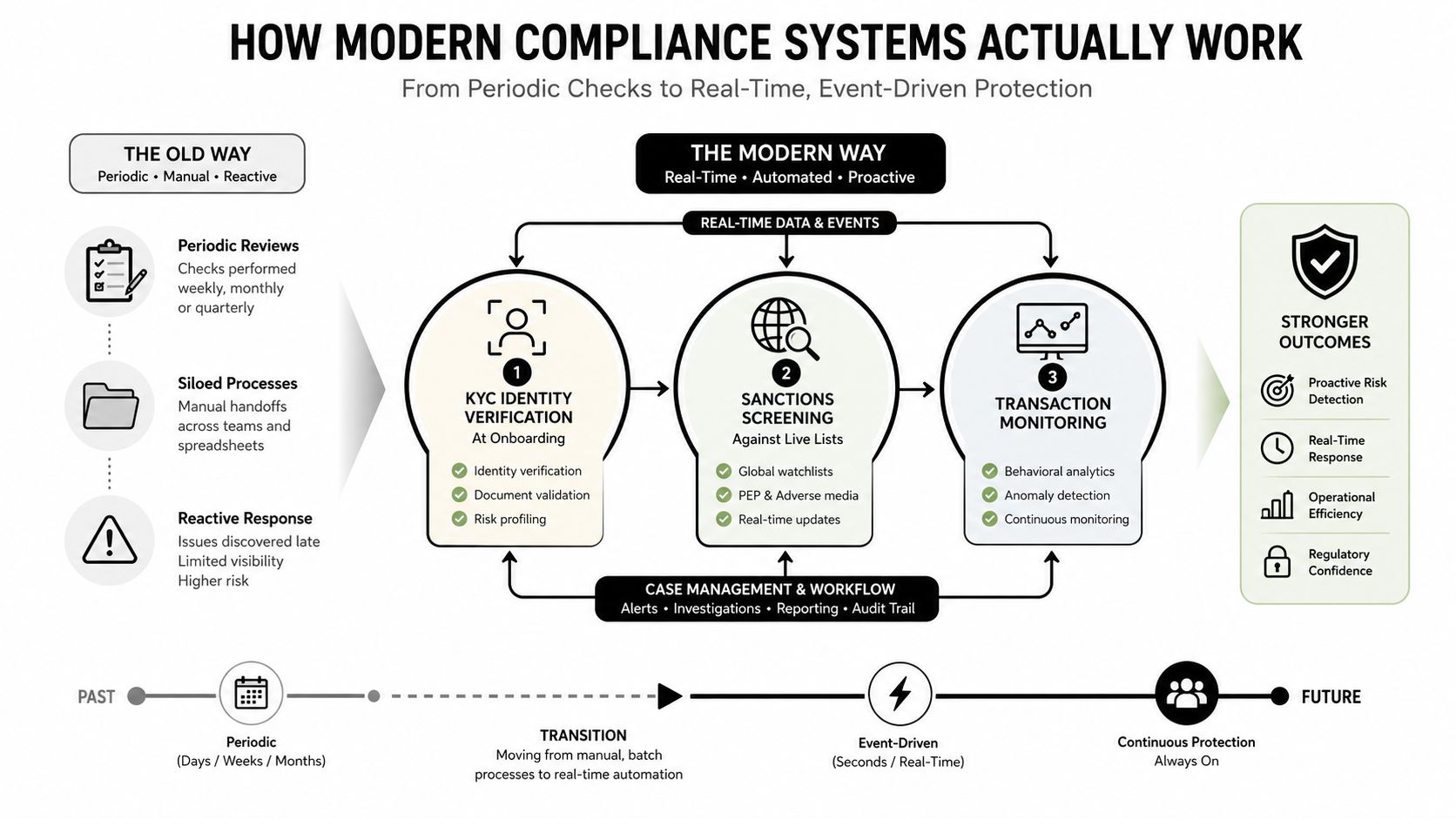
A modern compliance stack doesn't wait for an annual review to ask what happened. It connects identity, wallet activity, sanctions data, transaction behavior, policy changes, and evidence into an ongoing control process.
Start with onboarding. A business verifies identity, residency, beneficial ownership where relevant, and the customer's intended use. It then screens the customer and associated wallets against sanctions, politically exposed person, wanted, and watchlist data. Commercial screening providers document coverage of 3,000+ lists across 220+ countries, while another benchmark describes 215+ global sanction regimes with consolidated data and alias enrichment through Sanctions Scanner. Broader coverage improves the chance of finding a relevant match, but name normalization, transliteration, aliases, and careful entity resolution are necessary to prevent unmanageable alert volumes.
A deposit becomes a chain of control events
Consider a user depositing USDC into a lending protocol through a managed interface:
Identity verification checks whether the user can access the service.
Wallet screening examines the connected address and relevant transaction history.
Transaction monitoring evaluates deposits, withdrawals, transfers, and changes in behavior.
Risk scoring prioritizes alerts for human review.
Escalation begins if an address appears on a sanctions list or the activity matches a prohibited pattern.
Re-screening occurs as watchlists, customer information, or product policies change.
The output isn't a permanent good-or-bad verdict. It's a stream of signals. A human reviewer may need to distinguish a true match from a similar name, determine whether funds arrived through an indirect exposure, or request additional context before allowing activity to continue.
Auditors want evidence, not assurances
Evidence-based compliance connects each control to a specific action, owner, timestamp, version, and retention rule. Guidance associated with ISO 27001:2022 emphasizes the full evidence workflow, RACI ownership, version control, custody controls, and event-based collection. Auditors may expect logs, approvals, reports, and signed records with unique identifiers and reliable timestamp integrity, as described in this overview of compliance evidence and records.
For a customer-funds platform, useful events include deposits, withdrawals, strategy changes, contract upgrades, risk overrides, and account restrictions. A well-designed trail records UTC time, user or session ID, action, approver, policy version, and retention status. Teams building this layer can also review how a retention policy works to understand why deletion schedules, legal holds, access controls, and documented ownership belong in the design.
Design principle: If a control matters during an audit, connect it to the system event that proves it happened.
Teams looking for a broader technology map can use this guide to crypto compliance software. The best system is not the one that creates the most alerts. It's the one that turns relevant signals into timely decisions and preserves enough evidence to explain those decisions later.
Cutting Through Regulatory Noise as a Small Team
Monitoring regulatory updates isn't the same as receiving useful guidance. A 2026 survey found that 85.3% of organizations monitor regulatory updates, but only 30.9% say their alerts are always relevant, according to Regology's State of Regulatory Compliance survey. Smaller teams feel that mismatch sharply. In Canada, businesses with fewer than five employees spent 198 hours per employee on compliance in 2024, compared with 8 hours for firms with 100 or more employees, based on the same source.
Use a short filter before you spend time reading every update or before you deposit into a new venue.
Is the venue licensed or operating under a clear local framework? Check the relevant regulator's public register and confirm the exact legal entity, not just the brand name.
Could the yield product be treated as a security or equivalent regulated investment? Look for a legal memo, offering terms, risk disclosures, and language describing who manages the strategy.
Can you see the on-chain counterpart, reserves, or collateral? Use a block explorer and inspect contract addresses, treasury wallets, collateral dashboards, and upgrade permissions.
Does the platform screen wallets and provide usable tax exports? Confirm that it explains transaction monitoring and lets you retrieve activity records in a workable format.
A “yes” on three or more signals indicates a venue that may be usable for further review. Two or fewer signals should place the opportunity in a research-only category, not an automatic deposit decision. This is a practical heuristic, not legal advice or a guarantee of safety.

For a deeper diligence process around protocol risk, review this guide to vault due diligence. The same questions help both sides of the market. A protocol uses them before launching a feature, and a user can reuse them before supplying capital.
You can also use the following short video as a visual reminder of the screening mindset:
Decision rule: If you can't explain who operates the venue, what creates the yield, how your wallet is monitored, and how you'll document the transaction, don't deposit yet.
Real Risk Scenarios and How to Mitigate Them
Risk becomes easier to understand when you trace it from a specific action to a specific control.
An unexpected airdrop creates a screening problem
You receive an unsolicited token or transfer from a protocol address that a blockchain analytics provider has tagged as connected to mixer activity. You didn't request the funds, but the wallet now has an interaction that a custodial exchange or regulated venue may review. A sanctions or AML control fires because the screening system sees exposure, not because it has already established intent.
The likely consequence is a review, delayed withdrawal, restricted account, or request for transaction context. The mitigation is operational: avoid interacting with unsolicited assets, record the transaction ID, separate them from active funds where appropriate, and contact the relevant platform before moving them through a custodial venue. Teams should screen inbound and outbound addresses and document how they handle accidental exposure.
A US DAO distributes a yield-bearing token
A US-based DAO launches a token that promises returns from a treasury-managed strategy. The token may be technically transferable, but the economic design and marketing could lead regulators to examine whether purchasers rely on the work of the DAO or its contributors. If authorities characterize the product as an unregistered security, the DAO may face enforcement, distribution restrictions, remediation obligations, or demands to unwind activity.
A mitigation plan starts before launch. The team should obtain jurisdiction-specific legal analysis, define who may access the product, avoid unsupported return promises, document treasury controls, and build geofencing or allowlisting where counsel recommends it. A smart contract audit doesn't answer the securities question. Code security and product classification are separate controls.
An EU resident treats DeFi records as optional
A user supplies liquidity, claims rewards, and swaps the reward token but keeps only a wallet address and a few screenshots. Later, the user's tax records don't reconcile with exchange statements or the information needed for local reporting. MiCA may shape the platform's authorization and disclosure environment, but it doesn't replace the user's separate tax responsibilities.
The mitigation is documentation hygiene. Export transaction history, preserve wallet and contract addresses, label each action, record the asset and valuation basis used for your tax work, and consult a qualified local adviser. A product can provide reporting tools, but the user remains responsible for understanding the rules that apply to their residency.
These scenarios share one lesson: the triggering event is usually visible. A wallet interaction, a token design choice, or an incomplete record creates the starting point. Good compliance makes that event understandable before it becomes an expensive surprise.
Your Compliance Checklist and Next Steps
Run this checklist before depositing into a new stablecoin yield venue:
Map your jurisdiction: Identify your tax residence, location, and any additional country connection that could affect access.
Verify the entity: Find the operator's legal name, registration details, governing documents, and customer support channel.
Confirm KYC requirements: Know what information the platform collects and whether your residency is eligible.
Understand the yield: Identify the source of return, counterparties, collateral, incentives, borrowing, and withdrawal conditions.
Set up tax records: Capture wallet activity, transaction IDs, timestamps, asset quantities, and protocol labels from the beginning.
Review custody: Determine who controls keys, who can pause withdrawals, how upgrades work, and what happens during insolvency or a security incident.
Check evidence: Look for reserve disclosures, audits, monitoring practices, incident history, and clear geographic restrictions.
A compliant venue should present a recognizable legal entity, understandable yield disclosures, evidence of control testing, and explicit access limits. None of those features eliminates smart-contract or market risk, but missing information makes informed risk assessment much harder.
Short answers to common questions
Is DeFi itself illegal? No single answer applies everywhere. The legality depends on the activity, operator, product structure, user location, marketing, custody model, and applicable rules.
Does self-custody avoid reporting? No. Self-custody changes control of the keys, but wallet activity can still create tax, sanctions, and recordkeeping implications.
What should you do if a protocol suddenly geofences your country? Don't bypass the restriction with misleading information. Stop opening new positions, review withdrawal terms, preserve your records, and seek qualified advice if access or funds are affected.
Check regulator registers such as those maintained by FinCEN, the FCA, MAS, and ESMA, then combine that review with protocol documentation and professional tax guidance. Your next steps are concrete: map your jurisdiction, run this checklist on your top three protocols, and set calendar reminders for the tax filing windows that apply to you.
Yield Seeker helps stablecoin holders evaluate and automate DeFi yield with an AI Agent that monitors opportunities and allocates capital across protocols while keeping the experience transparent and risk-aware. Visit Yield Seeker to explore a guided way to compare strategies, track your positions, and make compliance-aware yield decisions without manually juggling fragmented dashboards.